
Grundy Center in Grundy County, Iowa — The American Midwest (Upper Plains)
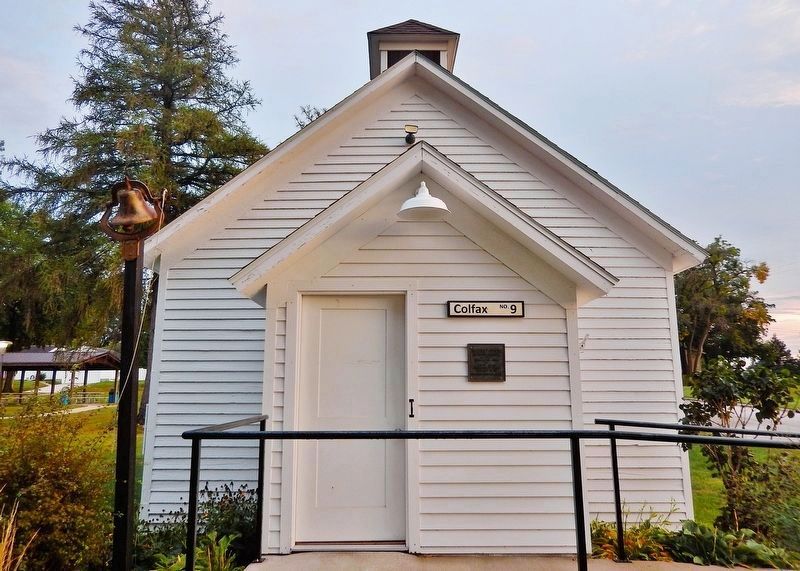
Colfax No. 9
Herbert Quick School House
Photographed by Cosmos Mariner, September 18, 2025
1. Colfax No. 9 Marker
Iowa Country School History
Grundy County's first school, located two miles east of Grundy Center, opened in 1850. The Iowa General Assembly in 1858 established the Iowa Rural School System under the Common School legislation. Schools were generally located in the center of a four-square mile area so that no child lived more than two miles from a school. By 1905, 12,623 Grundy County students were answering morning roll call from 117 rural schools. School consolidation, in which country school districts joined town districts, began slowly in the 1890s and early 1900s. Beaman organized the first consolidated school district in Grundy County in 1915, followed by Dike in 1917, Conrad in 1920, Reinbeck in 1923, and Wellsburg in 1952. The only area not in a consolidated district was the large area around Grundy Center. In 1953, boundaries for the township schools were changed to put all rural school districts within community school districts, including a proposed new Grundy Center Community School District. In March 1954, twenty-one districts voted, and 19 of them voted in favor of immediately joining the new district. The proposal
this page online
Herbert Quick School House
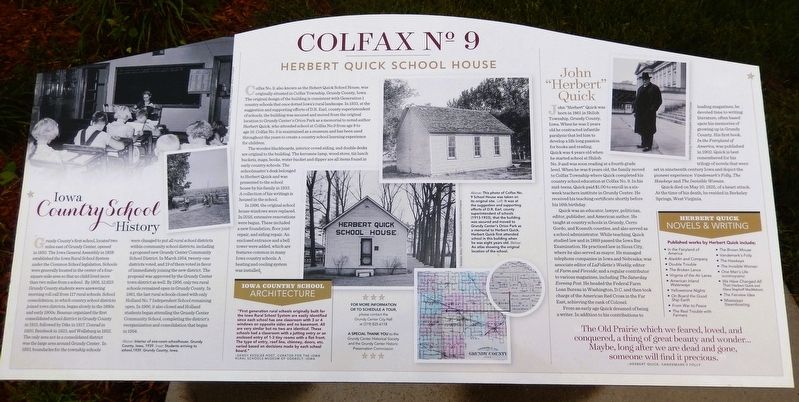
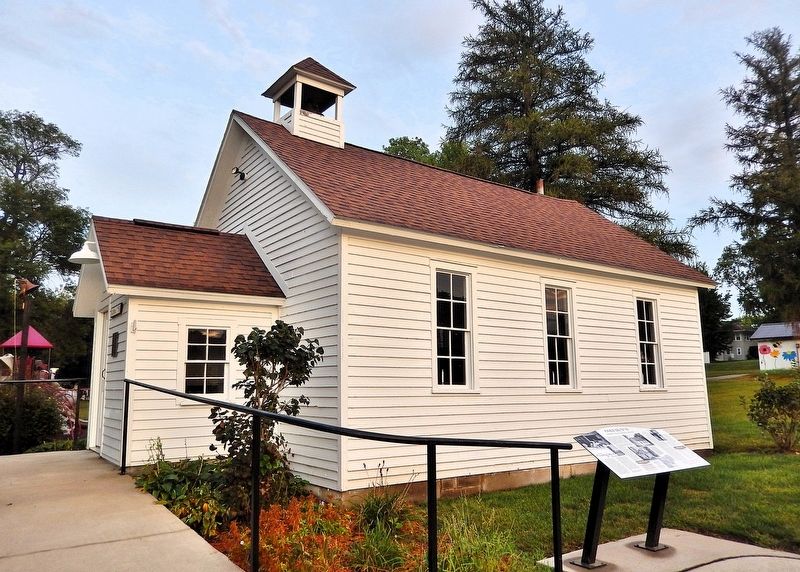
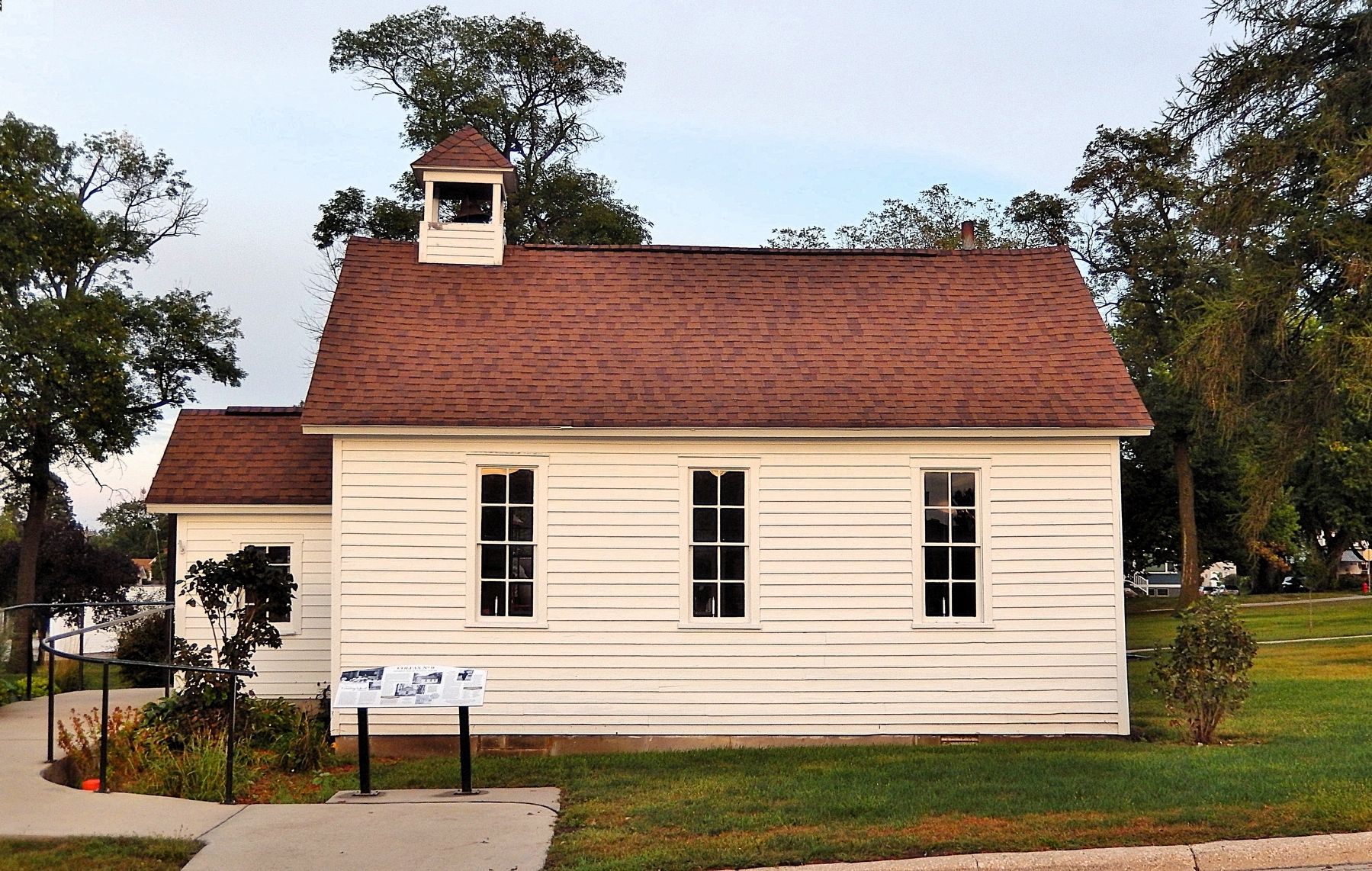
Colfax No. 9, also known as the Herbert Quick School House, was originally situated in Colfax Township, Grundy County, Iowa. The original design of the building is consistent with Generation 1 country schools that once dotted Iowa's rural landscape. In 1933, at the suggestion and supporting efforts of D.R. Earl, county superintendent of schools, the building was secured and moved from the original location to Grundy Center's Orion Park as a memorial to noted author Herbert Quick, who attended school at Colfax No. 9 from age 8 to age 16. Colfax No. 9 is maintained as a museum and has been used throughout the years to create a country school learning experience for children.
The wooden blackboards, interior coved siding,
Library of Congress
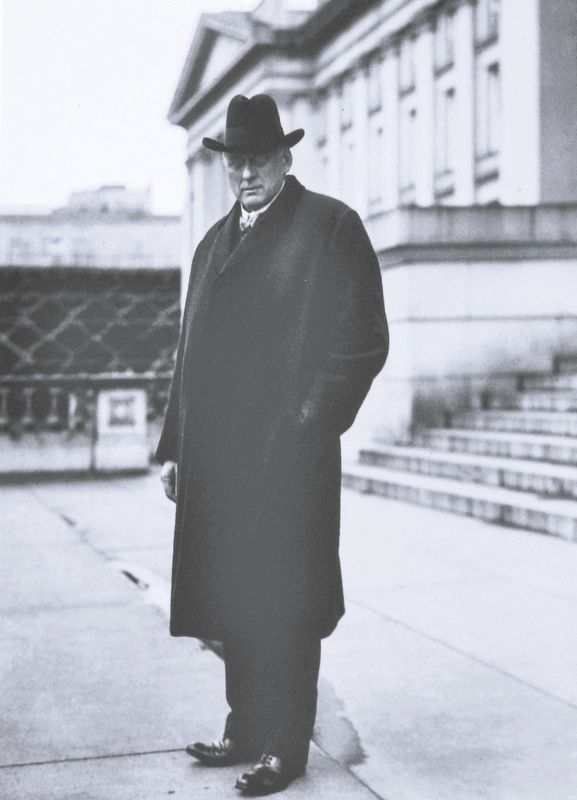
2. Marker detail: John Herbert Quick
Harris & Ewing, 1914-1918, photographer.
In 1996, the original school house windows were replaced. In 2016, extensive renovations were begun. These included a new foundation, floor joist repair, and siding repair. An enclosed entrance and a bell tower were added, which are features common in many Iowa country schools. A heating and cooling system was installed.
Iowa Country School Architecture
“First generation rural schools originally built for the Iowa Rural School System are easily identified since each school has one classroom with 3 or 4 windows on opposite sides and no basement. All are very similar but no two are identical. These schools had a classroom with a jutting entry or an enclosed entry of 1-3 tiny rooms with a flat front. The type of entry, roof line, chimney, doors, etc. varied based on decisions made by each school board.”
Photographed by Cosmos Mariner, September 18, 2025
3. Colfax No. 9 Marker
Looking southeast from 14th Street. Orion Park is behind the historic schoolhouse.
—Sandy Kessler Host, Curator for the Iowa Rural Schools Museum of Odebolt, Iowa
For more information or to schedule a tour, please contact the Grundy Center City Hall at (319) 825-6118
A special thank you to the Grundy Center Historical Society and the Grundy Center Historic Preservation Commission
[captions]
• Interior of one-room schoolhouse, Grundy County, Iowa, 1939.
• Students arriving to school, 1939, Grundy County, Iowa.
• This photo of Colfax No. 9 School House was taken on its original site.
• It was at the suggestion and supporting efforts of D.R. Earl, county superintendent of schools (1913-1933), that the building was secured and moved to Grundy Center's Orion Park as a memorial to Herbert Quick. Herbert Quick first attended school in this building when he was eight years old.
• An atlas showing the original location of the school.
John “Herbert” Quick
John “Herbert” Quick was born in 1861 in Shiloh Township, Grundy County, Iowa. When he was 2 years old he contracted infantile paralysis that led him to develop a life long passion for books and reading. Quick was 4 years old when he started school at Shiloh No. 9 and was soon
Photographed by Cosmos Mariner, September 18, 2025
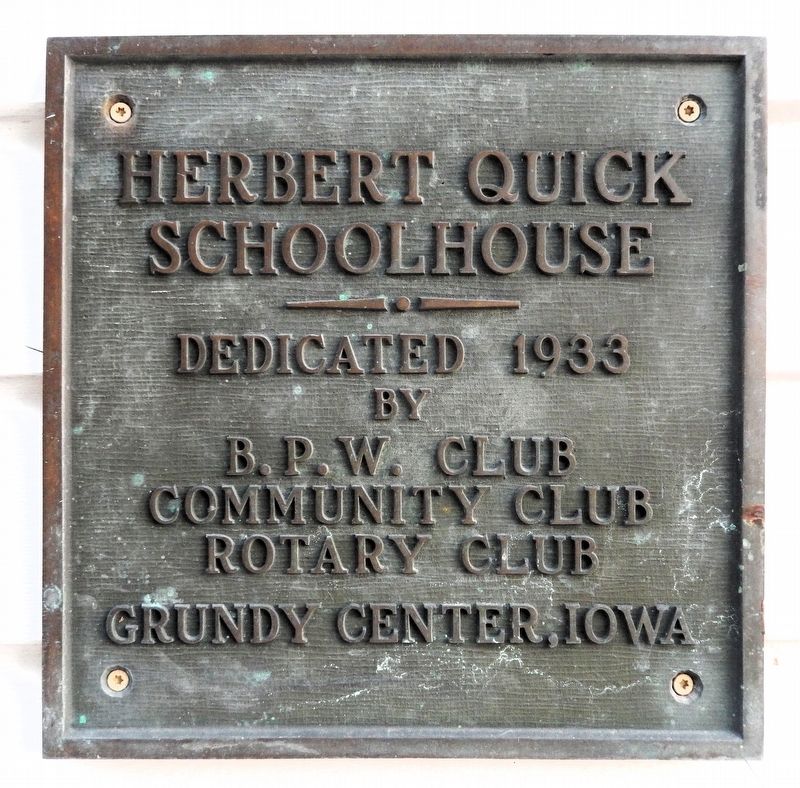
4. Herbert Quick Schoolhouse Marker
Dedicated 1933 by
B. P. W. Club
Community Club
Rotary Club
Grundy Center, Iowa
Quick was an educator, lawyer, politician, editor, publisher, and American author. He taught at country schools in Grundy, Cerro Gordo, and Kossuth counties, and also served as a school administrator. While teaching, Quick studied law and in 1889 passed the Iowa Bar Examination. He practiced law in Sioux City, where he also served as mayor. He managed telephone companies in Iowa and Nebraska; was associate editor of LaFollette's Weekly; editor of Farm and Fireside; and a regular contributor to various magazines, including The Saturday Evening Post. He headed the Federal Farm Loan Bureau in Washington, D.C. and then took charge of the American Red Cross in the Far East, achieving the rank of Colonel.
From an early age Quick dreamed of being a writer. In addition to his contributions to leading magazines, he devoted
Photographed by Cosmos Mariner, September 18, 2025
5. Colfax No. 9 Schoolhouse (front entrance)
Quick died on May 10, 1925, of a heart attack. At the time of his death, he resided in Berkeley Springs, West Virginia.
Herbert Quick Novels & Writing
Published works by Herbert Quick include:
• In the Fairyland of America • Aladdin and Company • Double Trouble • The Broken Lance • Virginia of the Air Lanes • American Inland Waterways • Yellowstone Nights • On Board the Good Ship Earth • From War to Peace • The Real Trouble with Farmers • The Brown Mouse • Vandemark's Folly • The Hawkeye • The Invisible Woman • One Man's Life (autobiography) • We Have Changed All That (Herbert Quick and Elena Staphoff MacMahon) • The Fairview Idea • Mississippi Steamboating
The Old Prairie which we feared, loved, and conquered, a thing of great beauty and wonder... Maybe, long after we are dead and gone, someone will find it precious.
—Herbert Quick, Vandemark’s Folly
Erected by Grundy
Photographed by Cosmos Mariner, September 18, 2025
6. Colfax No. 9 Schoolhouse (west elevation)
Looking east from 14th Street. Orion Park is behind the historic schoolhouse.
Topics. This historical marker is listed in these topic lists: Architecture • Arts, Letters, Music • Education. A significant historical year for this entry is 1933.
Location. 42° 21.665′ N, 92° 46.898′ W. Marker is in Grundy Center, Iowa, in Grundy County. It is on 14th Street just south of G Avenue (State Highway 14/175), on the left when traveling south. The marker is beside the sidewalk on the west side of the historic schoolhouse, near the northwest corner of Orion Park. Touch for map. Marker is in this post office area: Grundy Center IA 50638, United States of America. Touch for directions.

Regionally, this marker is in the American Midwest and in the Corn Belt. Globally, it is in North America, the Western Hemisphere, the Western World, and the Anglosphere. Historically, it finds itself in what was once the territory of the Mississippian Culture and also the Louisiana Purchase.
Other nearby markers. At least 5 other markers are within 13 miles of this marker, measured as the crow flies: Grundy County Court House (approx. 0.4 miles away); Replica of the Statue of Liberty (approx. 0.4 miles away); Conrad Freedom Rock Veterans Memorial (approx. 10½ miles away); Gladbrook Freedom Rock Veterans Memorial (approx. 13 miles away); Tama County Iowa Veterans Memorial (approx. 13 miles away).
Related markers. Click here for a list of markers that are related to this marker. John Herbert Quick
Also see . . .
1. Herbert Quick Schoolhouse (Iowa PBS).
(Interior video tour of Herbert Quick Schoolhouse with Abby Brown) Excerpt: Before Iowa even became a state, there were country schools sprinkled all over the place, proving that the early pioneers knew that it was important to educate their children. Some of the old schoolhouse structures still exist, like the one here in Grundy Center. It's called The Herbert Quick Schoolhouse because famous Iowan John Herbert Quick went to school in this building a long time ago. Inside the schoolhouse you can see how kids would have spent their school days. A single room with two-person wooden benches are set in two rows. A flat surface attached to the back of the bench creates a tabletop desk for the people sitting behind. A low, long bench sits at the front of the room. A cast iron wood stove is in the front of the room with a black chalk board standing in the corner and the teacher’s desk to the right.(Submitted on March 26, 2026, by Cosmos Mariner of Cape Canaveral, Florida.)All of the different ages and grade levels were in the same classroom. Younger students may have been working on their reading skills while older students were trying to solve complicated math problems. There was only one teacher for all of those different levels of learning. Older students would often help younger students with their lessons too, just like your older brother, sister, or friend might these days…
2. John Herbert Quick (Wikipedia).
Excerpt: When he was eight, Quick's family moved to Grundy Center, where he lived until 1880. Around that time he became a teacher, an occupation he followed until he passed the bar exam and moved to Sioux City. In 1908 he was the associate editor of Robert LaFollette's Weekly Magazine, in Madison, Wisconsin. From 1909 to 1916 he was the editor of the magazine Farm and Fireside, published in Springfield, Ohio. Quick established a law firm in Sioux City, where he practiced for 19 years. He also became a businessman and later served as the 27th Mayor of Sioux City, Iowa from 1898 to 1900. An early environmentalist, his best-known non-fiction work was On Board the Good Ship Earth (1913). Quick's 1906 comic novel, Double Trouble, or, Every Hero His Own Villain was the basis for a 1915 silent film produced by D.W. Griffith, directed by Christy Cabanne, and starring Douglas Fairbanks in one of his earliest film roles.(Submitted on March 26, 2026, by Cosmos Mariner of Cape Canaveral, Florida.)
Credits. This page was last revised on March 26, 2026. It was originally submitted on March 22, 2026, by Cosmos Mariner of Cape Canaveral, Florida. This page has been viewed 24 times since then. Photos: 1, 2, 3, 4, 5, 6. submitted on March 26, 2026, by Cosmos Mariner of Cape Canaveral, Florida.
