D&RG(W) Caboose 91 (0575)
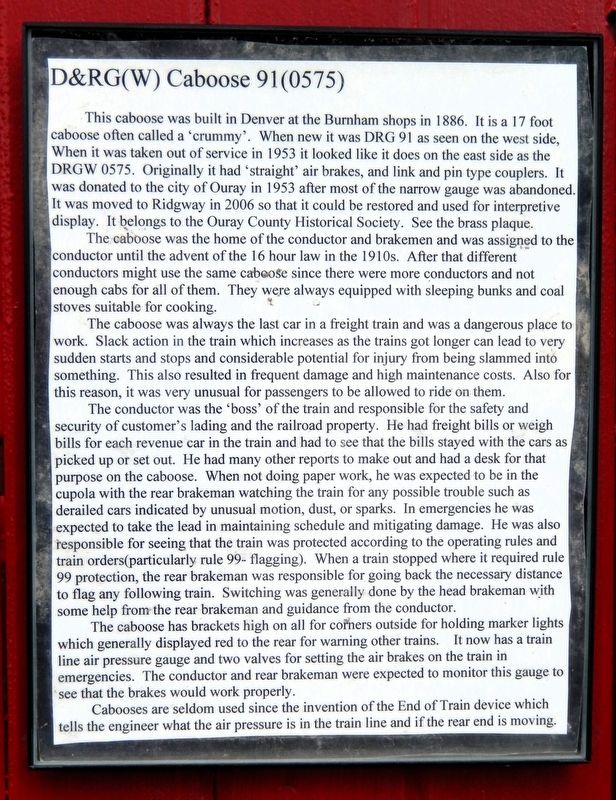
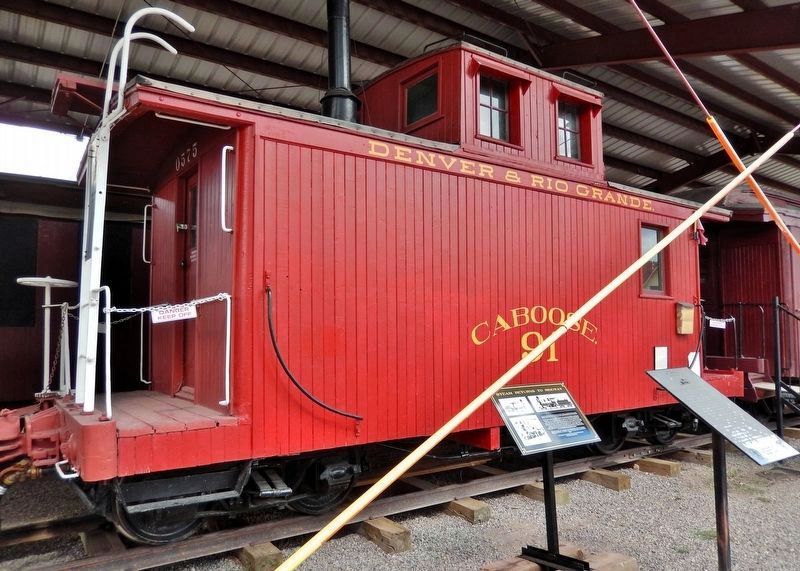
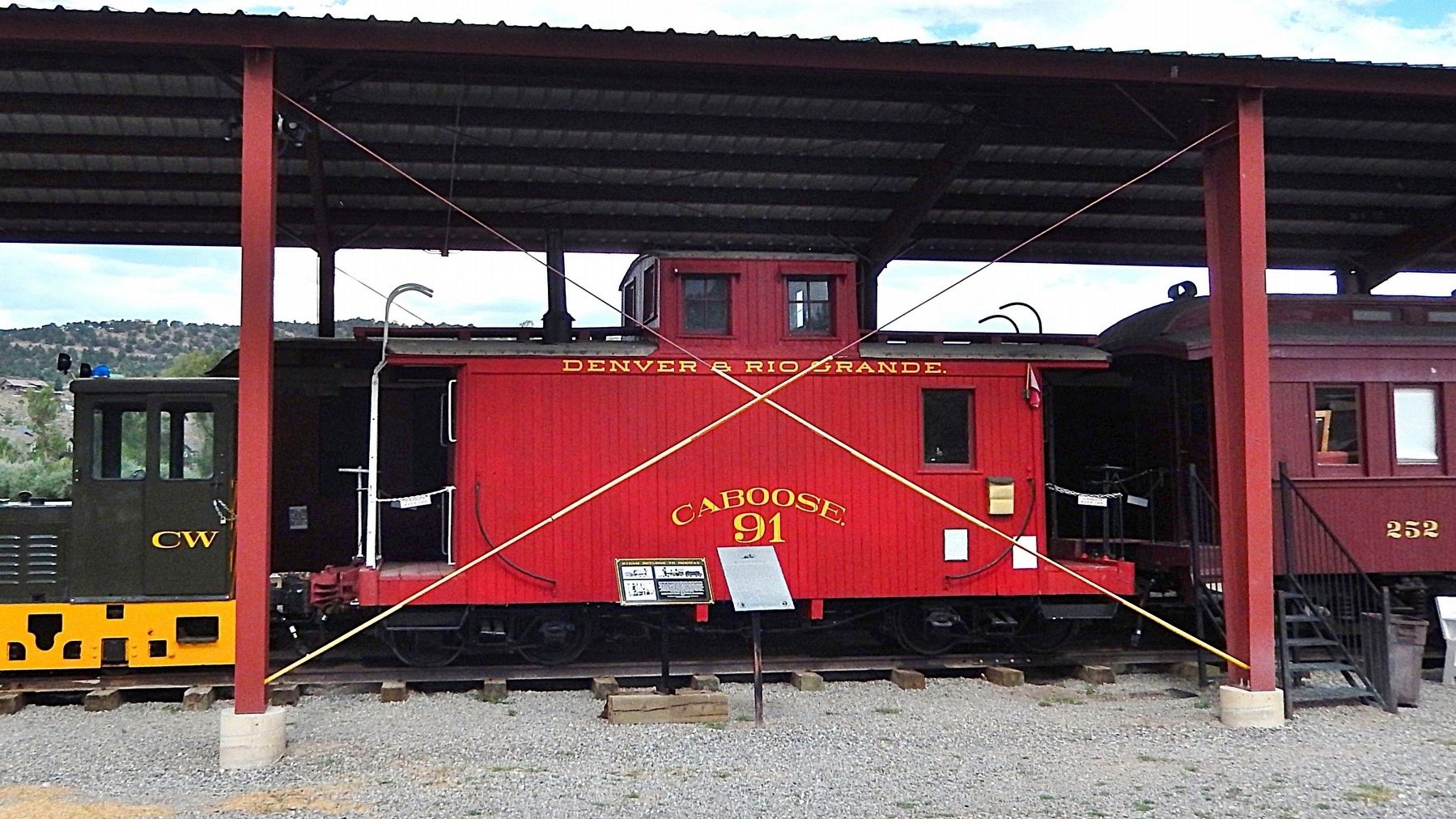
This caboose was built in Denver at the Burnham shops in 1886. It is a 17-foot caboose often called a 'crummy'. When new it was DRG 91 as seen on the west side. When it was taken out of service in 1953 it looked like it does on the east side as the DRGW 0575. Originally it had 'straight' air brakes, and link and pin type couplers. It was donated to the city of Ouray in 1953 after most of the narrow gauge was abandoned. It was moved to Ridgway in 2006 so that it could be restored and used for interpretive display. It belongs to the Ouray County Historical Society. See the brass plaque.
The caboose was the home of the conductor and brakemen and was assigned to the conductor until the advent of the 16 hour law in the 1910s. After that different conductors might use the same caboose since there were more conductors and not enough cabs for all of them. They were always equipped with sleeping bunks and coal stoves suitable for cooking.
The caboose was always the last car in a freight train and was a dangerous place to work. Slack action in the train which increases as the trains get longer can lead to very sudden starts and stops
this page online
The conductor was the 'boss' of the train and responsible for the safety and security of customer's lading and the railroad property. He had freight bills or weigh bills for each revenue car in the train and had to see that the bills stayed with the cars as picked up or set out. He had many other reports to make out and had a desk for that purpose on the caboose. When not doing paperwork, he was expected to be in the cupola with the rear brakeman watching the train for any possible trouble such as derailed cars indicated by unusual motion, dust, or sparks. In emergencies he was expected to take the lead in maintaining schedule and mitigating damage. He was also responsible for seeing that the train was protected according to the operating rules and train orders (particularly rule 99 — flagging). When a train stopped where it required rule 99 protection, the rear brakeman was responsible for going back the necessary
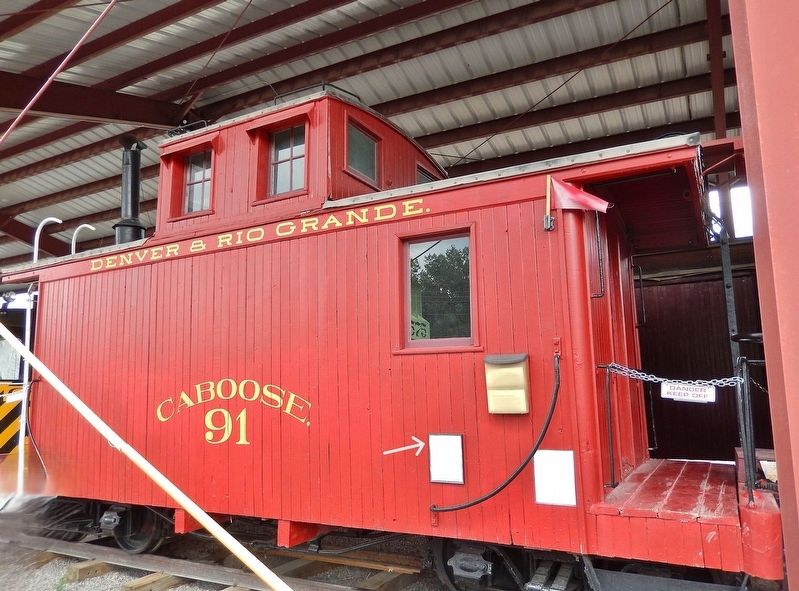
The caboose has brackets high on all four corners outside for holding marker lights which generally displayed red to the rear for warning other trains. It now has a train line air pressure gauge and two valves for setting the air brakes on the train in emergencies. The conductor and rear brakeman were expected to monitor this gauge to see that the brakes would work properly.
Cabooses are seldom used since the invention of the End of Train device which tells the engineer what the air pressure is in the train line and if the rear end is moving.
Erected by Ridgway Railroad Museum.
Topics. This historical marker is listed in this topic list: Railroads & Streetcars. A significant historical year for this entry is 1886.
Location. 38° 9.157′ N, 107° 45.258′ W. Marker is in Ridgway, Colorado, in Ouray County. It can be reached from North Railroad Street just north of Sherman Street (State Highway 62), on the right when traveling north. The marker and restored caboose are on the Ridgway

Regionally, this marker is in the Western Slope. It is also in the American Mountain West. Globally, it is in North America, the Rocky Mountains, the Western Hemisphere, the Western World, and the Anglosphere.
Other nearby markers. At least 8 other markers are within walking distance of this marker: RGS Coach 252 Restoration (here, next to this marker); RGS Motor 1 (a few steps from this marker); Galloping Goose No. 4 (within shouting distance of this marker); DRG(W) 5574 (within shouting distance of this marker); Ridgway Depot Outbuilding (within shouting distance of this marker); Ridgway Railroad Museum (within shouting distance of this marker); True Grit Jail Wagon (within shouting distance of this marker); True Grit Landmark #1 (about 300 feet away, measured in a direct line). Touch for a list and map of all markers in Ridgway.
Also see . . .
1. Caboose 0575 On-Going Restoration (Ridgway Railroad Museum).
Excerpt: When the D&RGW(Submitted on March 24, 2026, by Cosmos Mariner of Cape Canaveral, Florida.)began to abandon their narrow gauge lines in the 1950's they donated a number of cabooses to Colorado towns that were served by the narrow gauge. Caboose 0575 was donated to the City of Ouray in June of 1953. On April 6, 1953 it arrived in Montrose on a standard gauge flat car and, although the narrow gauge tracks were still intact from Ridgway to Ouray, there was no narrow gauge motive power to bring it to Ouray. On April 18th it was trucked to Ouray on a lowboy provided by the Colorado Highway Department and using a winch truck rented from the D&RGW. The caboose was used as the Chamber of Commerce information booth until 1977 when the Chamber moved to a building at the swimming pool. At some point the City of Ouray donated the caboose to the Ouray County Historical Society.Photographed by Cosmos Mariner, July 18, 20254. D&RG(W) Caboose 91 (0575)In 1979 Bill Jones of Silverton supervised extensive repairs to the caboose with the goal of preventing further water damage. The caboose was painted in its original 1886 lettering style. In 1991 to 1993 the Ouray Woman's Club funded an extensive restoration to its 1953 appearance. By 2006 the caboose had deteriorated significantly with the end sills and roofing
being the most serious problems and needing immediate attention. There were also a number of other major structural problems. In the Spring of 2006 the Ouray County Historical Society and the Ridgway Railroad Museum entered into an agreement that provided for the restoration and interpretation of D&RGW Caboose 0575. Under the terms of the agreement, ownership of 0575 will remain with the Ouray County Historical Society. On Tuesday May 30, 2006, the caboose was moved from the Ouray Hot Springs Park (Fellin Park) to the Ridgway Railroad Museum site at the corner of CO 62 and US 550 in Ridgway. The caboose is now displayed along with the Ridgway Railroad Museum's other D&RGW narrow gauge equipment. D&RGW Caboose 0575 is a uniquely important artifact of the railroad history of Ouray County.
2. D&RGW Long Caboose History (Blackstone Models).
(by Jeff Johnson) Excerpt: On the D&RG narrow gauge, the distinctive piece of rolling stock that brought up the rear of freight and coal trains throughout the Rockies was an important part of a trainman’s life! These little “hacks” were essentially the office, living room, kitchen, bedroom, and sometimes game room for the hearty working men that chose to spend their life toiling on the rails from the late 19th Century and well into the 1960s.(Submitted on March 24, 2026, by Cosmos Mariner of Cape Canaveral, Florida.)From 1871 to 1923, the D&RG(W) built just over one hundred cabooses with many of these going through various configurations and rebuilds during their lifetime. The earliest of these were short cabooses of the four-wheeled variety with a body length of 16’. The first four little “crummies” were built by Jackson and Sharp, and the D&RG subsequently built dozens more to a slightly different design standard until 1885. After this time, short cabooses with an eight-wheel (two truck) design arrived on the scene.
Credits. This page was last revised on March 25, 2026. It was originally submitted on March 23, 2026, by Cosmos Mariner of Cape Canaveral, Florida. This page has been viewed 17 times since then. Photos: 1, 2. submitted on March 24, 2026, by Cosmos Mariner of Cape Canaveral, Florida. 3, 4. submitted on March 25, 2026, by Cosmos Mariner of Cape Canaveral, Florida.
