Heuchling in Lauf an der Pegnitz in Nürnberger Land, Bavaria, Germany — Central Europe
Liebesbriefe aus dem Forsthaus auf der Insel
⎯⎯⎯
Love Letters from the Forester’s House on the Island
Photographed by James Hulse, March 3, 2026
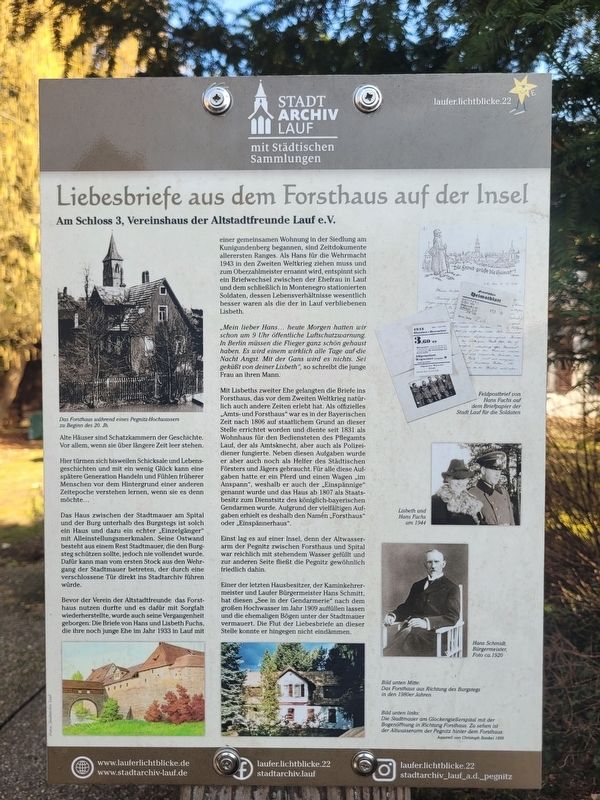
1. Liebesbriefe aus dem Forsthaus auf der Insel / Love Letters from the Forester’s House on the Island

Am Schloss 3, Vereinshaus der Altstadtfreunde Lauf e. V.
Alte Häuser sind Schatzkammern der Geschichte. Vor allem, wenn sie über längere Zeit leer stehen.
Hier türmen sich bisweilen Schicksale und Lebensgeschichten und mit ein wenig Glück kann eine spätere Generation Handeln und Fühlen früherer Menschen vor dem Hintergrund einer anderen Zeitepoche verstehen lernen, wenn sie es denn möchte...
Das Haus zwischen der Stadtmauer am Spital und der Burg unterhalb des Burgstegs ist solch ein Haus und dazu ein echter „Einzelgänger“ mit Alleinstellungsmerkmalen. Seine Ostwand besteht aus einem Rest Stadtmauer, die den Burgsteg schützen sollte, jedoch nie vollendet wurde. Dafür kann man vom ersten Stock aus den Wehrgang der Stadtmauer betreten, der durch eine verschlossene Tür direkt ins Stadtarchiv führen würde.
Bevor der Verein der Altstadtfreunde das Forsthaus nutzen durfte und es dafür mit Sorgfalt wiederherstellte, wurde auch seine Vergangenheit geborgen: Die Briefe von Hans und Lisbeth Fuchs, die ihre noch junge Ehe im Jahr 1933 in Lauf mit einer gemeinsamen Wohnung in der Siedlung am Kunigundenberg begannen, sind Zeitdokumente allerersten Ranges. Als Hans für die Wehrmacht 1943 in den Zweiten Weltkrieg ziehen muss und zum Oberzahlmeister ernannt wird, entspinnt sich ein Briefwechsel zwischen der Ehefrau in Lauf und dem schließlich in Montenegro stationierten Soldaten, dessen Lebensverhältnisse wesentlich besser waren als die der in Lauf verbliebenen Lisbeth.
„Mein lieber Hans... heute Morgen hatten wir schon um 9 Uhr öffentliche Luftschutzwarnung. In Berlin müssen die Flieger ganz schön gehaust haben. Es wird einem wirklich alle Tage auf die Nacht Angst. Mit der Gans wird es nichts. Sei geküßt von deiner Lisbeth“,
this page online
Mit Lisbeths zweiter Ehe gelangten die Briefe ins Forsthaus, das vor dem Zweiten Weltkrieg natürlich auch andere Zeiten erlebt hat. Als offizielles „Amts- und Forsthaus“ war es in der Bayerischen Zeit nach 1806 auf staatlichem Grund an dieser Stelle errichtet worden und diente seit 1831 als Wohnhaus für den Bediensteten des Pflegamts Lauf, der als Amtsknecht, aber auch als Polizeidiener fungierte. Neben diesen Aufgaben wurde er aber auch noch als Helfer des Städtischen Försters und Jägers gebraucht. Für alle diese Aufgaben hatte er ein Pferd und einen Wagen „im Anspann“, weshalb er auch der „Einspännige“ genannt wurde und das Haus ab 1807 als Staatsbesitz zum Dienstsitz des königlichbayerischen Gendarmen wurde. Aufgrund der vielfältigen Aufgaben erhielt es deshalb den Namen „Forsthaus“ oder „Einspännerhaus“.
Einst lag es auf einer Insel, denn der Altwasserarm der Pegnitz zwischen Forsthaus und Spital war reichlich mit stehendem Wasser gefüllt und zur anderen Seite fließt die Pegnitz gewöhnlich friedlich dahin.
Einer der letzten Hausbesitzer, der Kaminkehrermeister und Laufer Bürgermeister Hans Schmitt, hat diesen „See in der Gendarmerie“ nach dem großen Hochwasser im Jahr 1909 auffüllen lassen und die ehemaligen Bögen unter der Stadtmauer vermauert. Die Flut der Liebesbriefe an dieser Stelle konnte er hingegen nicht eindämmen.
[Untertitel:]
Das Forsthaus während eines Pegnitz-Hochwassers zu Beginn des 20. Jh.
Feldpostbrief von Hans Fuchs auf dem Briefpapier der Stadt Lauf für die Soldaten.
Lisbeth und Hans Fuchs um 1944.
Hans Schmidt, Bürgermeister, Foto ca. 1920
Bild unten Mitte: Das Forsthaus aus Richtung des Burgstegs in den 1980er Jahren
Bild unten links: Die Stadtmauer am Glockengießerspital mit der Bogenöffnung in Richtung Forsthaus. Zu sehen ist der Altwasserarm der Pegnitz hinter dem Forsthaus. Aquarell von Christoph Bankel 1899
Fotos: Stadtarchiv Lauf
Am Schloss 3, clubhouse of the Altstadtfreunde Lauf association
Old
Photographed by James Hulse, March 3, 2026
2. Liebesbriefe aus dem Forsthaus auf der Insel / Love Letters from the Forester’s House on the Island
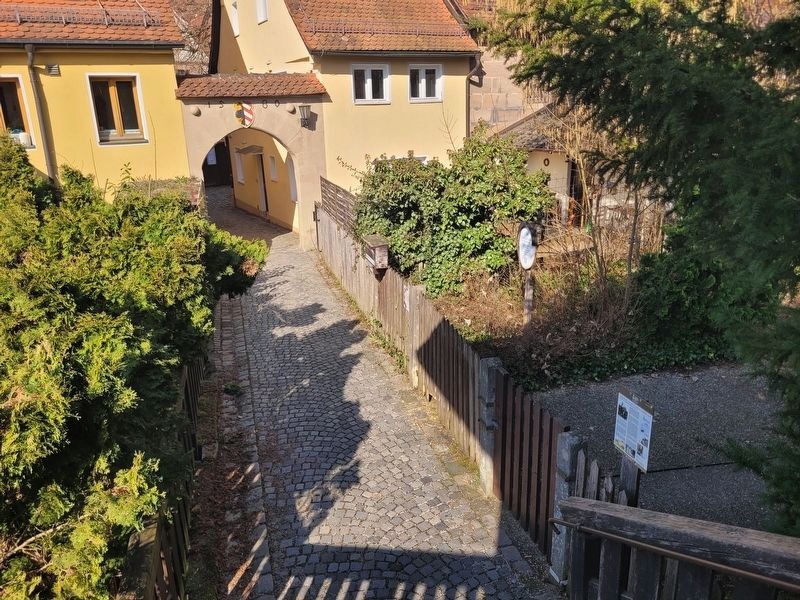
The walkway in front of the house with the marker on the right side.
In such places, destinies and life stories sometimes accumulate, and with a bit of luck a later generation can learn to understand the actions and feelings of earlier people against the background of another era—if they wish to do so.
The house between the city wall by the Spital and the castle below the Burgsteg is such a house, and moreover a true “individual” with unique characteristics. Its east wall consists of a remaining section of the city wall that was meant to protect the Burgsteg but was never completed. From the first floor one can enter the city wall’s walkway, which—through a locked door—would lead directly into the city archive.
Before the association Altstadtfreunde was allowed to use the Forester’s House and carefully restore it, its past was also uncovered. The letters of Hans and Lisbeth Fuchs, who began their still young marriage in 1933 in Lauf with a shared apartment in the settlement at Kunigundenberg, are historical documents of the highest order. When Hans had to leave for the Wehrmacht in 1943 during the Second World War and was appointed Oberzahlmeister (senior paymaster), a correspondence developed between his wife in Lauf and the soldier eventually stationed in Montenegro—whose living conditions were considerably better than those of Lisbeth, who remained in Lauf.
“My dear Hans… this morning we already had a public air-raid warning at 9 o’clock. In Berlin the aircraft must have caused quite a devastation. One is really afraid every day when night comes. The goose will come to nothing. Be kissed by your Lisbeth,”
Photographed by James Hulse, March 3, 2026
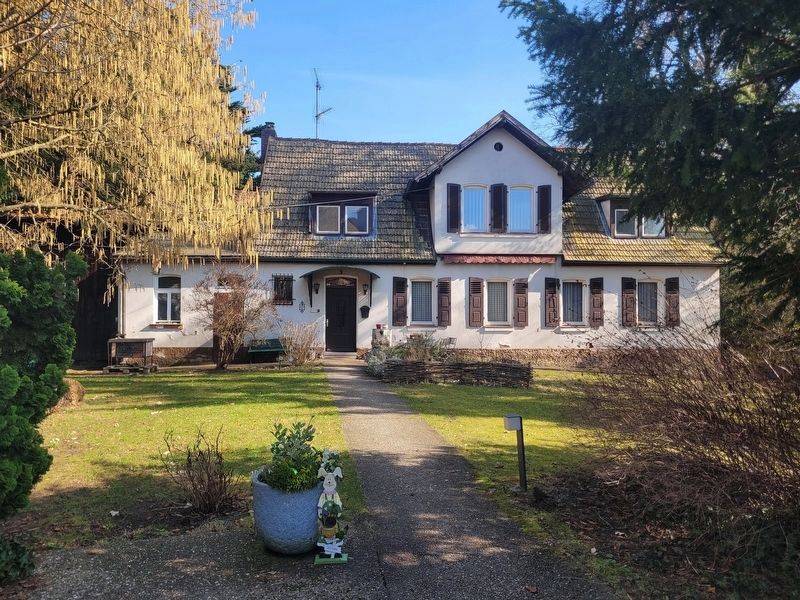
3. Forester’s House
Through Lisbeth’s second marriage the letters eventually came into the Forester’s House, which of course had experienced other times before the Second World War. As the official “Amts- und Forsthaus” (administrative and forestry house), it had been built on state land at this location during the Bavarian period after 1806. From 1831 it served as the residence of an employee of the Pflegamt Lauf, who functioned as court servant and also as a police officer. In addition to these duties he also assisted the municipal forester and hunter. For all these tasks he had a horse and wagon “in harness,” which earned him the nickname “Einspänniger” (the single-horse driver), and from 1807 the house, as state property, became the official residence of the Royal Bavarian gendarme. Because of its many functions, it came to be known as the “Forsthaus” or “Einspännerhaus.”
Once it lay on an island: the old branch of the Pegnitz between the Forester’s House and the Spital was filled with standing water, while on the other side the Pegnitz usually flowed peacefully past.
One of the last owners of the house, the master chimney sweep and mayor of Lauf, Hans Schmitt, had this “lake in the gendarmerie” filled in after the great flood of 1909 and the former arches beneath the city wall bricked up. The flood of love letters found at this place, however, he could not contain.
[Captions:]
The Forester’s House during a Pegnitz flood at the beginning of the 20th century.
Field post letter from Hans Fuchs written on stationery from the city of Lauf for soldiers.
Lisbeth and Hans Fuchs around 1944.
Hans Schmidt, mayor, photo circa 1920.
Image below center: The Forester’s House seen from the direction of the Burgsteg in the 1980s.
Image below left: The city wall at the Glockengießer Spital with the arch opening toward the Forester’s House. The old branch of the Pegnitz behind the Forester’s House can be seen. Watercolor by Christoph Bankel, 1899.
Photos: Stadtarchiv Lauf
Erected by City Archive of Lauf with Municipal Collections.
Topics. This historical marker is listed in these topic lists: Communications • War, World II. A significant historical year for this entry is 1933.
Location. 49° 30.628′ N, 11° 16.907′ E. Marker is in Lauf an der Pegnitz, Bayern (Bavaria), in Nürnberger Land. It is in Heuchling. It is on Am Schloß just south of Spitalstraße, on the left when traveling south. Touch for map. Marker is at or near this postal address: Am Schloß 3, Lauf an der Pegnitz BY 91207, Germany. Touch for directions.

Regionally, this marker is in German Franconia. Globally, it is in Europe, the European Union, Atlantic Europe, Central Europe, the Schengen Area, Western Europe, and the Western World. Historically, it finds itself in what was once the Holy Roman Empire and also the former West Germany.
Other nearby markers. At least 8 other markers are within walking distance of this marker: Früheres Forsthaus oder "Einspänn(ig)er-Haus" / Former Forester’s House or Einspänniger House (here, next to this marker); Wassertores / Water Gate (within shouting distance of this marker); Wenzelschloß / Castle of St. Wenceslas (within shouting distance of this marker); Glockengießerspital mit St. Leonhardskirche / Glockengießer Hospital with St. Leonhard’s Church (within shouting distance of this marker); Ehemalige Pfarr- und Spitalkirche St. Leonhard / Former Parish and Hospital Church of St. Leonhard (about 90 meters away, measured in a direct line); Laufer Wenzelburg -Lieblingsort des Kaisers? / Lauf Wenceslas Castle – the Emperor’s favorite place? (about 90 meters away); Lauf a. d. Pegnitz, Reichelsche Schleif / Lauf on the Pegnitz, Reichel Grinding Mill (about 90 meters away); Kindergarten Alter Schulhof / Kindergarten Old Schoolyard (about 90 meters away). Touch for a list and map of all markers in Lauf an der Pegnitz.
Also see . . . City Archive of Lauf with Municipal Collections (German language web site). (Submitted on March 24, 2026, by James Hulse of Medina, Texas.)
Credits. This page was last revised on March 25, 2026. It was originally submitted on March 24, 2026, by James Hulse of Medina, Texas. This page has been viewed 15 times since then. Photos: 1, 2, 3. submitted on March 25, 2026, by James Hulse of Medina, Texas.
