RGS Coach 252 Restoration
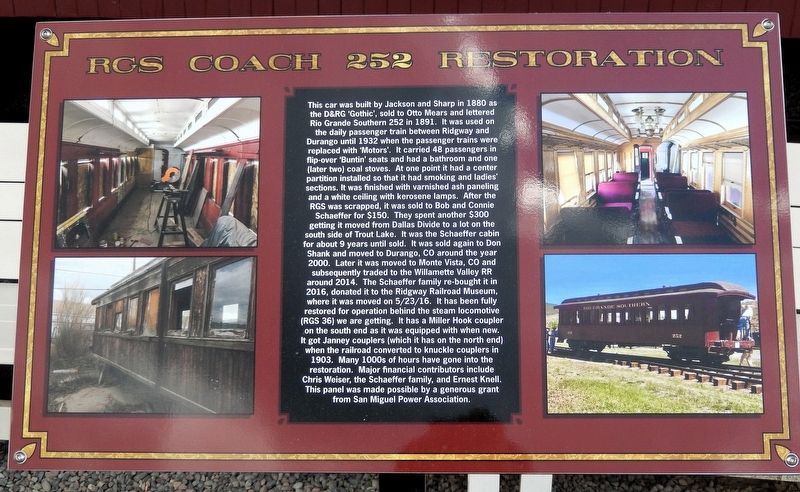
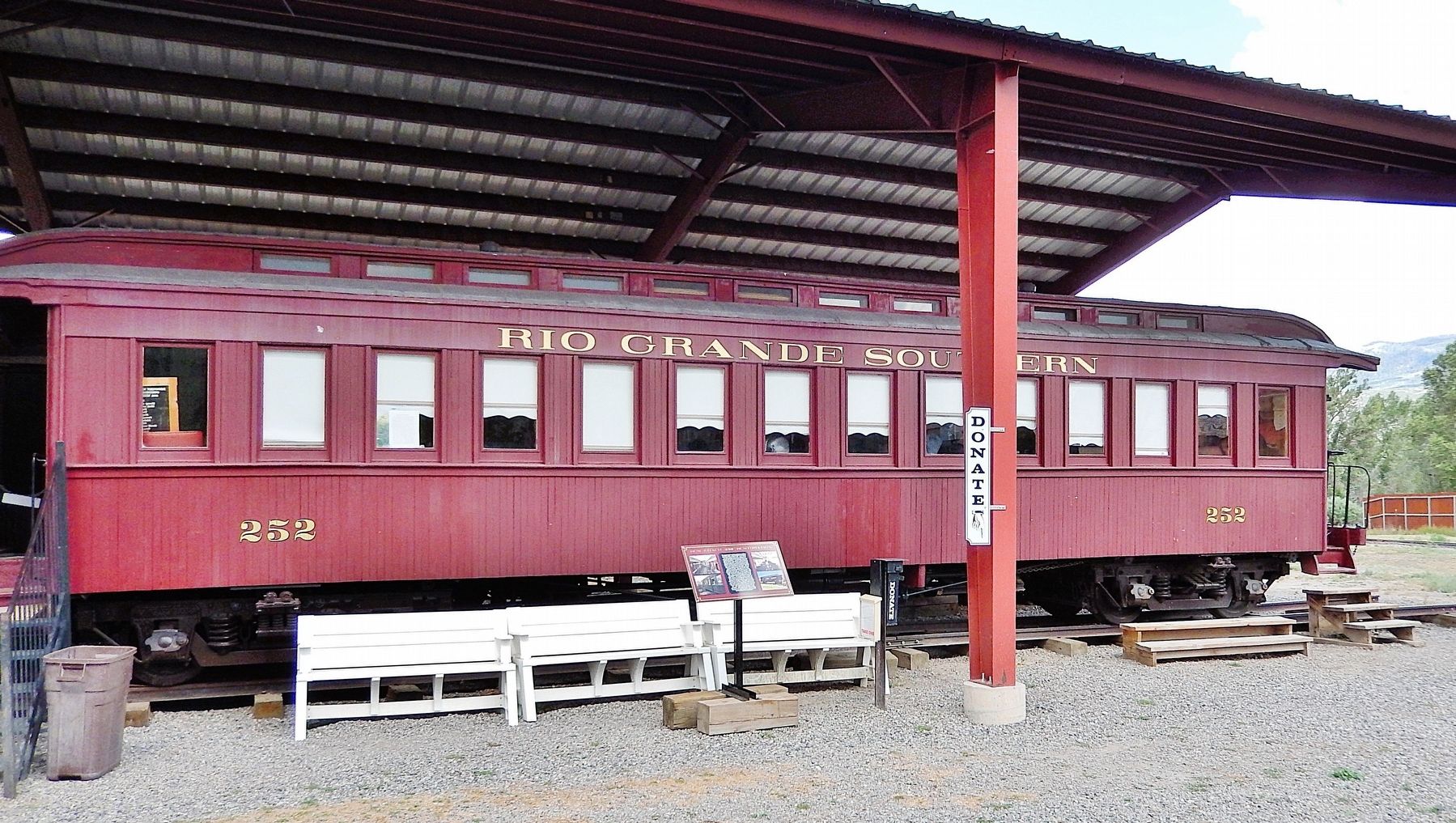
This car was built by Jackson and Sharp in 1880 as the D&RG 'Gothic', sold to Otto Mears and lettered Rio Grande Southern 252 in 1891. It was used on the daily passenger train between Ridgway and Durango until 1932 when the passenger trains were replaced with 'Motors'. It carried 48 passengers in flip-over `Buntin' seats and had a bathroom and one (later two) coal stoves. At one point it had a center partition installed so that it had smoking and ladies' sections. It was finished with varnished ash paneling and a white ceiling with kerosene lamps. After the RGS was scrapped, it was sold to Bob and Connie Schaeffer for $150. They spent another $300 getting it moved from Dallas Divide to a lot on the south side of Trout Lake. It was the Schaeffer cabin for about 9 years until sold. It was sold again to Don Shank and moved to Durango, CO around the year 2000. Later it was moved to Monte Vista, CO and subsequently traded to the Willamette Valley RR around 2014. The Schaeffer family re-bought it in 2016, donating it to the Ridgway Railroad Museum, where it was moved on 5/23/16. It has been fully restored for operation behind
this page online
Erected by Ridgway Railroad Museum and San Miguel Power Association.
Topics. This historical marker is listed in this topic list: Railroads & Streetcars. A significant historical year for this entry is 1880.
Location. 38° 9.154′ N, 107° 45.256′ W. Marker is in Ridgway, Colorado, in Ouray County. It can be reached from North Railroad Street just north of Sherman Street (State Highway 62), on the right when traveling north. The marker and restored coach are on the Ridgway Railroad Museum grounds. Touch for map. Marker is at or near this postal address: 200 North Railroad Street, Ridgway CO 81432, United States of America. Touch for directions.

Regionally, this marker is in the
Other nearby markers. At least 8 other markers are within walking distance of this marker: D&RG(W) Caboose 91 (0575) (here, next to this marker); DRG(W) 5574 (a few steps from this marker); RGS Motor 1 (within shouting distance of this marker); Galloping Goose No. 4 (within shouting distance of this marker); Ridgway Depot Outbuilding (within shouting distance of this marker); Ridgway Railroad Museum (within shouting distance of this marker); True Grit Jail Wagon (within shouting distance of this marker); True Grit Landmark #1 (about 300 feet away, measured in a direct line). Touch for a list and map of all markers in Ridgway.
Also see . . .
1. Rio Grande Southern Coach 252 Photo Gallery (Ridgway Railroad Museum).
1) RGS Coach 252 as a work car 0252 in the 1930s(Submitted on March 25, 2026, by Cosmos Mariner of Cape Canaveral, Florida.)
2) RGS Coach 252 at Trout Lake in the 1970s
3) Coach 252 after being moved to Monte Vista, CO
4) Coach 252 arriving in Ridgway on May 23, 2016
5) Coach 252 with new end sill and decking
6) Coach 252 getting new clerestory windows, Sept. 17, 2019
7) Completion of Coach 252 exterior restoration
8) Car 252 Interior Restoration
2. Rio Grande Southern Railroad, The Fabled Narrow-Gauge (American Rails).
(by Adam Burns) Excerpt: The state of Colorado was filled with a near-endless list of fabled narrow-gauge systems. One of the last built, largest, and longest to remain in service was the Rio Grande Southern. The RGS was conceived by Otto Mears to tap the region's rich silver ore trade. Unfortunately, the road's success was very short-lived due to the Sherman Silver Purchase Act's repeal in 1893. In addition, the RGS suffered from stiff grades and tight curves. While not uncommon for a narrow-gauge system, particularly those operated in Colorado, the railroad's route was quite circuitous between its end terminal points.(Submitted on March 25, 2026, by Cosmos Mariner of Cape Canaveral, Florida.)Otto Mears incorporated the Rio Grande Southern Railroad (RGS) on November 5, 1889. After being stymied by Uncompahgre Canyon from both ends, he was determined to finally complete the north-south routing to connect the Denver & Rio Grande's Marshall Pass and Cumbres Pass lines. Interestingly, the RGS would ultimately require 162 miles to do so although Ouray, and the end-of-track at Irondale on the Silverton Railroad, were a mere 12 miles apart. A direct route from Ridgway-Ouray-Durango would have required just 83 miles; today, this alignment is utilized by Highway 550. Construction of the RGS was initiated from both ends; the northern segment from Dallas Junction (later Ridgway) began grading on March 19, 1890 and was completed to Telluride on November 23rd that same year, a distance of 45 miles.
Credits. This page was last revised on March 25, 2026. It was originally submitted on March 24, 2026, by Cosmos Mariner of Cape Canaveral, Florida. This page has been viewed 10 times since then. Photos: 1, 2. submitted on March 25, 2026, by Cosmos Mariner of Cape Canaveral, Florida.
