Heuchling in Lauf an der Pegnitz in Nürnberger Land, Bavaria, Germany — Central Europe
St. Johannis
Photographed by James Hulse, March 3, 2026
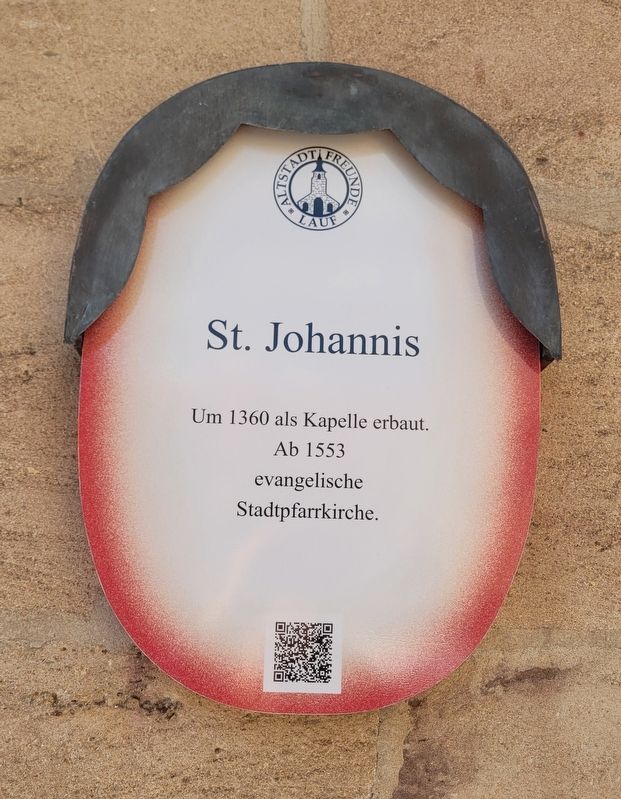
1. St. Johannis Marker

Um 1360 als Kapelle erbaut.
Ab 1553
evangelische
Stadtpfarrkirche.
St. Johannis. Built around 1360 as a chapel. From 1553 an Evangelical parish church of the town.
Erected by Old Town Friends of Lauf e.V. (Marker Number 18.)
Topics. This historical marker is listed in this topic list: Religion & Religious Structures. A significant historical year for this entry is 1360.
Location. 49° 30.67′ N, 11° 16.789′ E. Marker is in Lauf an der Pegnitz, Bayern (Bavaria), in Nürnberger Land. It is in Heuchling. It is at the intersection of Kirchenplatz and Marktpl., on the left when traveling north on Kirchenplatz. Touch for map. Marker is at or near this postal address: Kirchenpl 4, Lauf an der Pegnitz BY 91207, Germany. Touch for directions.

Regionally, this marker is in German Franconia. Globally, it is in Europe, the European Union, Atlantic Europe, Central Europe, the Schengen Area, Western Europe, and the Western World. Historically, it finds itself in what was once the Holy Roman Empire and also the former West Germany.
Other nearby markers. At least 8 other markers are within walking distance of this marker: Nürnberger Tor / Nuremberg Gate (within shouting distance of this marker); Prof. Dr. jur. Hermann Roesler (within shouting distance of this marker); Judenturm / Jewish Tower (about 90 meters away, measured in a direct line); Reichel’sche Schleif / Reichel Grinding Mill (about 120 meters away); Wassertores / Water Gate (about 120 meters away); Lauf a. d. Pegnitz, Reichelsche Schleif / Lauf on the Pegnitz, Reichel Grinding Mill (about 120 meters
this page online
Also see . . . Old Town Stroll Sign 18 – St. John's Church (German language). Excerpt (in translation):
A chapel dedicated to John the Baptist, belonging to the parish in Neunkirchen am Sand, was first mentioned in 1275. During Lauf's heyday under Charles IV around 1360, a larger stone building was erected, roughly the same size as today: the nave with tower and Gothic chancel still bear witness to this.(Submitted on March 24, 2026, by James Hulse of Medina, Texas.)
1691 Addition of the sacristy, 1907 addition with the southern staircase, the two gallery entrances and the western extension.
The Nuremberg bell-founding couple Kessler generously endowed a hospital and a church. As a result, Lauf became its own parish in 1375. The St. John's Chapel was placed under the jurisdiction of the foundation church of St. Leonard. In 1504, Lauf became part of the Free Imperial City of Nuremberg and, by decree of the city, became Protestant in 1525. The Reformation took hold gradually. Pastor Matthäus Vogel, who had studied under Luther and Melanchthon, introduced the new Protestant service consistently from 1544 onward.
The town fire during the Margrave War of 1553 destroyed the hospital church, which was never rebuilt. St. John's Chapel survived. The citizens of Lauf elevated it to the status of their Protestant town church.
Photographed by James Hulse, March 3, 2026
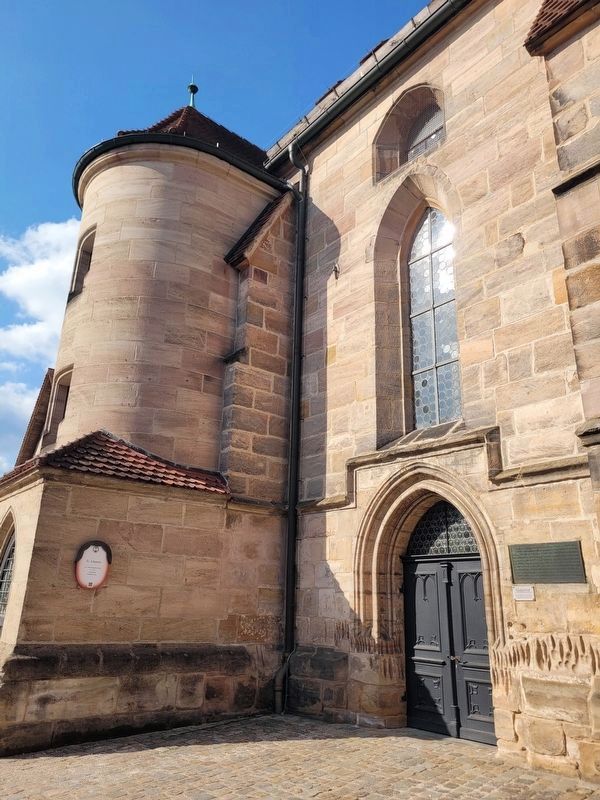
2. St. Johannis Marker
The marker is located at the southwest entrance to the church.
Photographed by James Hulse, March 3, 2026
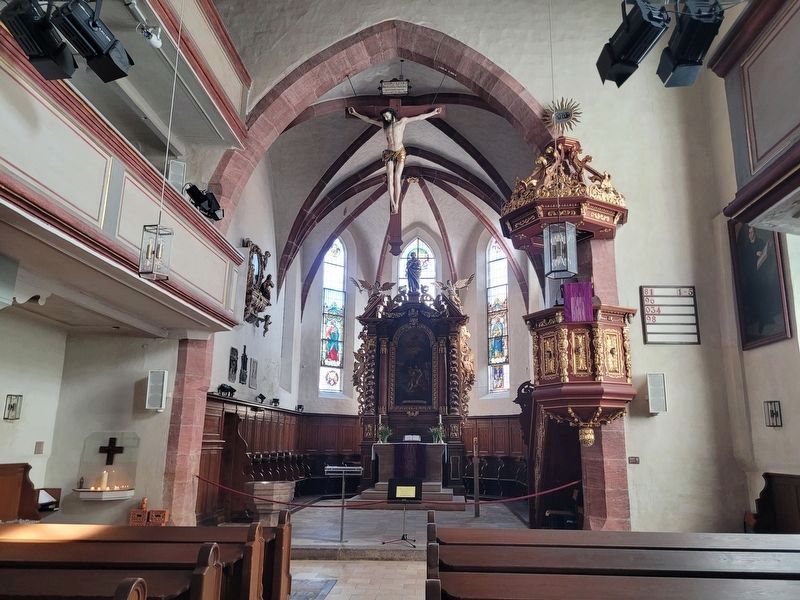
3. St. Johannis Marker
The interior view of the church with the pulpit on the right side.
Photographed by James Hulse, March 3, 2026
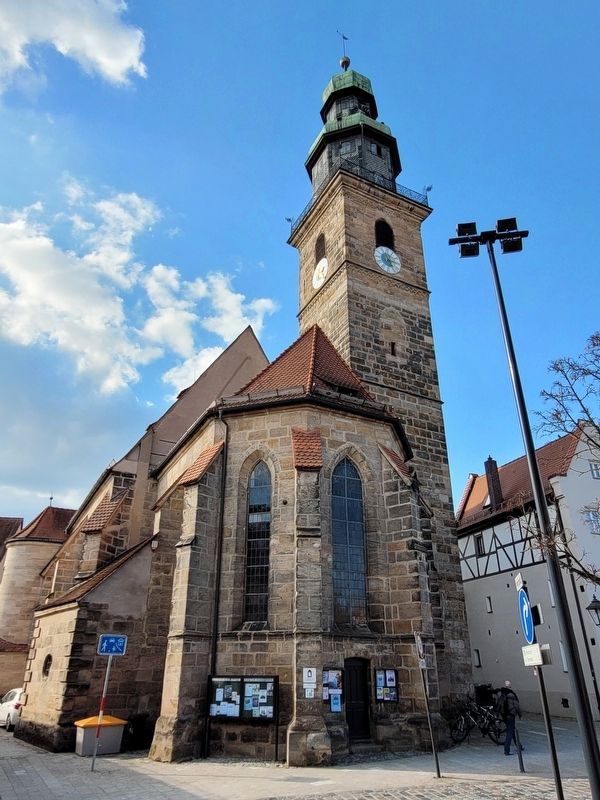
4. St. Johannis Marker
The view of the church and tower from the east side.
Credits. This page was last revised on March 26, 2026. It was originally submitted on March 24, 2026, by James Hulse of Medina, Texas. This page has been viewed 10 times since then. Photos: 1, 2, 3, 4. submitted on March 26, 2026, by James Hulse of Medina, Texas.
