Heuchling in Lauf an der Pegnitz in Nürnberger Land, Bavaria, Germany — Central Europe
Schlicht'sche Kunstmühle und Schleifmühle Reichel
Radtour Industriegeschichte
⎯⎯⎯
Schlicht Roller Mill and Reichel Grinding Mill
Industrial History Bicycle Tour
Photographed by James Hulse, March 3, 2026
1. Schlicht'sche Kunstmühle und Schleifmühle Reichel / Schlicht Roller Mill and Reichel Grinding Mill M

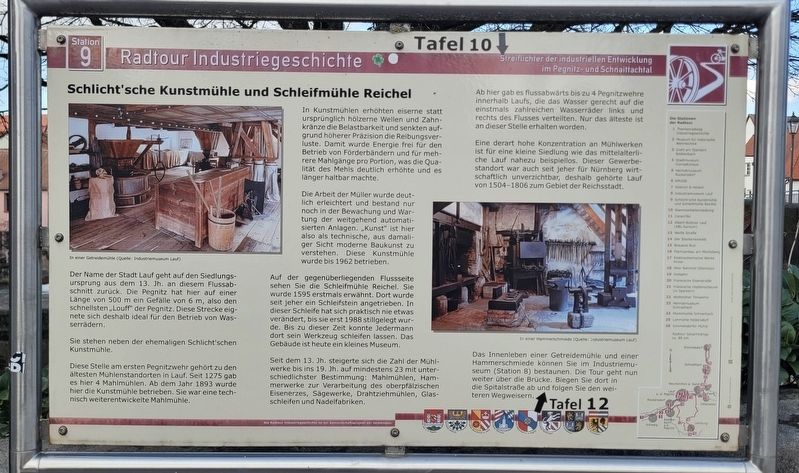
Der Name der Stadt Lauf geht auf den Siedlungsursprung aus dem 13. Jh. an diesem Flussabschnitt zurück. Die Pegnitz hat hier auf einer Länge von 500 m ein Gefälle von 6 m, also den schnellsten „Louff“ der Pegnitz. Diese Strecke eignete sich deshalb ideal für den Betrieb von Wasserrädern.
Sie stehen neben der ehemaligen Schlicht'schen Kunstmühle.
Diese Stelle am ersten Pegnitzwehr gehört zu den ältesten Mühlenstandorten in Lauf. Seit 1275 gab es hier 4 Mahlmühlen. Ab dem Jahr 1893 wurde hier die Kunstmühle betrieben. Sie war eine technisch weiterentwickelte Mahlmühle. In Kunstmühlen erhöhten eiserne statt ursprünglich hölzerne Wellen und Zahnkränze die Belastbarkeit und senkten aufgrund höherer Präzision die Reibungsverluste. Damit wurde Energie frei für den Betrieb von Förderbändern und für mehrere Mahlgänge pro Portion, was die Qualität des Mehls deutlich erhöhte und es länger haltbar machte.
Die Arbeit der Müller wurde deutlich erleichtert und bestand nur noch in der Bewachung und Wartung der weitgehend automatisierten Anlagen. „Kunst“ ist hier also als technische, aus damaliger Sicht moderne
this page online
Auf der gegenüberliegenden Flussseite sehen Sie die Schleifmühle Reichel. Sie wurde 1595 erstmals erwähnt. Dort wurde seit jeher ein Schleifstein angetrieben. In dieser Schleife hat sich praktisch nie etwas verändert, bis sie erst 1988 stillgelegt wurde. Bis zu dieser Zeit konnte jedermann dort sein Werkzeug schleifen lassen. Das Gebäude ist heute ein kleines Museum.
Seit dem 13. Jh. steigerte sich die Zahl der Mühlwerke bis ins 19. Jh. auf mindestens 23 mit unterschiedlichster Bestimmung: Mahlmühlen, Hammerwerke zur Verarbeitung des oberpfälzischen Eisenerzes, Sägewerke, Drahtziehmühlen, Glasschleifen und Nadelfabriken. Ab hier gab es flussabwärts bis zu 4 Pegnitzwehre innerhalb Laufs, die das Wasser gerecht auf die einstmals zahlreichen Wasserräder links und rechts des Flusses verteilten. Nur das älteste ist an dieser Stelle erhalten worden.
Eine derart hohe Konzentration an Mühlwerken ist für eine kleine Siedlung wie das mittelalterliche Lauf nahezu beispiellos. Dieser Gewerbestandort war auch seit jeher für Nürnberg wirtschaftlich unverzichtbar, deshalb gehörte
Photographed by James Hulse, March 3, 2026
2. Schlicht Roller Mill and Reichel Grinding Mill M
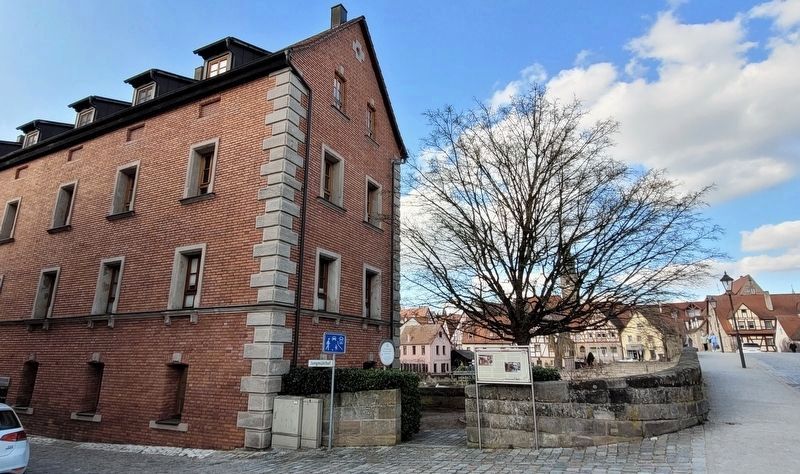
The marker is located in front of the art mill building.
[Untertitel:]
In einer Getreidemühle (Quelle: Industriemuseum Lauf)
In einer Hammerschmiede (Quelle: Industriemuseum Lauf)
The name of the town of Lauf goes back to the origin of a settlement from the 13th century at this section of the river. Here the Pegnitz drops 6 meters over a distance of 500 meters, creating the fastest “run” (Louff) of the Pegnitz. This stretch was therefore ideal for the operation of waterwheels.
You are standing next to the former Schlicht roller mill.
This location at the first Pegnitz weir is one of the oldest mill sites in Lauf. Since 1275 there were four grain mills here. From the year 1893 the roller mill operated here. It was a technically advanced grain mill. In roller mills, iron shafts and gear rings replaced the originally wooden ones, increasing durability and reducing friction losses
Photographed by James Hulse, March 3, 2026
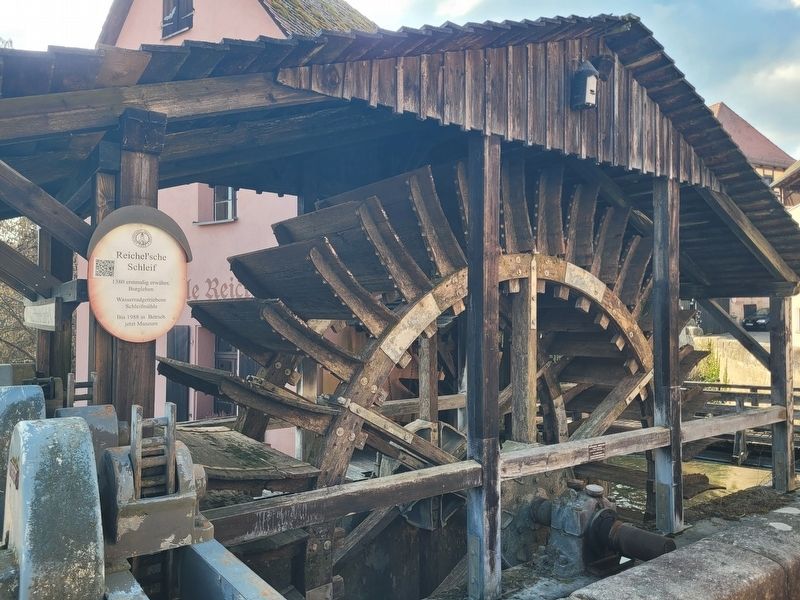
3. Reichel Grinding Mill
The Reichel Grinding Mill is located across the river from the marker.
The work of the millers became much easier and consisted mainly of monitoring and maintaining the largely automated machinery. The term “Kunst” here refers to technical engineering that was considered modern construction technology at the time. This roller mill remained in operation until 1962.
On the opposite side of the river you can see the Reichel grinding mill. It was first mentioned in 1595. A grinding stone had been driven there for centuries. Practically nothing changed in this mill until it was finally closed in 1988. Until that time anyone could have their tools sharpened there. Today the building is a small museum.
Since the 13th century, the number of mills increased until the 19th century to at least 23 with many different purposes: grain mills, hammer mills for processing iron ore from the Upper Palatinate, sawmills, wire-drawing mills, glass grinding works, and needle factories. From this point downstream there were once up to
Photographed by James Hulse, March 3, 2026
4. Schlicht Roller Mill and Reichel Grinding Mill Marker
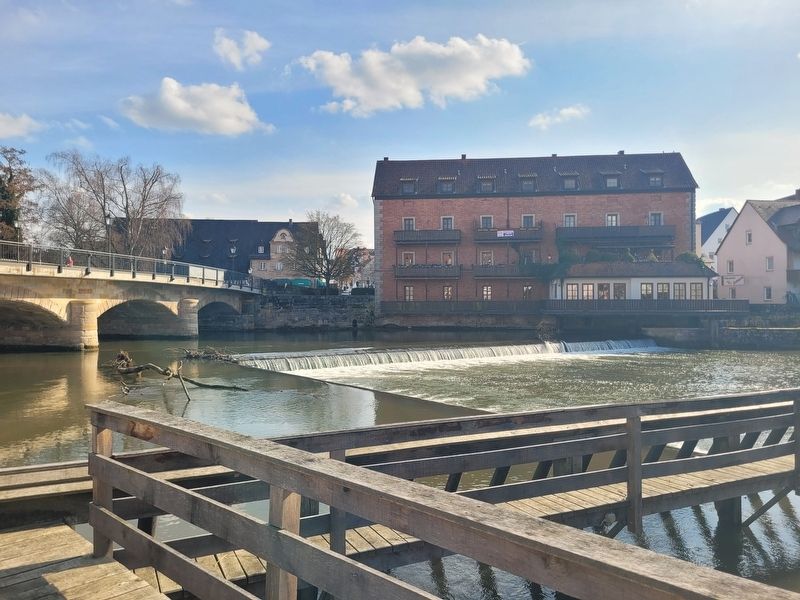
The view of the Schlicht Roller Mill from across the river.
Such a high concentration of mills is almost unparalleled for a small settlement like medieval Lauf. This industrial location was economically indispensable for Nuremberg, which is why Lauf belonged to the territory of the Imperial City from 1504 to 1806. You can see the interior workings of a grain mill and a hammer forge in the Industrial Museum (Station 8). The tour now continues across the bridge. Turn there into Spitalstraße and follow the further signs.
[Captions:]
Inside a grain mill (Source: Industrial Museum Lauf)
Inside a hammer forge (Source: Industrial Museum Lauf)
Erected by Stadt Lauf a. d. Pegnitz, Gemeinden Leinburg, Gemeinden Neunkirchen a. Sand, Gemeinden Ottensoos, Stadt Röthenbach a. d. Pegnitz, Gemeinden Rückersdorf, Markt Schnaittach and Gemeinden Simmelsdorf. (Marker Number 9.)
Topics. This historical marker is listed in this topic list: Industry & Commerce. A significant historical year for this entry is 1275.
Location. 49° 30.581′ N, 11° 16.864′ E.
Photographed by James Hulse, March 3, 2026
5. Schlicht Roller Mill and Reichel Grinding Mill Marker
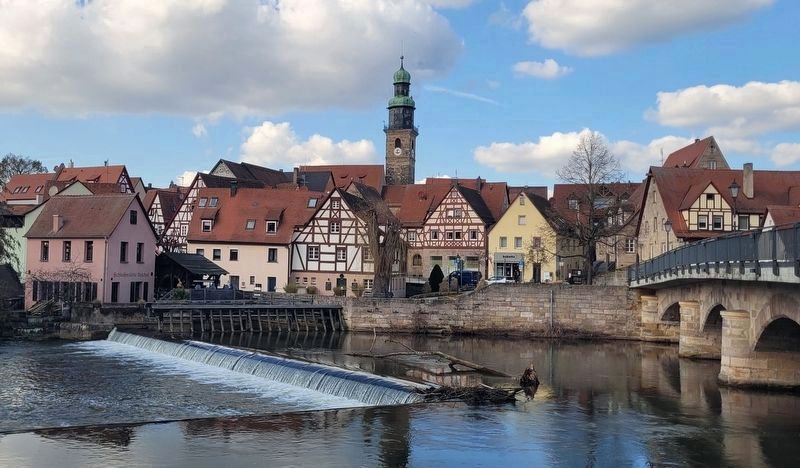
The view of the historic town of Lauf an der Pegnitz from the marker with the Reichel Grinding Mill on the left side of the buildings.

Regionally, this marker is in German Franconia. Globally, it is in Europe, the European Union, Atlantic Europe, Central Europe, the Schengen Area, Western Europe, and the Western World. Historically, it finds itself in what was once the Holy Roman Empire and also the former West Germany.
Other nearby markers. At least 8 other markers are within walking distance of this marker: Ehemalige Kunstmühle Schlicht / Former Schlicht Roller Mill (here, next to this marker); Laufer Wenzelburg -Lieblingsort des Kaisers? / Lauf Wenceslas Castle – the Emperor’s favorite place? (within shouting distance of this marker); Wenzelschloß / Castle of St. Wenceslas (within shouting distance of this marker); Lauf a. d. Pegnitz, Reichelsche Schleif / Lauf on the Pegnitz, Reichel Grinding Mill (within shouting distance of this marker); Reichel’sche Schleif / Reichel Grinding Mill (within shouting distance of this marker); Wassertores / Water Gate (within shouting distance of this marker); Liebesbriefe aus dem Forsthaus auf der Insel / Love Letters from the Forester’s House on the Island (about 90 meters away, measured in a direct line); Judenturm / Jewish Tower (about 90 meters away). Touch for a list and map of all markers in Lauf an der Pegnitz.
Credits. This page was last revised on March 26, 2026. It was originally submitted on March 25, 2026, by James Hulse of Medina, Texas. This page has been viewed 14 times since then. Photos: 1, 2, 3, 4, 5. submitted on March 26, 2026, by James Hulse of Medina, Texas.
