Streeterville in Chicago in Cook County, Illinois — The American Midwest (Great Lakes)
Captain George “Cap” Wellington Streeter
Born 1843 — Died 1921
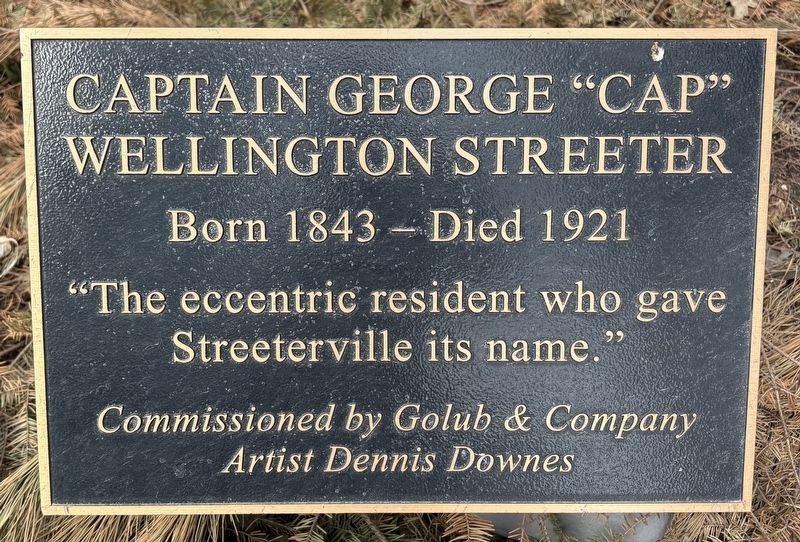
Photographed by Sean P. Flynn, March 25, 2026
1. Captain George “Cap” Wellington Streeter Marker
Erected 2010.
Topics. This historical marker is listed in these topic lists: Arts, Letters, Music • Settlements & Settlers. A significant historical year for this entry is 1843.
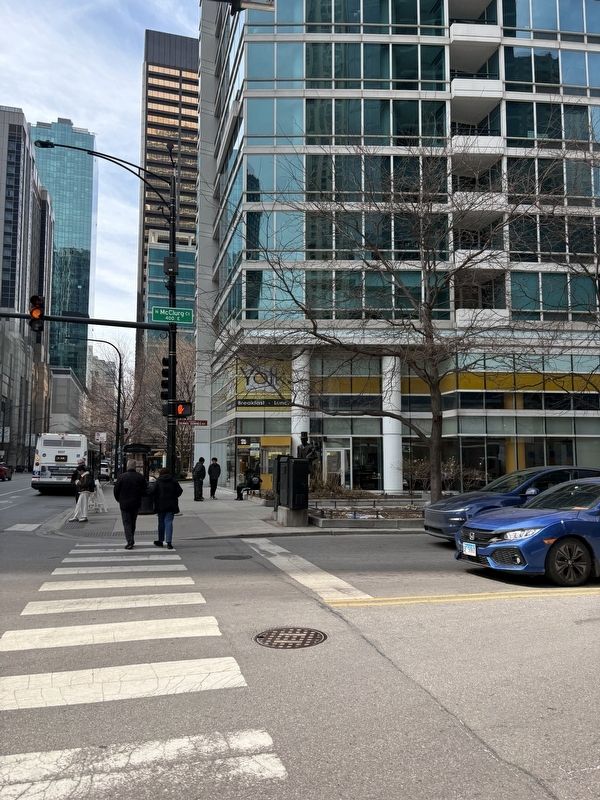
Location. 41° 53.52′ N, 87° 37.07′ W. Marker is in Chicago, Illinois, in Cook County. It is in Streeterville. It is at the intersection of North McClurg Court and Grand Avenue, on the left when traveling north on North McClurg Court. Touch for map. Marker is at or near this postal address: 355 East Ohio Street, Chicago IL 60611, United States of America. Touch for directions.

Regionally, this marker is on Chicago’s North Side. It is also in the American Midwest. Globally, it is in North America, on the Great Lakes, in the Western Hemisphere, in the Western World, and in the Anglosphere. Historically, it finds itself in what was once the Viceroyalty of New France, the territory of the Mississippian Culture, and the Northwest Territory.
Other nearby markers. At least 8 other markers are within walking distance of this marker: Life at the Beach (approx. ¼ mile away); Welcome to Jane Addams Park Natural Area
this page online
Regarding Captain George “Cap” Wellington Streeter. Born in 1937 in Flint, Michigan, George Wellington Streeter served in the Civil War (but apparently not as a captain) and came to Chicago sometime after the war. During his life he was a salesman, a circus owner, a logger and a miner.
In his most famous incident in 1886, Streeter's steamship, the Reutan became stuck (whether due to a storm or on purpose) in the sand near where Superior Street met Lake Michigan, and Streeter refused to move, staking a claim to the shoreline and calling it "The District of Lake Michigan." He was finally removed from the land in 1893, but soon began selling some of that shoreline, owned by many of Chicago's wealthiest families, to unwitting buyers while sending squatters
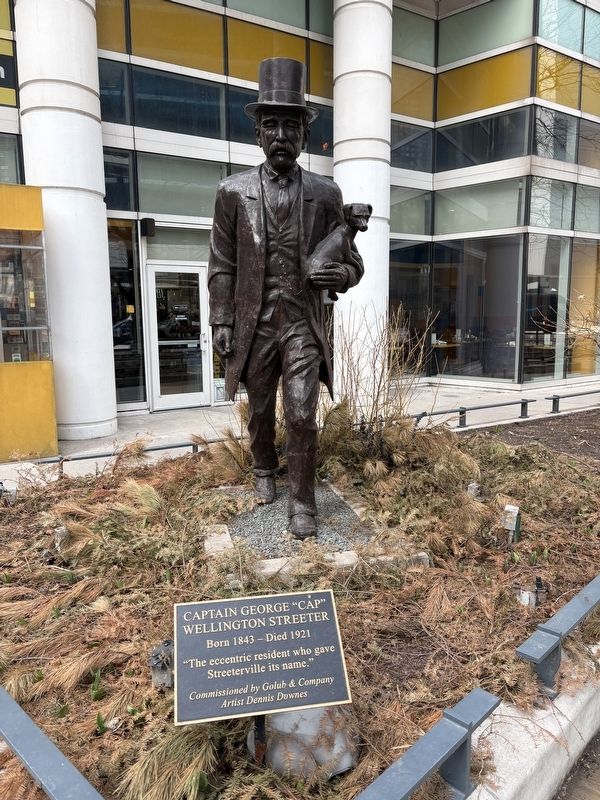
Photographed by Sean P. Flynn, March 25, 2026
2. Captain George “Cap” Wellington Streeter Marker
While his efforts to claim the land pultimately failed, the near north side neighborhood where he undertook his hijinks became known after his death as Streeterville. It is roughly bounded on the north and east by Lake Michigan, on the west by Michigan Avenue and the south by the Chicago River.
Also see . . .
1. 1886--Streeterville. This story from the Chicagology website includes contemporary articles and photographs about Cap Streeter's attempt to lay claim to the land on Chicago's near north side that is now known as Streeterville.
Excerpt from Nov. 18, 1892: "Nathianel K. Fairbank filed an answer before Judge Collins yesterday to the suit involving a controversy over land bordering on Lake Michigan at the foot of Superior street. Capt. Streeter is seeking to enjoin Mr. Fairbank from interfering with his possession of the land. Mr. Fairbank(Submitted on March 25, 2026, by Sean P. Flynn of Oak Park, Illinois.)says that in the sporing of 1889 Streeter called upon him and stated that he had been notified by the city authorities to remove his boat from Superior street; that he was repairing his boat and getting ready to go away. He asked Mr. Fairbank for permission to move his boat on his land until he could get ready to move. This permission was granted, but Streeter declined to move. Neighbors complained that Streeter and his wife were disorderly, and that the residence there was a nuisance. Finally he ordered, says Mr. Fairbank, his agents to begin litigation to oust Streeter from the property."Photographed by Sean P. Flynn, March 25, 20263. Captain George “Cap” Wellington Streeter statue in front of Yolk
2. Chicago Tribune: Streeterville quite a bit ritzier than Streeter was. A May 2007 article looked at the history of Streeterville.
Excerpt: "Streeter was arrested for murder several times after interlopers to his realm ended up dead, according to Dick Bales, a historian working on a book about him. Streeter managed to wiggle out of the charges. He was eventually convicted of murder in 1902, Bales said. He was jailed only nine months until he was pardoned (Streeter claimed he was framed). Streeter continued to fight authorities in the courts until he died of pneumonia in 1921 at 84."(Submitted on March 25, 2026, by Sean P. Flynn of Oak Park, Illinois.)
Credits. This page was last revised on March 26, 2026. It was originally submitted on March 25, 2026, by Sean P. Flynn of Oak Park, Illinois. This page has been viewed 30 times since then. Photos: 1, 2, 3. submitted on March 25, 2026, by Sean P. Flynn of Oak Park, Illinois.
