B'nai Jacob Synagogue
Built 1915

Built 1915
has been placed on the
National Register of Historic Places
by the United States Department of the Interior
Topics and series. This historical marker is listed in these topic lists: Architecture • Notable Buildings • Religion & Religious Structures. In addition, it is included in the National Register of Historic Places (NRHP) series list. A significant historical year for this entry is 1915.
Location. 41° 0.835′ N, 92° 24.418′ W. Marker is in Ottumwa, Iowa, in Wapello County. It is on East Main Street just north of South Union Street, on the right when traveling north. The marker is mounted directly on the subject building, on the right side of the front entrance. Touch for map. Marker is at or near this postal address: 529 East Main Street, Ottumwa IA 52501, United States of America. Touch for directions.

Regionally, this marker is in Southern Iowa. It is also in the American Midwest and in the Corn Belt. Globally, it is in North America, the Western Hemisphere, the Western World, and the Anglosphere. Historically, it finds itself in what was once the territory of the Mississippian
this page online
Other nearby markers. At least 8 other markers are within walking distance of this marker: The Jefferson Street Viaduct (about 800 feet away, measured in a direct line); Twin Galaxies (approx. ¼ mile away); J.W. Garner Building (approx. 0.3 miles away); J. B. Sax Co. (approx. 0.4 miles away); Philip B. Hofmann (approx. 0.4 miles away); Edna Ferber (approx. 0.4 miles away); Ottumwa City Hall (approx. 0.4 miles away); Civil War Memorial (approx. 0.4 miles away). Touch for a list and map of all markers in Ottumwa.
Regarding B'nai Jacob Synagogue. National Register of Historic Places № 04000815.
From the National Register Nomination prepared by Molly Myers Naumann, 3/2004:
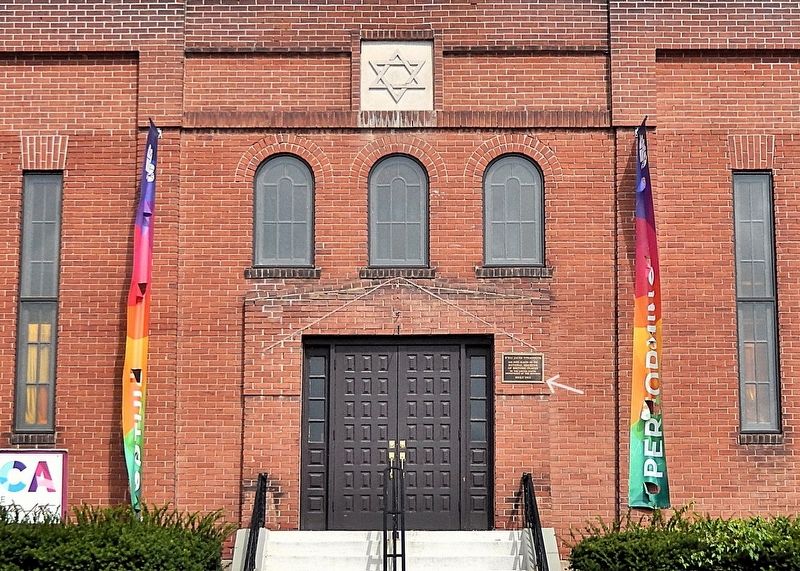
The B'nai Jacob Synagogue features a symmetrical tripartite facade. The broad (17'6") central portion is separated from the sides by shallow brick piers (1'10" wide), and these piers are repeated at the corners. The central portion features a double door entrance flanked by sidelights. Each door contains twenty-one rectangular panels. This entry is surrounded by a shallow brick pavilion. Above the entry are three roundarched windows. The reddish-brown brick is laid in a running bond with a few decorative elements such as the simple arches around some windows. A single soldier course frieze above the windows creates a recessed brick panel containing a stone Star of David.Photographed by Cosmos Mariner, September 21, 20252. B'nai Jacob Synagogue MarkerThe marker is mounted on the right side of the front entrance.The side elevations continue the tripartite divisions with the tall narrow windows at each end, and the recessed brick paneled frieze found on the facade is repeated above the central portions on each side. On the west elevation the center portion is filled with five tall round arched windows measuring 2'5" wide. On the east elevation the center portion is composed of four of the tall arched windows, with a windowless polygonal bay in the center.
The B'nai Jacob Synagogue is significant because it illustrates the importance of the Jewish community in Ottumwa's business and social history, and because it was composed of an ethnically cohesive group of people. The immigrants who arrived between 1890 and 1910 were Orthodox Jews. They organized the B'nai Jacob Congregation in 1900. In 1914 the decision was made to build a synagogue. The location selected for the building, in the 500
block of East Main, was a very practical one. Orthodox Jews are forbidden from driving or riding in a vehicle on the Sabbath. Therefore, it was of primary importance that the synagogue be located within easy walking distance of the majority of the members of the congregation. Bricks were sold to raise money for the new building. By the time the synagogue was dedicated, over 75% of the $10,000 cost had been paid, leaving only a $2,500 debt.Photographed by Cosmos Mariner, September 21, 20253. B'nai Jacob Synagogue (southwest elevation)The southwest/front elevation faces East Main Street.The B'nai Jacob Synagogue is significant as the only synagogue in Ottumwa's history, and as an example of a design executed by local master architect George M. Kerns. Kerns had designed the Wapello County Jail a few years earlier, and two decades later would be responsible for the National Guard Armory/Coliseum. The B'nai Jacob Synagogue appears to be the only synagogue designed by George Kerns during his career.
Synagogue design never appears to have been as codified as that for Christian churches. By and large the designs followed styles popular in the geographic region and often reflected the architecture of nearby churches. One of the major principles of design was simplicity. The only constants
in synagogue interior design are presence of an ark (the cabinet that holds the holy Torah scrolls) and a bimah (the platform and table for reading the Torah and leading services).Photographed by Cosmos Mariner, September 21, 20254. B'nai Jacob Synagogue (northwest elevation)


Also see . . .
1. B’nai Jacob Synagogue (Synagogues360).
360° interior view of the Synagogue(Submitted on March 29, 2026, by Cosmos Mariner of Cape Canaveral, Florida.)
2. B'nai Jacob Synagogue (Wikipedia).
Excerpt: The Renaissance or Deco Vernacular synagogue building was constructed in 1915. The architect was George M. Kerns and L.T. Chrisman and Company was the contractor. The exterior is brick, with an addition in the back holding a kitchen and social hall, built sometime in the 1950s. The building was added to the National Register of Historic Places on August 10, 2004, and a major historic restoration was completed during 2004–2005.(Submitted on March 29, 2026, by Cosmos Mariner of Cape Canaveral, Florida.)The first Jewish settlement in Ottumwa in the 19th century was dominated by German Jews, and in the early 1880s, there was an organized German congregation. By 1884, this had dissolved as most of the original German pioneers died out and their children left town. By the turn of the 20th century,
Ottumwa had fewer than 50 Jewish families, immigrants from Germany and across eastern Europe. Most were "in the junk and second-hand business", but there were also laborers, shoemakers, tailors and one prominent merchant. In the early 1900s, many people called the area around the 300, 400 and 500 blocks of Main Street "Jew Town" because the stores in the neighborhood were mostly owned by Jewish families, many of whom lived above their stores. By 1919, the Jewish population of Ottumwa had risen to 412 and the congregation had moved into the current building. By 2010, the congregation on a typical Saturday morning had shrunk to seven or so, and by 2018, as few as two. In August of that year, the congregation donated its Torah scroll "to a new synagogue forming in South America", and ceased functioning. In February 2019 the building was donated to the American Gothic Performing Arts Festival and renamed Temple of Creative Arts, to be used as meeting and performance space.Photographed by Cosmos Mariner, September 21, 20255. B'nai Jacob Synagogue (south elevation)

Credits. This page was last revised on March 29, 2026. It was originally submitted on March 25, 2026, by Cosmos Mariner of Cape Canaveral, Florida. This page has been viewed 18 times since then. Photos: 1, 2, 3, 4, 5. submitted on March 29, 2026, by Cosmos Mariner of Cape Canaveral, Florida.
