The Jefferson Street Viaduct
Built in 1935-36
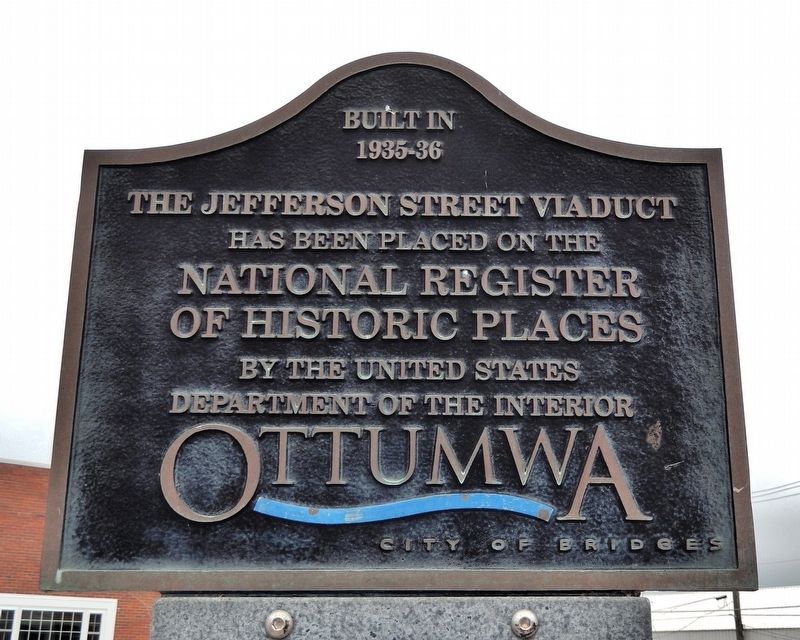
has been placed on the
National Register of Historic Places
by the United States Department of the Interior
Ottumwa
City of Bridges
Topics and series. This historical marker is listed in these topic lists: Architecture • Bridges & Viaducts. In addition, it is included in the National Register of Historic Places (NRHP) series list. A significant historical year for this entry is 1935.
Location. 41° 0.912′ N, 92° 24.555′ W. Marker is in Ottumwa, Iowa, in Wapello County. It is at the intersection of Jefferson Street Viaduct and East Main Street, on the right when traveling north on Jefferson Street Viaduct. The marker is near the southeast corner of the intersection. Touch for map. Marker is in this post office area: Ottumwa IA 52501, United States of America. Touch for directions.

Regionally, this marker is in Southern Iowa. It is also in the American Midwest and in the Corn Belt. Globally, it is in North America, the Western Hemisphere, the Western World, and the Anglosphere. Historically, it finds itself in what was once the territory of the Mississippian Culture and also the Louisiana
this page online
Other nearby markers. At least 8 other markers are within walking distance of this marker: Twin Galaxies (about 700 feet away, measured in a direct line); J.W. Garner Building (about 800 feet away); B'nai Jacob Synagogue (about 800 feet away); J. B. Sax Co. (approx. 0.2 miles away); Edna Ferber (approx. 0.2 miles away); Philip B. Hofmann (approx. 0.2 miles away); Ottumwa City Hall (approx. ¼ mile away); Civil War Memorial (approx. 0.3 miles away). Touch for a list and map of all markers in Ottumwa.
Regarding The Jefferson Street Viaduct. National Register of Historic Places № 98000475.
From the National Register Nomination prepared by Clayton B. Fraser, 8/31/1994:
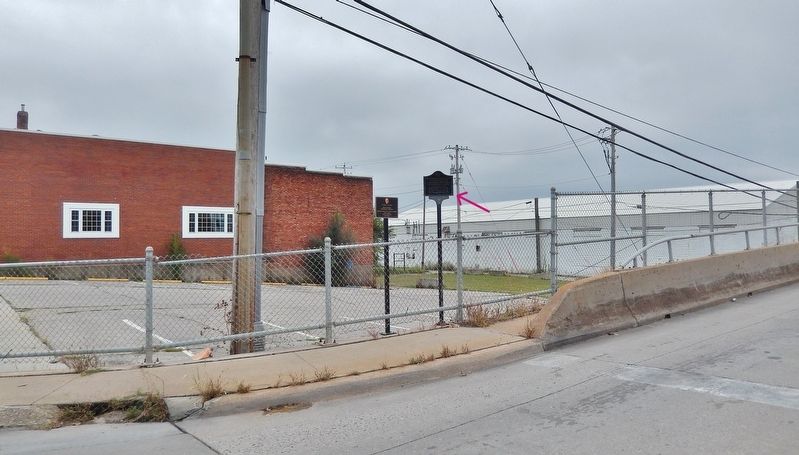
Although it was built in 1935-36, the Jefferson Street Viaduct traces its roots 15 years earlier. Beginning in 1921, Ottumwa city officials began meeting with the CB&Q, the GRI&P and the CM&StP railroads with the idea of building a viaduct over the numerous tracks that paralleled the Des Moines River. Nothing concrete came of these discussions, however, and, after a change of city administration, the project was shelved until 1929. Planning began againthat year, with the city considering sites at several streets. Because the proposed bridge was to carry U.S. Highways 34 and 63 - then carried over the Market Street Bridge (1892), the city sought financial and design help from the Iowa State Highway Commission. ISHC agreed to fund construction of a new bridge over the Des Moines River, provided the city would pay for construction of the viaduct on the northern end. Jefferson Street was eventually designated as the crossing site. Between 1930 and 1935 ISHC presided over meetings with the city and the railroads to resolve differences between the three entities.Photographed by Cosmos Mariner, September 21, 20252. The Jefferson Street Viaduct MarkerThe marker is on a tall post near the northeast end of the viaduct.
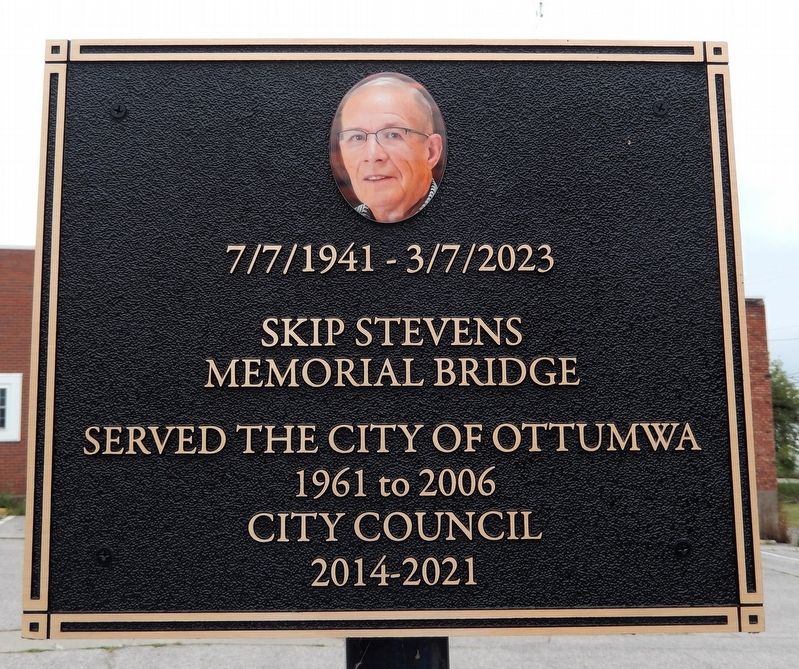
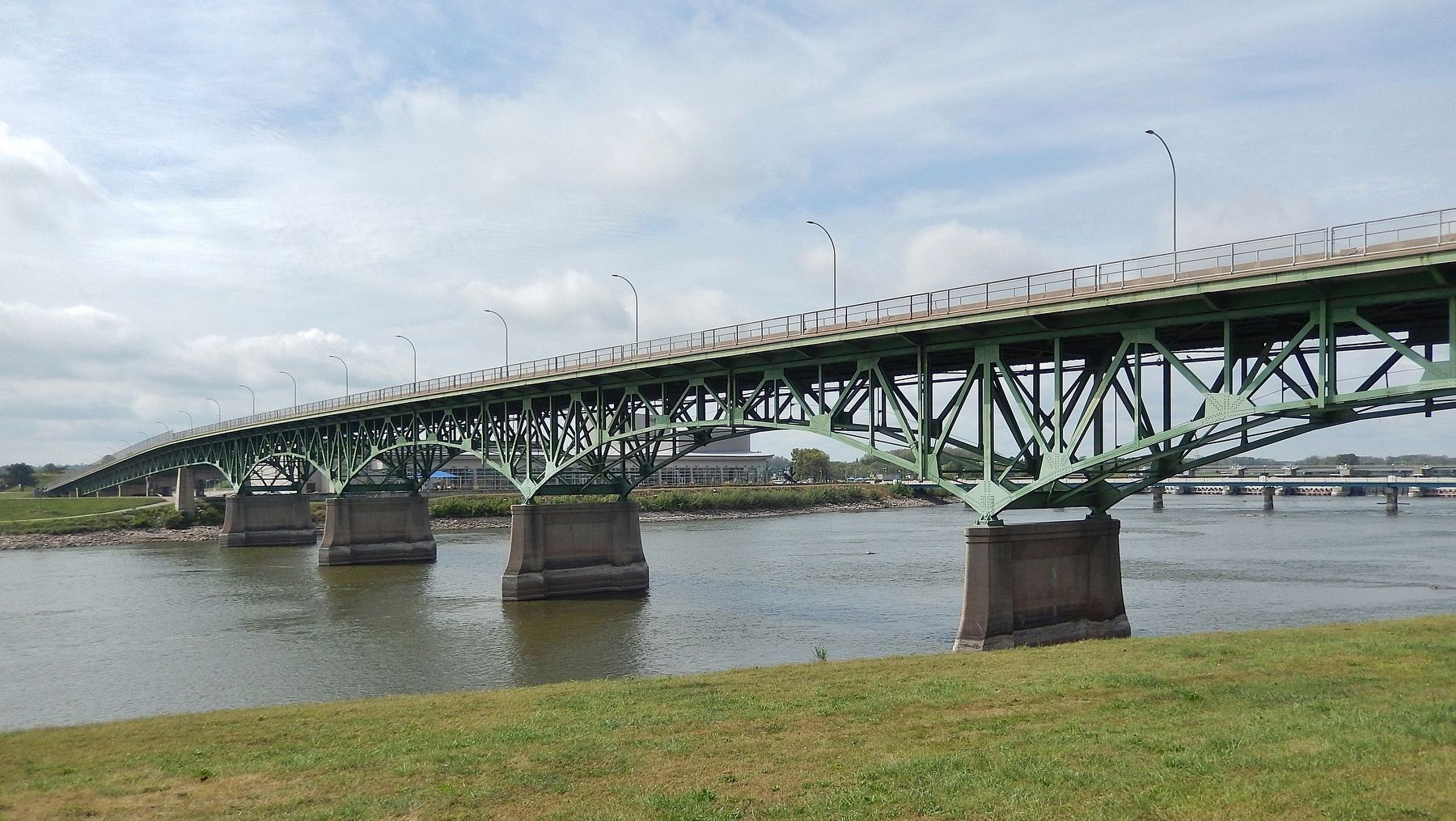
Finally, highway commission engineers delineated a five-span, riveted Warren deck truss, carried continuously by massive concrete piers in the river. The highway commission designated the viaduct's construction Project P-480 and in December 1934 awarded a contract for it to the Wisconsin Bridge and Iron Company. The Milwaukee-based firm began excavations for the substructure early in 1935, hoping to complete the structure by Christmas. But difficulties with weather and labor unions delayed the work, and it was not until May 1936that the structure was completed. At the dedication ceremonies on May 28th, Iowa Governor Clyde Herring and Ottumwa Mayor Edwin Manning spoke before a crowd of about 15,000 people, before two Ottumwa girls christened the bridge with bottles of champagne. The Jefferson Street Viaduct has carried heavy traffic since, with a major rehabilitation of its deck and guardrails in 1983 as its most substantial alteration.Photographed by Cosmos Mariner, September 21, 20253. Skip Stevens Memorial Bridge Marker(located beside the National Register marker)
7/7/1941-3/7/2023
Skip Stevens Memorial Bridge
Served the City of Ottumwa
1961 to 2006
City Council
2014-2021Fueled with federal funds from the various relief agencies, the Iowa State Highway Commission designed several large-scale urban viaducts in the 1930s. These featured a variety of superstructure types, but perhaps none was as distinctive as the Jefferson Street Viaduct in Ottumwa. The city had wanted a concrete bridge here, in part because of the aesthetics of the concrete arch form. But ISHC opted instead for this steel truss design as a more economical alternative. With its five arched deck truss spans held above the Des Moines River on tapered concrete pedestals, the structure is one of Iowa's most handsomely proportioned highway trusses. It is technologically noteworthy as an uncommon application of deck truss technology
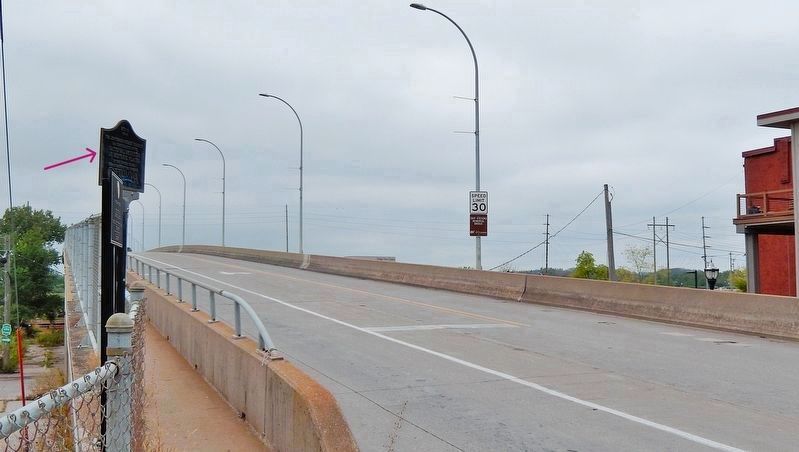
in Iowa, a state not known for generous underdeck clearances at its stream and river crossings. With its structural integrity largely intact, the Jefferson Street Viaduct was an important exercise in Iowa urban bridge construction in the 1930s.Photographed by Cosmos Mariner, September 21, 20254. The Jefferson Street ViaductLooking south from East Main Street; the marker is beside the sidewalk on the left. The Jefferson Street Viaduct, also more recently known as the “Skip Stevens Memorial Bridge,” carries traffic over the Des Moines River and active railroad tracks.
Also see . . . Jefferson Street Viaduct (Wikipedia).
Excerpt: The Iowa State Highway Commission (ISHC) agreed to share the costs of the bridge with the city in January 1934. Pittsburgh-Des Moines Steel Company of Des Moines was paid $10,400 to prepare design plans for a steel viaduct and Marsh Engineering Company, also of Des Moines, was paid $10,500 to prepare plans for a reinforced concrete bridge. In December of the same year, bids were submitted and Snyder & Johnson of Humboldt, Iowa, won the bid for the concrete structure and Wisconsin Bridge and Iron Company won the bid for the steel design. The ISHC took full control of the project, including its financing, and chose the less expensive steel design. The bridge was built in fifteen months in 1935 and 1936.(Submitted on March 29, 2026, by Cosmos Mariner of Cape Canaveral, Florida.)The bridge carried traffic for US 34 and US 63 until a new bridge was built on the west side of downtown to carry
the highway traffic. The bridge underwent a major rehabilitation project in 1983–1984. The original railings were replaced with Jersey barriers at the time. The Jefferson Street Viaduct has a total of nine main spans and eight approach spans. The south side of the main span consists of four riveted Warren deck trusses. The north side consists of five cantilevered Warren deck truss spans over the river. It is a rare use of deck truss technology in Iowa. The main spans are 150 feet long and the whole structure is 2,120.5 feet long. The roadway is 33 feet wide.Photographed by Cosmos Mariner, September 21, 20255. The Jefferson Street ViaductLooking southwest across the Des Moines River.
Credits. This page was last revised on March 29, 2026. It was originally submitted on March 25, 2026, by Cosmos Mariner of Cape Canaveral, Florida. This page has been viewed 18 times since then. Photos: 1, 2, 3, 4, 5. submitted on March 29, 2026, by Cosmos Mariner of Cape Canaveral, Florida.
