Chicago, Burlington & Quincy Locomotive 3001
Historic Railroad District
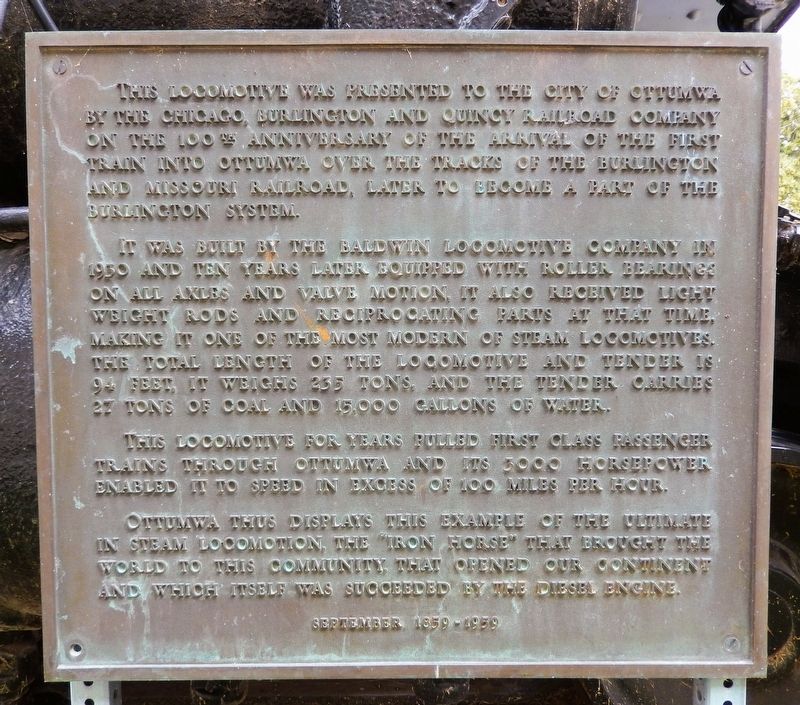
This locomotive was presented to the City of Ottumwa by the Chicago, Burlington & Quincy Railroad Company on the 100th anniversary of the arrival of the first train into Ottumwa over the tracks of the Burlington and Missouri Railroad, later to become a part of the Burlington System.
It was built by the Baldwin Locomotive Company in 1950 and ten years later equipped with roller bearings on all axles and valve motion. It also received light weight rods and reciprocating parts at that time, making it one of the most modern steam locomotives. The total length of the locomotive and tender is 94 feet, it weighs 235 tons, and the tender carries 27 tons of coal and 15,000 gallons of water.
This locomotive for years pulled First Class passenger trains through Ottumwa, and its 3000 horsepower enabled it to speed in excess of 100 miles per hour.
Ottumwa thus displays this example of the ultimate in steam locomotion, the “Iron Horse” that brought the world to this community, that opened our continent and which itself was succeeded by the diesel engine.
Topics and series. This historical marker is listed in
this page online
Location. 41° 1.13′ N, 92° 24.898′ W. Marker is in Ottumwa, Iowa, in Wapello County. It can be reached from South Washington Street (River Street) just south of West Main Street, on the right when traveling south. The marker and locomotive are in front of the Ottumwa Amtrak Station adjacent to Ballingall Park. Touch for map. Marker is at or near this postal address: 210 West Main Street, Ottumwa IA 52501, United States of America. Touch for directions.

Regionally, this marker is in Southern Iowa. It is also in the American Midwest and in the Corn Belt. Globally, it is in North America, the Western Hemisphere, the Western World, and the Anglosphere. Historically, it finds itself in what was once the territory of the Mississippian Culture and also the Louisiana Purchase.
Other nearby markers. At least 8 other markers are within walking distance of this marker: History of Ballingall Park (a few steps from this marker); Depots of Ottumwa (within shouting

Regarding Chicago, Burlington & Quincy Locomotive 3001. Contributing property, Historic Railroad District, National Register of Historic Places № 11000723.
From the National Register Nomination prepared by Molly Myers Naumann, 2/2011:
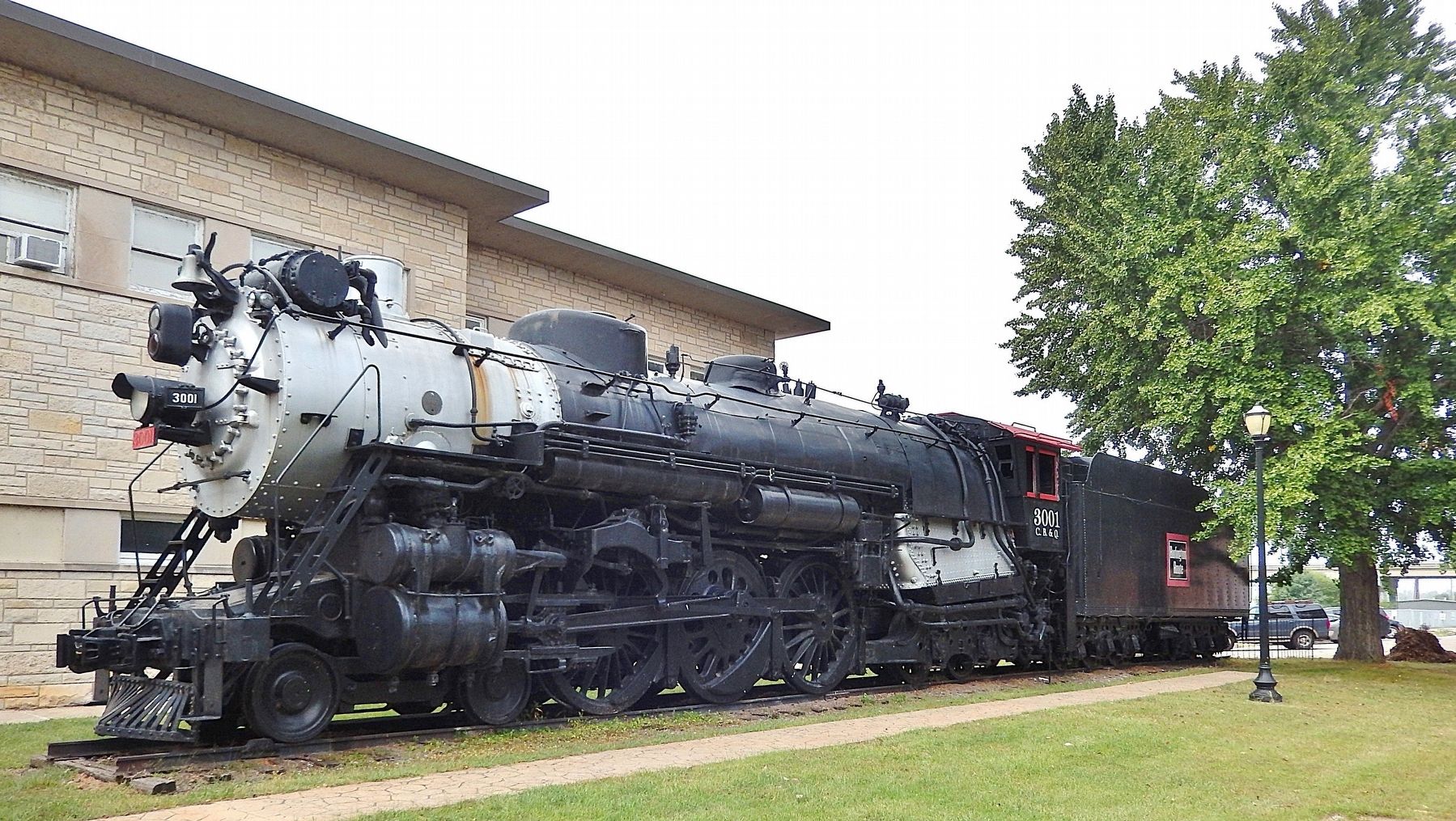
This locomotive was built by the Baldwin Locomotive Works of Eddystone, Pennsylvania and measures 97 feet long (including the tender) by 16 feet high. It is a 4-6-4 design, meaning that it has four pilot wheels, six driving wheels, and four trailing wheels. This design was originally built by the American Locomotive Company (Alco) for the New York Central Railroad and was known as the "Hudson” after the river of the same name.The steam engine, Locomotive #3001, was given to the City of Ottumwa by the CB&Q Railroad
in September 1959, marking the 100th anniversary of the arrival of the first Burlington & Missouri River Railroad train on September 1, 1859. George M. Foster, long-time member of the Park Commission, presided over the dedication of the engine on September 7, 1959.Photographed by Cosmos Mariner, September 21, 20253. Chicago, Burlington & Quincy Locomotive 3001The locomotive is 16 feet tall!The 4-6-4 was an ideal locomotive for fast passenger service in level territory. It was a stable riding engine at speed, and it had sufficient power to rapidly accelerate its train after stops or stretches of slow running. It was used by several railroads operating in the Mid-west, with the Burlington owning fourteen of these locomotives. The 4-6-4 was used for a brief period as diesel locomotives were introduced in the 1930s and replaced steam engines for passenger service in the early 1950s.

Also see . . .
1. CB&Q 4-6-4 Class S-4 3001 (Internet Archive).
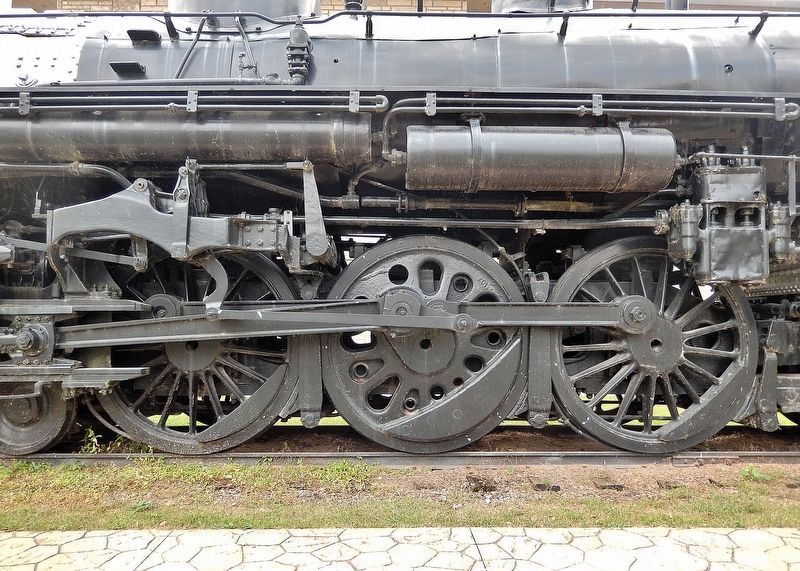
Excerpt: Chicago Burlington & Quincy Railroad 4-6-4 Class S-4 3001 at Barstow, Illinois on August 31, 1958, Kodachrome by unknown photographer, Chuck Zeiler collection. This locomotive was built by Baldwin in 1930 (c/n 61446), one of 12 class S4 4-6-4 types the CB&Q received from Baldwin during that year (#'s(Submitted on March 26, 2026, by Cosmos Mariner of Cape Canaveral, Florida.)3000-3011). The CB&Q built one more S4 (# 3012) at their West Burlington, Iowa shops in 1935 using a boiler supplied by Baldwin. The Burlington thought highly of the S4's, five out of the 13 were donated to various cities on the system, this one was donated to the City of Ottumwa.Photographed by Cosmos Mariner, September 21, 20254. Chicago, Burlington & Quincy Locomotive 3001There are six gigantic 78-inch diameter drive wheels, 3 on each side of the locomotive.
2. CB&Q 3001 on display at the Ottumwa AMTRAK Station (flickr.com).
Excerpt: This a S-4 Hudson class passenger locomotive was the 2nd engine produced by the Baldwin Locomotive Works for the Chicago Burlington & Quincy Railroad [CB&Q]. In 1930 when the steam engine was built it was considered to be state of the art and the ultimate in rail passenger travel. The steam powered engine pulled passenger trains at speeds up to 90 mph and was capable of traveling at speeds of 120 mph.(Submitted on March 26, 2026, by Cosmos Mariner of Cape Canaveral, Florida.)The Hudson 4-6-4 was an improvement from the steam locomotives designed by the American Locomotive Company. It was first used in 1927 by the New York Central. Since the New York Central mainline ran along the mighty Hudson River, the locomotives were given the Hudson name. The locomotives represented
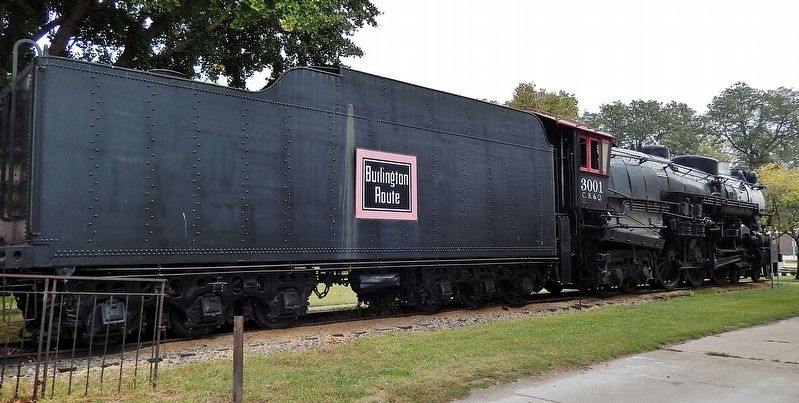
one of the greatest technological achievements of that time. This made possible by the commercial development of the outside bearing four wheel radial, trailing truck, and increased power output from the fireboxes with grate areas so large they had previously been considered impractical. 3001 carried 24 tons of coal and 15,000 gallons of water. It could haul a heavy train 500 miles without replenishing the supply of coal but needed two more 15,000 gallon resupplies of water on such a run. The CB&Q ordered a dozen S-4 Hudson locomotives which were assigned numbers 3000 to 3011.Photographed by Cosmos Mariner, September 21, 20255. Chicago, Burlington & Quincy Tender & Locomotive 3001The tender carries 27 tons of coal and 15,000 gallons of water.
3. 4-6-4 "Hudson" Steam Locomotives in the USA (steamlocomotive.com).
Excerpt: The Chicago, Burlington & Quincy Railroad purchased twelve Hudsons from the Baldwin Locomotive Works in 1930. These 4-6-4's were designated Class S-4 and assigned road numbers 3000 through 3011. The CB&Q also built two Hudsons in its own shops and assigned them road numbers 3012 and 4001. There are four surviving CB&Q Hudsons and they are on display at locations in Iowa, Illinois and Wisconsin.(Submitted on March 26, 2026, by Cosmos Mariner of Cape Canaveral, Florida.)Photographed by Cosmos Mariner, September 21, 20256. Chicago, Burlington & Quincy Locomotive 3001This perspective illustrates the 4-6-4 wheel configuration: 4 leading wheels under the front end (2 on each side of the locomotive), 6 gigantic drive wheels in the middle, and 4 trailing wheels under the back end.

Credits. This page was last revised on March 27, 2026. It was originally submitted on March 25, 2026, by Cosmos Mariner of Cape Canaveral, Florida. This page has been viewed 45 times since then. Photos: 1, 2. submitted on March 26, 2026, by Cosmos Mariner of Cape Canaveral, Florida. 3, 4, 5, 6, 7. submitted on March 27, 2026, by Cosmos Mariner of Cape Canaveral, Florida.
