Belgravia in City of Westminster in Greater London, England, United Kingdom — Northwestern Europe (the British Isles)
Field Marshal Viscount Gort
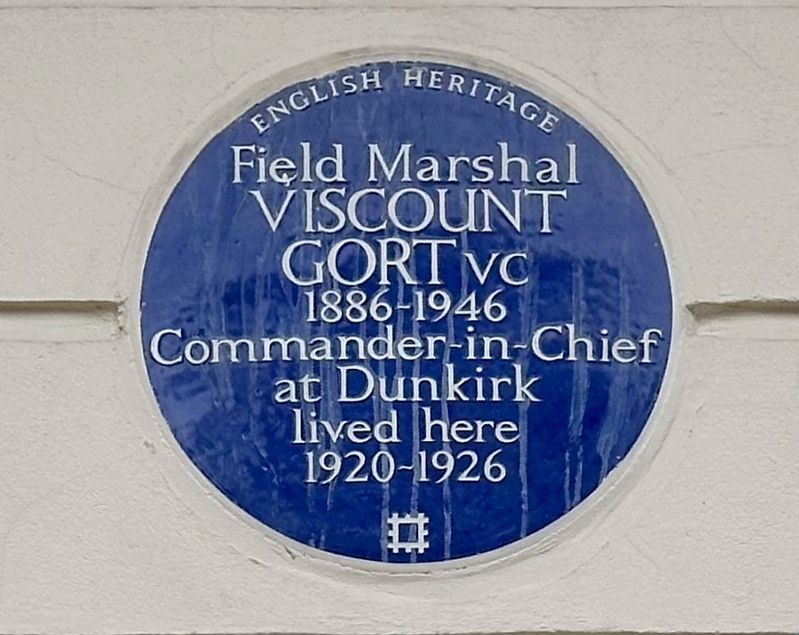
Photographed by Andrew Ruppenstein, March 27, 2026
1. Field Marshal Viscount Gort Marker
Field Marshal Viscount Gort VC
1886-1946
Commander-in-Chief at Dunkirk
lived here 1920-1926
Erected 2005 by English Heritage.
Topics and series. This historical marker is listed in this topic list: War, World II. In addition, it is included in the Victoria Cross and George Cross Recipients series list. A significant historical date for this entry is May 25, 1940.
Location. 51° 29.927′ N, 0° 9.127′ W. Marker is in City of Westminster, England, in Greater London. It is in Belgravia. It is on Belgrave Square west of Upper Belgrave Street, on the left when traveling west. Touch for map. Marker is at or near this postal address: 34 Belgrave Square, City of Westminster, England SW1X 8QB, United Kingdom. Touch for directions.

Regionally, this marker is in London and in the Greater South East. Globally, it is on the Atlantic Ocean, in the North Atlantic Region, in Europe, in Atlantic Europe, on one of the British Isles, in the Western World, and in the Anglosphere. Historically, it finds itself in what was once the Roman Empire.
Other nearby markers. At least 8 other markers are within walking distance of this
this page online
Also see . . . Vereker, John, Viscount Gort, V.C. (1886-1946) (English Heritage). Excerpt on his command at Dunkirk:
Gort was delighted to leave his desk at the War Office to be Commander-in-Chief of the British Expeditionary Force (BEF) to France. ‘Here we go again, marching to war’, he remarked on taking up the appointment in September 1939.(Submitted on March 27, 2026.)
Caught out by a rapid German advance that threatened to encircle the British force, Gort withdrew towards the coast on 25 May 1940, disregarding orders to join French forces in a counter attack. This decision made the subsequent evacuation of some 340,000 British and French troops from Dunkirk possible.
In the circumstances,the wisdom of ordering a retreat is not widely held in doubt: the BEF would otherwise have been annihilated. But the overall failure of the mission led to a widespread belief that Gort was over-promoted. He was not helped, however, by the size of his force, the failings of his French and Belgian allies, poor communications and an uncertain chain of command.Photographed by Andrew Ruppenstein, March 27, 20262. Field Marshal Viscount Gort Marker - wide view

Additional keywords. blue plaque
Credits. This page was last revised on March 27, 2026. It was originally submitted on March 27, 2026, by Andrew Ruppenstein of Lamorinda, California. This page has been viewed 10 times since then. Photos: 1, 2. submitted on March 27, 2026, by Andrew Ruppenstein of Lamorinda, California.
