Ashland in Hanover County, Virginia — The American South (Mid-Atlantic)
Railroad Company Sees Potential For A Town Among The Slash Pines
Ashland Museum Inside Out
Photographed by Bernard Fisher, February 21, 2016
1. Railroad Company Sees Potential For A Town Among The Slash Pines Marker
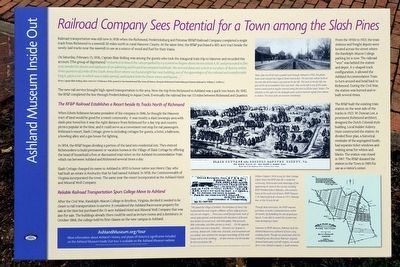
Railroad transportation was still new in 1836 when the Richmond, Fredericksburg and Potomac (RF&P) Railroad Company completed a single track from Richmond to a sawmill 20 miles north in rural Hanover County. At the same time, the RF&P purchased a 482-acre tract beside the newly-laid tracks near the sawmill to use as a source of wood and fuel for their trains.
On Saturday, February 13, 1836, Captain Blair Bolling was among the guests who took the inaugural train trip to Hanover and recorded this account. [The group of dignitaries] “embarked on board the cars propelled by a Locomotive Engine about eleven oclock A.M. and proceeded in fine style amidst the shouts and applause of an admiring and (in part) an amazed multitude. We arrived about one oclock at our place of destiny within three quarters of a mile of the South Anna River where we found a light but neat building, one of the appendages of the railroad and transferrable long it, upon a car, in which was a table spread, and loaded with the finest wines and liquors, …”
(From Captain Blair Bolling, diary entry for 13 February 1836, quoted in One Hundred and Fifty Years of History: Along the Richmond, Fredericksburg & Potomac Railroad by William E. Griffin Jr.)
The
this page online
The RF&P Railroad Establishes a Resort beside Its Tracks North of Richmond
When Edwin Robinson became president of the company in 1846, he thought the Hanover tract of land would be good for a resort community. It was mostly a slash (swampy area with slash pine trees) but it was the right distance from Richmond for a day trip and country picnics popular at the time, and it could serve as a convenient rest stop for rail passengers. Robinson's resort, Slash Cottage, grew to including cottages for guests, a hotel, a ballroom, a bowling alley and a gas house for lighting.
In 1854, the RP&P began dividing a portion of the land into residential lots. They enticed Richmonders to build permanent or vacation homes in the Village of Slash Cottage by offering the head of household a free or discounted train ticket on the Ashland Accommodation Train which ran between
Photographed by Bernard Fisher, February 21, 2016
2. Ashland Railroad Station
Slash Cottage changed its name to Ashland in 1855 to honor native son Henry Clay, who had built an estate in Kentucky that he had named Ashland. In 1858, the Commonwealth of Virginia incorporated the town. The same year the resort incorporated as the Ashland Hotel and Mineral Well Company.
Reliable Railroad Transportation Spurs College Move to Ashland
After the Civil War, Randolph-Macon College in Boydton, Virginia, decided it needed to be closer to rail transportation to survive. It considered the Ashland Racecourse property for sale at the time but purchased the 13-acre Ashland Hotel and Mineral Well Company that was also for sale. The buildings already there could be used as lecture rooms and a dormitory. In October 1868, the college held its first classes on the new campus in Ashland.
From the 1850s to 1923, the train stations and freight depots were located across the street where the Randolph-Macon Coleg parking lot is now. The railroad “wye” was behind the station and depot. A y-shaped track configuration, it allowed the Ashland Accommodation Train to turn around and head back to Richmond. During the Civil War, the station was burned and rebuilt several times.
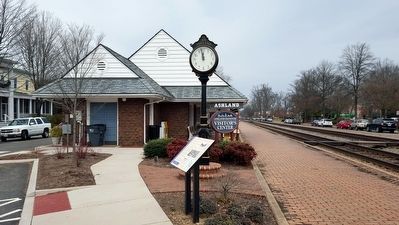
The RF&P built the existing train station on the west side of the tracks in 1923. W. Duncan Lee, a prominent Richmond architect, designed the Dutch Colonial style building. Local builder Aubrey Hunt constructed the station. Its divided floor plan, a historical reminder of the segregated South, had separate ticket windows and waiting areas for whites and blacks. The station was closed in 1967. The RFSP donated the station to the Town in 1985 for use as a visitor's center.
(captions)
Taken after the RF&P laid a parallel track through Ashland in 1903, this photo looks south toward the England Street intersection. The last train station built on the east side of the tracks is pictured at the far left. The track at the far left was part of the Accommodation Train wye track. Also on the left is one of the water towers constructed at regular intervals along the track to fill the trains' boilers. The tall poles on the right are the telegraph poles used to transmit signals from station to station. The short poles are kerosene streetlamps.
“We passed the village of Ashland, ‘the birthplace of Henry Clay,’… It presented the most singular collection of fairy lodging-houses any one can imagine. … There was a small fanciful hotel, built of wood, gaily painted, and decorated with abundance of Brussels lace borders of carved work, with little gables, little pinnacles, little colonnades, and little columns to match. … On the opposite side of the road was a long shed … Around a sort of green or common, dotted with ‘shade trees’ and seats, and everywhere else you looked, were scattered the strangest assemblage of little dolls’ houses and summer dwellings. … all open and airy and al intended for the out-of-doors life … .”
From Life in the South; From the Commencement of the War, by Catherine Cooper Hopley, Volume l, 1863, pp. 235-236.
William Clopton's 1854 survey for Slash Cottage (right) shows the RF&P plan for a residential community. Richmonders took advantage of the opportunity to move to the country including RF&P President Edwin Robinson, who owned a home at the south end of town. RF&P Treasurer C.W. Macmurdo built a home at 713 S. Railroad Ave. on the 10-acre lot #4.
Through deed restrictions, the RF&P required purchasers to build a substantial home within 18 months. By forbidding the sale of spirituous liquors, it was able to control the lucrative bar trade developing in town.
Unknown to RF&P directors, Robinson built the Ashland Racecourse southwest of town using company funds. Though not prosecuted when his embezzling was discovered, Robinson resigned, declared bankruptcy and left Virginia. He would form a new railroad company in South America.
AshlandMuseum.org/tour
More information about Ashland's history and places of historical significance included on the Ashland Museum Inside Out tour is available on the Ashland Museum website.
Ashland Museum Inside Out is funded in part by a grant from CultureWorks championed by Altria.
Erected by The Ashland Museum.
Topics. This historical marker is listed in these topic lists: Industry & Commerce • Railroads & Streetcars. A significant historical date for this entry is February 13, 1836.
Location. 37° 45.564′ N, 77° 28.874′ W. Marker is in Ashland, Virginia, in Hanover County. It is on North Railroad Avenue south of Henry Clay Road, on the left when traveling south. Touch for map. Marker is at or near this postal address: 112 N Railroad Ave, Ashland VA 23005, United States of America. Touch for directions.

Regionally, this marker is in the Piedmont, in Central Virginia, and in the Richmond Metropolitan Area. It is also in the American South, specifically in the Upper South, and on the Eastern Seaboard. Globally, it is in the North Atlantic Region, North America, the Western Hemisphere, the Western World, and the Anglosphere. Historically, it finds itself in what was once the territory of the Mississippian Culture, one of the original Thirteen Colonies, one of the Confederate States of America, and the Antebellum South.
Other nearby markers. At least 8 other markers are within walking distance of this marker: Porters: the Unsung Heroes of Rail Travel (a few steps from this marker); Ashland (within shouting distance of this marker); Secretariat: America's Super Horse and Virginia's Pride (within shouting distance of this marker); Randolph-Macon College (within shouting distance of this marker); Bringing up the Rear (about 400 feet away, measured in a direct line); Downtown Business Growth Fuels Ashland Expansion (about 400 feet away); Railroad Lays Track from Richmond to Washington (about 500 feet away); Electric Train Generates Electricity for Ashland (about 600 feet away). Touch for a list and map of all markers in Ashland.
Also see . . . The Ashland Museum. (Submitted on February 21, 2016.)
Credits. This page was last revised on March 31, 2026. It was originally submitted on February 21, 2016, by Bernard Fisher of Richmond, Virginia. This page has been viewed 988 times since then and 52 times this year. Last updated on March 29, 2026, by Kevin Vincent of Arlington, Virginia. Photos: 1, 2. submitted on February 21, 2016, by Bernard Fisher of Richmond, Virginia. • Devry Becker Jones was the editor who published this page.
