Ottumwa Public Library
In Grateful Memory of James T. Hackworth
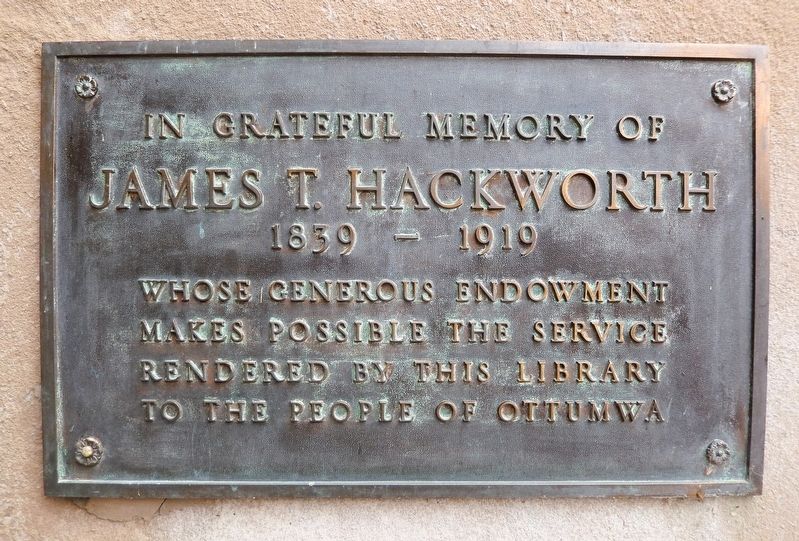
James T. Hackworth
1839-1919
Topics and series. This historical marker is listed in these topic lists: Architecture • Charity & Public Work • Education • Notable Buildings. In addition, it is included in the Carnegie Libraries, and the National Register of Historic Places (NRHP) series lists. A significant historical year for this entry is 1901.
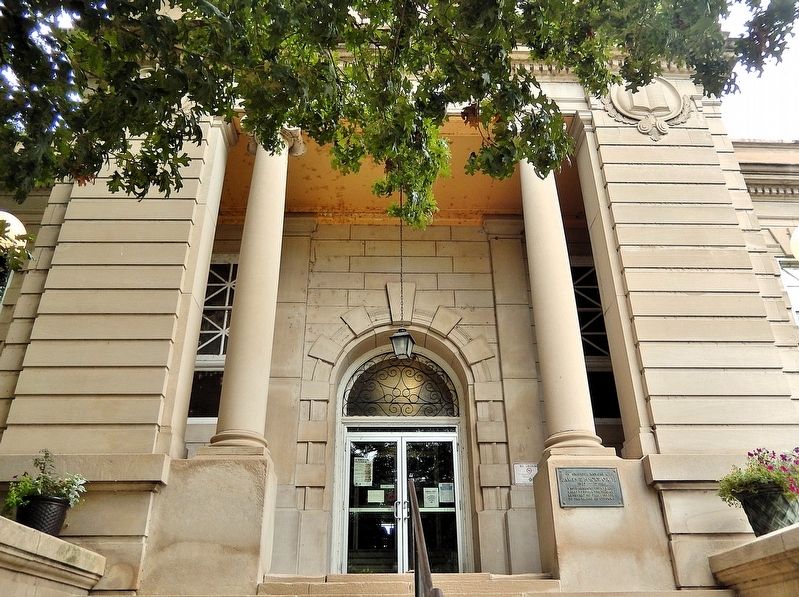
Location. 41° 1.183′ N, 92° 24.676′ W. Marker is in Ottumwa, Iowa, in Wapello County. It can be reached from West 4th Street just west of North Court Street, on the left when traveling west. The marker is mounted directly on the subject building, on the right side of the front entrance. Touch for map. Marker is at or near this postal address: 102 West 4th Street, Ottumwa IA 52501, United States of America. Touch for directions.

Regionally, this marker is in Southern Iowa. It is also in the American Midwest and in the Corn Belt. Globally, it is in North America, the Western Hemisphere, the Western World, and the Anglosphere. Historically,
this page online
Other nearby markers. At least 8 other markers are within walking distance of this marker: Civil War Memorial (within shouting distance of this marker); Ottumwa City Hall (about 300 feet away, measured in a direct line); Philip B. Hofmann (about 700 feet away); Edna Ferber (about 800 feet away); J. B. Sax Co. (approx. 0.2 miles away); J.W. Garner Building (approx. 0.2 miles away); National Humane Alliance Fountain (approx. 0.2 miles away); Depots of Ottumwa (approx. 0.2 miles away). Touch for a list and map of all markers in Ottumwa.
Regarding Ottumwa Public Library. National Register of Historic Places № 84001605.
From the National Register Nomination prepared by Molly Myers Naumann and James E. Jacobsen, 3/6/1984:
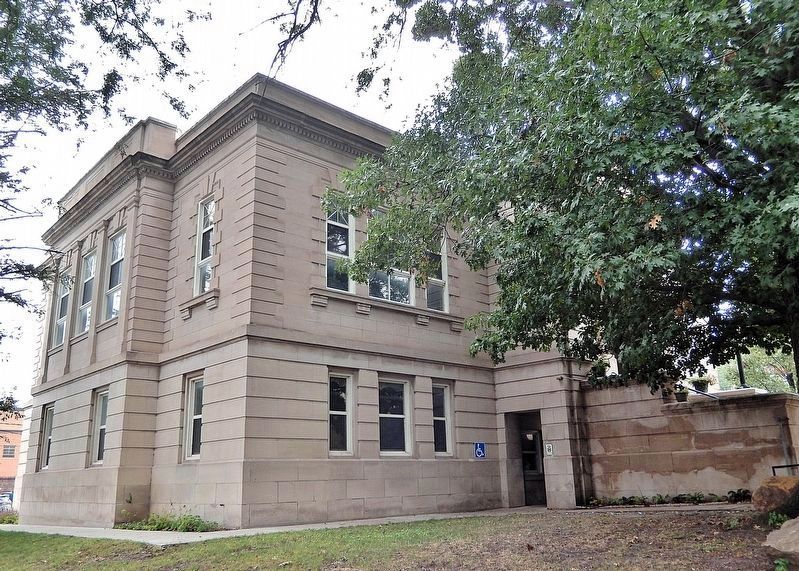
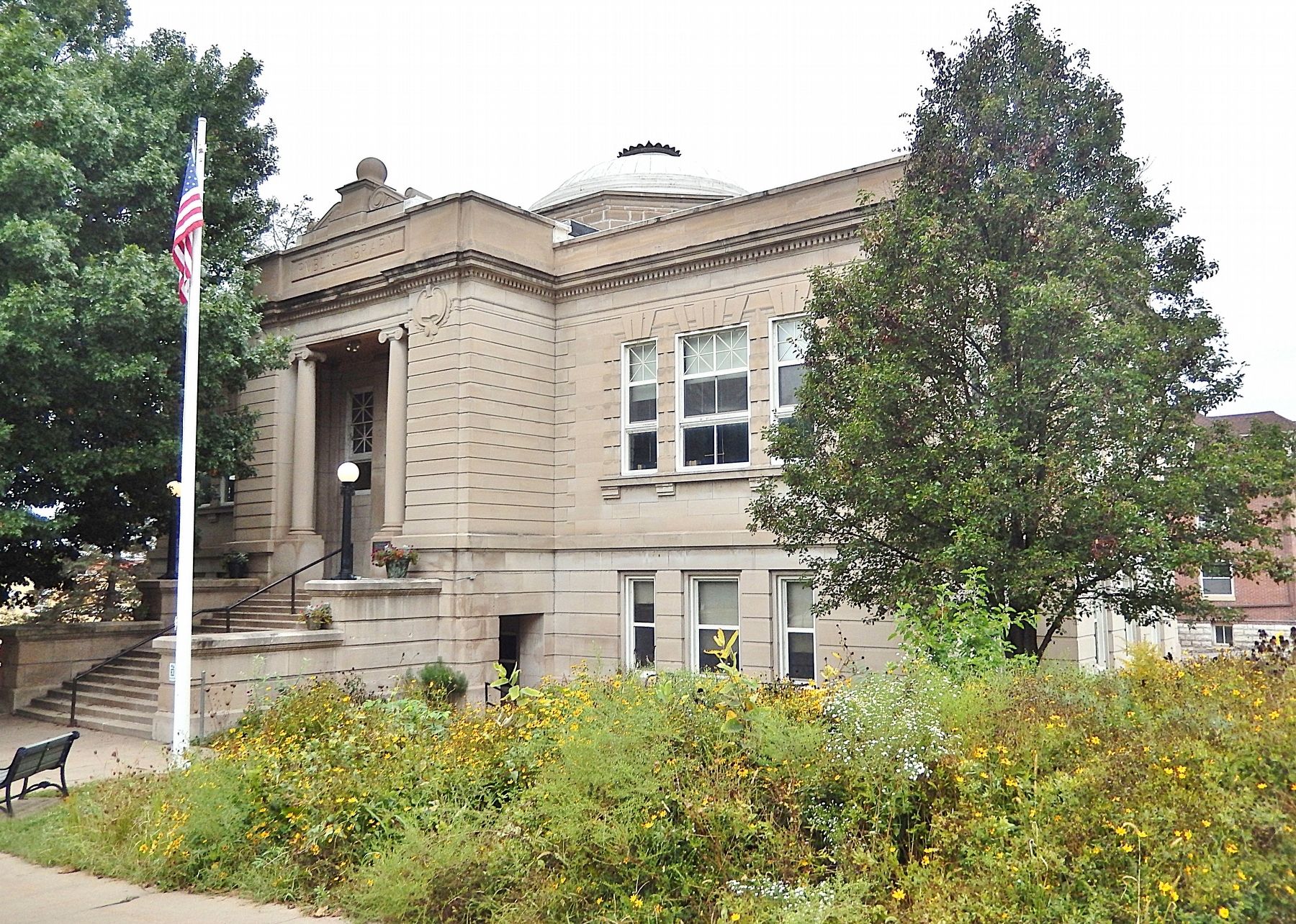
The Ottumwa Public Library (1901) is a fine example of the Classical Revival style. One of 101 Carnegie libraries constructed in Iowa, the relatively unaltered condition of the building speaks to its place of importance within the community and the support it has received over the years. Resting on ahigh foundation, the gray limestone structure (87’ x 61’) has the monumental quality favored for public buildings of the period with its symmetrical facade, projecting entrance, colossal Ionic columns, massive stone staircase, and central dome.Photographed by Cosmos Mariner, September 21, 20252. Ottumwa Public Library MarkerMounted below the column on the right side of the front entrance.The plan by Des Moines architects Smith and Gutterson was selected from a field of fourteen entries in competition for the design of this Carnegie Library. Smith and Gutterson are best known for their designs of the State Historical Building and the Des Moines Public Library but did a number of other important buildings as well. Major decorative elements include the Gibbs-surrounds on the main level openings, the quoined corners, and simple denticulated cornice.
The focal point of the interior is the main level rotunda with its eight Doric columns on polished stone bases. The dome is lit by the original stained-glass skylight. Panels on the four corners of the rotunda feature allegorical figures of Poesia, Historic, Scientia, and Artes. These frescoes were executed in 1909 by German-born artist Johannes Scheiwe. A dome fresco by Scheiwe was destroyed by roof leaks in the 1940's. Just as classical
architecture was deemed the most appropriate for public buildings, so classical subjects were appropriate for their decoration. Surprisingly few alterations have been made to this structure. Following World War II, the tile roof was replaced by shingles, and the diagonal pattern was removed from many windows. The entrance doors were replaced in 1962. Interior alterations have been limited to the unobtrusive installation of an elevator in 1979.Photographed by Cosmos Mariner, September 21, 20253. Ottumwa Public Library (southwest elevation)In 1900 Andrew Carnegie agreed to contribute the sum of $50,000 for the construction of a public library in Ottumwa with his customary stipulation that the community provide the land, and that the City would provide $5,000 per year (10% of the Carnegie amount) for the library. This created a problem. Due to a technicality in state law, first class cities of under 25,000 population had not been given the right to levy taxes for library purposes. Special bills were introduced and passed by both houses of the State Legislature in early 1900 giving Ottumwa the right to levy such taxes.
The Ottumwa Library Association had been formed in 1872 and became an important part of the community. Two prominent
businessmen made substantial financial commitments to the library. Peter G. Ballingall, local philanthropist and major force behind the famed Ottumwa Coal Palace, left a portion of his estate to the perpetuation of the library in 1891. In 1921, J.T. Hackworth provided that his estate should establish a trust for the library. The library budget, even today, is dependent upon the Hackworth Trust for approximately one-third of its funds.Photographed by Cosmos Mariner, September 21, 20254. Ottumwa Public Library (southeast elevation)
Also see . . .
1. Ottumwa Public Library (Wikipedia).
Excerpt: The current building was built in 1902. It is part of the Central Park area, which is the civic center of the community. Local newspaper editor H. R. Moore contacted Andrew Carnegie about providing a grant for a new library building. Carnegie agreed to grant the city of Ottumwa $50,000 on January 16, 1900. The Des Moines architectural firm of Smith and Gutterson was chosen in a contest out of 14 entries to design the building. The new building was dedicated on September 24, 1902, at a program held in the Market Street Theatre. Mary E. Downey was the librarian at the time. Local businessman, J.T. Hackworth, used his estate to establish a trust in 1921 to support the library.(Submitted on March 30, 2026, by Cosmos Mariner of Cape Canaveral, Florida.)The library building is a fine example of the Neo-Classical style. The two-story building rests on a raised basement and is topped by a shallow Roman style dome. It features a symmetrical façade and a projecting portico. The exterior walls are covered in grey Bedford stone that is cut into smooth ashlar blocks. Larger blocks, or quoins, are featured on the corners of the building. The original main doors were replaced c. 1950, but the original iron scrollwork remains in the transom area. The interior of the building has retained its original layout. The rotunda also retains the original tile floor. The hexagonal tiles feature a creamy white center area and blue and grey patterned border.
2. James T. Hackworth (iagenweb.org).
Excerpt: James T. Hackworth won himself a place as a philanthropist in Ottumwa history by his bequest of approximately one-half million dollars to the Ottumwa Public Library, from which the first payment of income was received by that institution on October 9, 1923. He was a prominent businessman of the city during his life and lived here over seventy years. J.T. Hackworth was born in Ohio, January 12, 1839, and when 6 years of age came west with his parents who settled here. He received a law education and was connected with public education in the county. He later became associated with industrial and business enterprises and was very successful. He died April 13, 1919, and his will granted a life estate to his wife, and provided that the entire fortune, with the exception of a few specific bequests, should go to the library after her death. Mrs. Hackworth died July 9, 1921.(Submitted on March 30, 2026, by Cosmos Mariner of Cape Canaveral, Florida.)
Credits. This page was last revised on March 30, 2026. It was originally submitted on March 30, 2026, by Cosmos Mariner of Cape Canaveral, Florida. This page has been viewed 12 times since then. Photos: 1, 2, 3, 4. submitted on March 30, 2026, by Cosmos Mariner of Cape Canaveral, Florida.
