Gloucester Point in Gloucester County, Virginia — The American South (Mid-Atlantic)
Gloucester Point
The 1781 Siege of Yorktown
| — | Colonial National Historical Park | — |
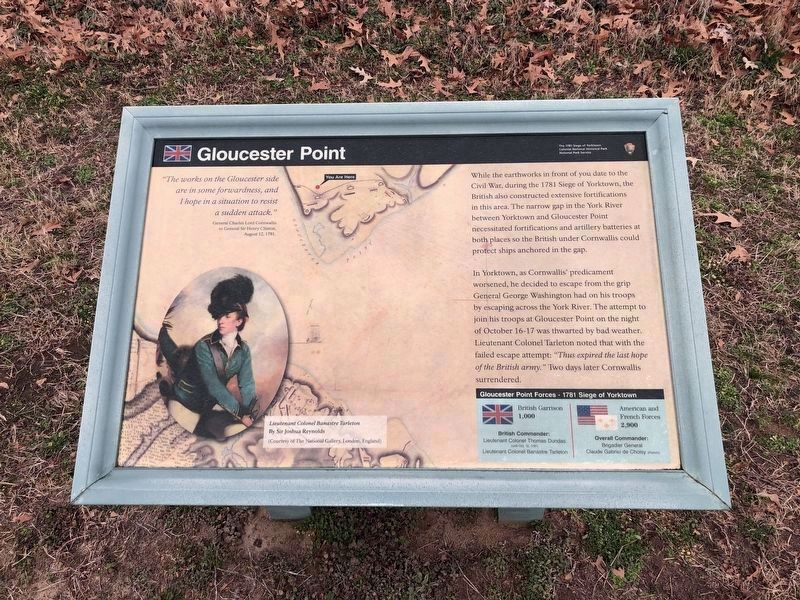
“The works on the Gloucester side are in some forwardness, and I hope a situation to resist a sudden attack.” General Charles Lord Cornwallis to General Sir Henry Clinton, August 12, 1781.
While the earthworks in front of you date to the Civil War, during the 1781 Siege of Yorktown, the British also constructed extensive fortifications in this area. The narrow gap in the York River between Yorktown and Gloucester Point necessitated fortifications and artillery batteries at both places so the British under Cornwallis could protect ships anchored in the gap.
In Yorktown, as Cornwallis’ predicament worsened, he decided to escape from the grip General George Washington had on his troops by escaping across the York River. The attempt to join his troops at Gloucester Point on the night of October 16-17 was thwarted by bad weather. Lieutenant Colonel Tarleton noted that with the failed escape attempt: “Thus expired the last hope of the British army.” Two days later Cornwallis surrendered.
[Sidebar:]
Gloucester Point Forces – 1781 Siege of Yorktown
British Garrison
1,000
British Commander:
Lieutenant Colonel Thomas Dundas (until Oct. 12, 1781)
Lieutenant Colonel Banastre Tarleton
American and French Forces
2,900
Overall Commander:
Brigadier General Claude Gabriel de Choisy (French)
Erected by National
this page online
Topics. This historical marker is listed in this topic list: War, US Revolutionary. A significant historical date for this entry is October 16, 1781.
Location. 37° 15.022′ N, 76° 30.085′ W. Marker is in Gloucester Point, Virginia, in Gloucester County. It is on Vernon Street near Riverview Street, on the right when traveling south. The marker stands at the entrance to Tyndall’s Point Park. Touch for map. Marker is at or near this postal address: 1376 Vernon Street, Gloucester Point VA 23062, United States of America. Touch for directions.

Regionally, this marker is on the Middle Peninsula and in the Hampton Roads Metropolitan Area. It is also in the American South, specifically in the Upper South, in the Tidewater, in the Chesapeake Bay Region, and on the Eastern Seaboard. Globally, it is in the North Atlantic Region, North America, the Western Hemisphere, the Western World, and the Anglosphere. Historically, it finds itself in what was once the territory of the Mississippian Culture, one of the original Thirteen Colonies, one of the Confederate States of America, and the Antebellum
Photographed by Bernard Fisher, May 2, 2009
2. Gloucester Point Marker
This is a prior iteration of the marker.
Other nearby markers. At least 8 other markers are within walking distance of this marker: A different marker also named Gloucester Point (here, next to this marker); Welcome to Gloucester Point (here, next to this marker); Early Land Patent (here, next to this marker); After the Surrender at Yorktown (a few steps from this marker); Where North Meets South (within shouting distance of this marker); Attacking with “Decisive Vigor” (within shouting distance of this marker); Classic Camp Life (within shouting distance of this marker); Parts of a Parrott Rifle (about 300 feet away, measured in a direct line). Touch for a list and map of all markers in Gloucester Point.
Another marker is no longer nearby. Gloucester Point (has been replaced with this marker).
More about this marker. On the lower left is a portrait of "Lieutenant Colonel Banastre Tarleton" By Sir Joshua Reynolds (Courtesy of The National Gallery, London, England)
Photographed by Bernard Fisher, May 2, 2009
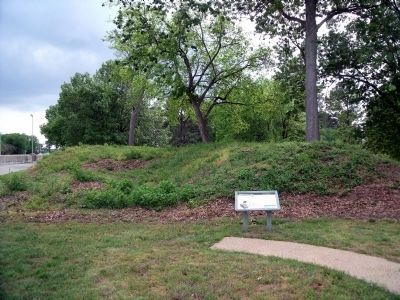
3. Gloucester Point marker in front of earthworks.
Photographed by Bernard Fisher, May 2, 2009
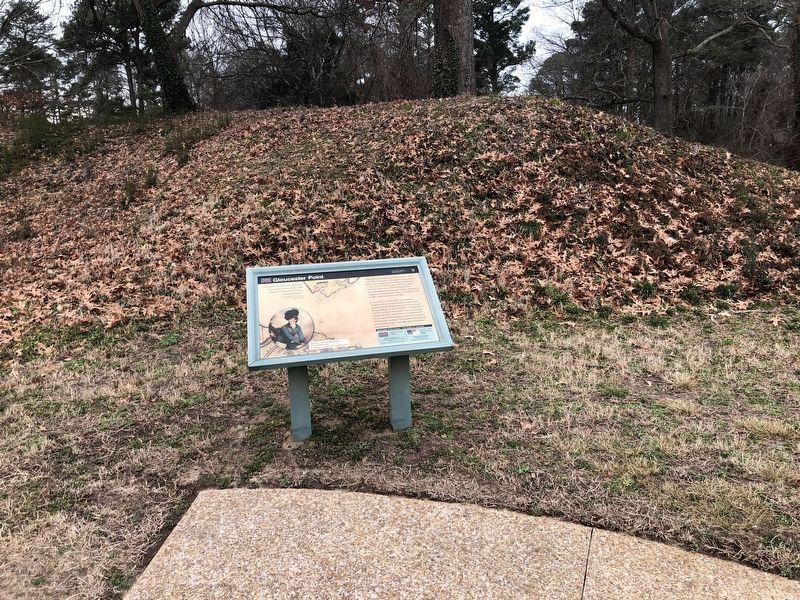
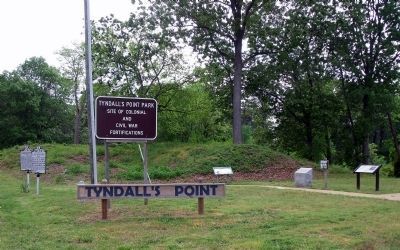
5. Gloucester Point Markers at Tyndall's Point Park.
Credits. This page was last revised on March 31, 2026. It was originally submitted on May 7, 2009, by Bernard Fisher of Richmond, Virginia. This page has been viewed 1,539 times since then and 62 times this year. Last updated on March 30, 2026, by Kevin Vincent of Arlington, Virginia. Photos: 1. submitted on March 1, 2021, by Devry Becker Jones of Washington, District of Columbia. 2, 3. submitted on May 7, 2009, by Bernard Fisher of Richmond, Virginia. 4. submitted on March 1, 2021, by Devry Becker Jones of Washington, District of Columbia. 5. submitted on May 7, 2009, by Bernard Fisher of Richmond, Virginia. • Devry Becker Jones was the editor who published this page.
