Central London in Middlesex County, Ontario — Central Canada (North America)
South-Western Traction Line, 1902-1918
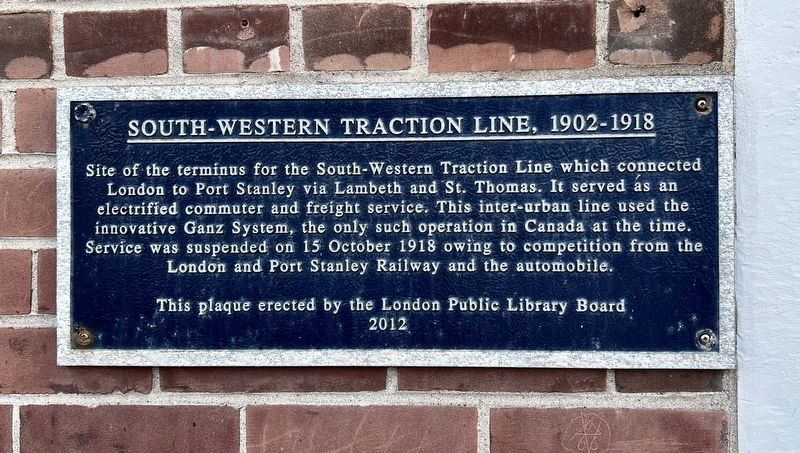
Photographed by Tim Boyd, March 30, 2026
1. South-Western Traction Line, 1902-1918 Marker
Erected 2012 by London Public Library Board.
Topics. This historical marker is listed in this topic list: Railroads & Streetcars. A significant historical date for this entry is October 15, 1918.
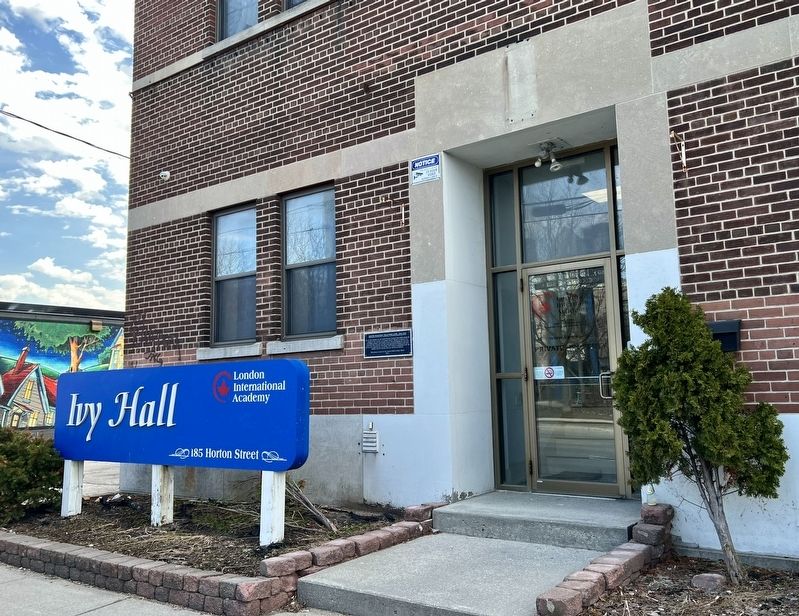
Location. 42° 58.748′ N, 81° 14.779′ W. Marker is in London, Ontario, in Middlesex County. It is in Central London. It is on Horton Street East 0.1 kilometers east of Richmond Street, on the right when traveling east. Touch for map. Marker is at or near this postal address: 185 Horton Street E, London ON N6B 1K8, Canada. Touch for directions.

Regionally, this marker is in the Southwest Ontario Area and in Southwestern Ontario. It is also in Central Canada. Globally, it is in North America, the Western Hemisphere, the Western
this page online
Other nearby markers. At least 8 other markers are within walking distance of this marker: Duffield Block (approx. 0.6 kilometers away); The Industrial Banner (approx. 0.6 kilometers away); London Hydro Shop, 1912 to 1956 (approx. 0.7 kilometers away); 122 Carling Street (approx. 0.7 kilometers away); The Farmer’s Advocate (approx. 0.7 kilometers away); The Gaol and Courthouse, London, c.1843 (approx. 0.7 kilometers away); The Petition of John Ewart (approx. 0.7 kilometers away); Middlesex Court House (approx. 0.7 kilometers away). Touch for a list and map of all markers in London.
Also see . . . The South-Western Traction Company.
The Southwestern Traction Company was headed up by four prominent London residents; former mayor and local business owner Frederick George Rumball, Solicitor Thomas H Purdom, Realtor A.E. Welch and Thomas Luscombe. Three other men from the area composed the remainder of the Board of Directors. Construction(Submitted on April 2, 2026, by Tim Boyd of Hamilton, Ontario.)began in 1903 from London southward to Lambeth. By early 1904, rails had reached Lambeth, and there, the money ran out and construction came to a halt. The company directors travelled to England in an attempt to secure additional funding, and spoke with several potential investors. Their inquiries drew the attention of the Bruce Peebles Company of Edinburgh, Scotland. Peebles was an electrical engineering firm that manufactured generators and traction equipment including electric motors. Peebles & Co. had just secured a license with the Ganz Conmpany of Hungary, another engineering firm, to develop and market their three-phase AC electric traction system.Photographed by Tim Boyd, March 30, 20262. South-Western Traction Line, 1902-1918 Marker
Credits. This page was last revised on April 4, 2026. It was originally submitted on April 2, 2026, by Tim Boyd of Hamilton, Ontario. This page has been viewed 22 times since then. Photos: 1, 2. submitted on April 2, 2026, by Tim Boyd of Hamilton, Ontario. • Andrew Ruppenstein was the editor who published this page.
