
Altstadt in Würzburg, Bavaria, Germany — Central Europe
Neumünster
Photographed by James Hulse, July 14, 2025
1. Neumünster Marker

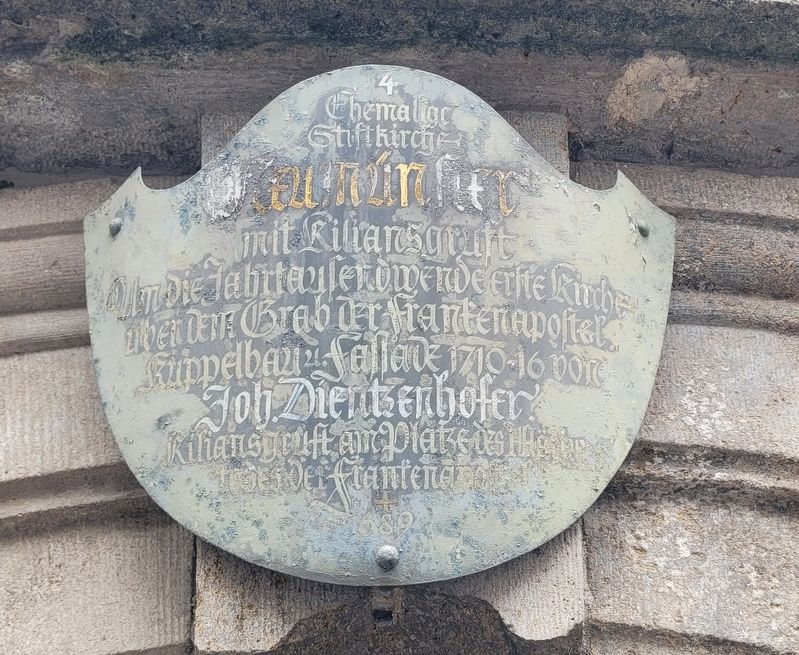
Neumünster
mit Kiliansgruft
Um die Jahrtausendwende erste Kirche
über dem Grab der Frankenapostel,
Kuppelbau u. Fassade 1710–16 von
Joh. Dientzenhofer,
Kiliansgruft am Platze des
Märtyrertodes der Frankenapostel.
† 689
The former collegiate church of Neumünster, with the Kilian crypt, marks the site where around the turn of the millennium the first church stood above the grave of the apostles of the Franks; its dome and façade were built between 1710 and 1716 by Johann Dientzenhofer, and the Kilian crypt stands at the place of the martyrdom of the Frankish apostles († 689). (Marker Number 4.)
Topics. This historical marker is listed in this topic list: Religion & Religious Structures. A significant historical year for this entry is 1710.
Location. 49° 47.636′ N, 9° 55.867′ E. Marker is in Würzburg, Bayern (Bavaria). It is in Altstadt. It is at the intersection of Kürschnerhof and Schmalzmarkt, on the right when traveling north on Kürschnerhof. Touch for map. Marker is at or near this postal address: Kürschnerhof 4, Würzburg BY 97070, Germany. Touch for directions.

Regionally,
this page online
Other nearby markers. At least 8 other markers are within walking distance of this marker: Der Kreuzgang des Neumuensterstiftes / The Cloister of the Neumuenster Seminary (within shouting distance of this marker); Domkirche St. Kilian / Cathedral of St. Kilian (within shouting distance of this marker); Lusam-Gärtlein (within shouting distance of this marker); Lusamgärtchen / Lusam Garden (within shouting distance of this marker); Haus zum Falken / House of the Falcon (about 90 meters away, measured in a direct line); Kaufhaus am Markt / Department Store at the Market (about 90 meters away); Schönbornkapelle / Schönborn Chapel (about 90 meters away); Emy Roeder (about 120 meters away). Touch for a list and map of all markers in Würzburg.
Also see . . . Neumünster, Würzburg. Wikipedia
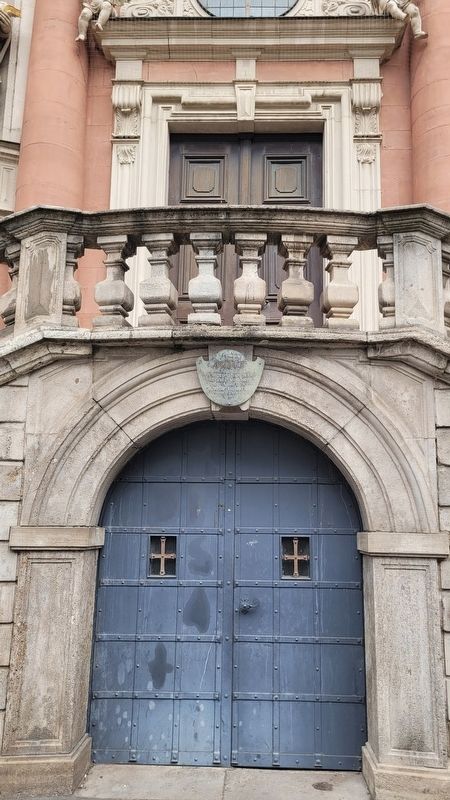
The first church on the site was probably built during the tenure of Meningoz of Würzburg to commemorate the place where the so-called Franconian(Submitted on April 3, 2026, by James Hulse of Medina, Texas.)Apostles, Kilian, Colman, and Totnan, were martyred. Burchard, Meningoz's predecessor, and later Meningoz himself were buried in this church. The monumental inscription on Meningoz's sarcophagus is the oldest post-roman inscription in Franconia.Photographed by James Hulse, July 14, 20252. Neumünster MarkerThe marker is located in front of the entrance to the church.
In 1057, Adalbero of Würzburg founded the college of canons of Neumünster, dedicated to John the Evangelist. The church was completed three years later in the Romanesque style. The church was renovated and expanded from 1180 to 1250.
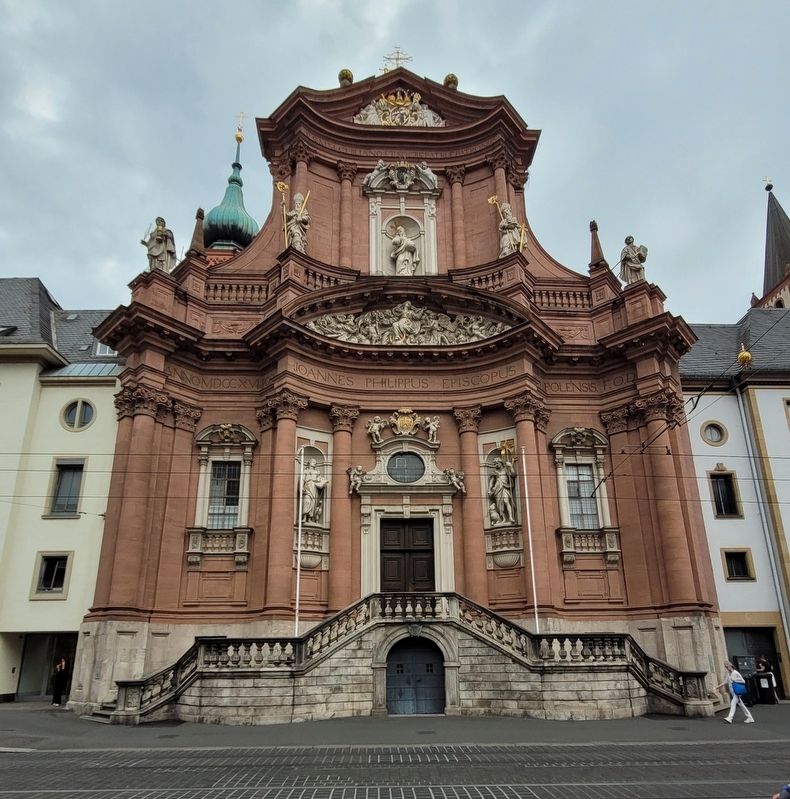
From 1711 to 1716 Josef Greising built the west façade in the Baroque style. From 1725 the interior was redesigned in the baroque style by the brothers Johann Baptist Zimmermann and Dominikus Zimmermann. As a consequence of the German mediatisation, the church was temporarily used as a munitions depot until 1821. The Neumünster first became a parish church, separate from the adjacent Cathedral, in 1908. The parish is dedicated to John the Baptist and John the Evangelist.
The church was heavily damaged in the bombing of Würzburg in 1945, leading to the destruction of much of the church's interior, including the Tilman Riemenschneider busts of the FranconianApostles (afterwards replaced by copies). However, damage was not as severe as that in the Cathedral, so the Neumünster was the seat of the Bishop of Würzburg from 1950 until the Cathedral's reopening in 1967. The Neumünster was once again renovated from 2009 to 2011, some baroque elements were restored and art by modern artists including Michael Triegel and Hann Trier was installed.Photographed by James Hulse, July 14, 20253. Neumünster MarkerThe front of the church.
Credits. This page was last revised on April 3, 2026. It was originally submitted on April 2, 2026, by James Hulse of Medina, Texas. This page has been viewed 8 times since then. Photos: 1, 2, 3. submitted on April 3, 2026, by James Hulse of Medina, Texas.
