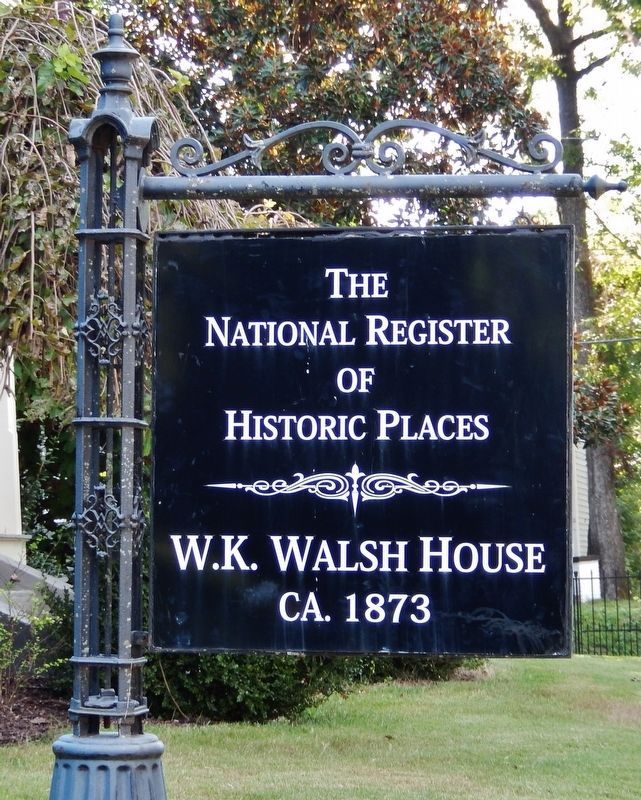
W.K. Walsh House
CA. 1873
———
W.K. Walsh House
CA. 1873
Topics and series. This historical marker is listed in these topic lists: Architecture • Industry & Commerce • Notable Buildings. In addition, it is included in the National Register of Historic Places (NRHP) series list. A significant historical year for this entry is 1873.
Location. 35° 37.188′ N, 88° 48.935′ W. Marker is in Jackson, Tennessee, in Madison County. It is at the intersection of East Deaderick Street and North Cumberland Street, on the left when traveling east on East Deaderick Street. The marker is near the sidewalk on the north side of the house. Touch for map. Marker is at or near this postal address: 204 East Deaderick Street, Jackson TN 38301, United States of America. Touch for directions.

Regionally, this marker is in West Tennessee. It is also in the American South, specifically in the Deep South, and specifically in the Upper South. Globally, it is in North America, the Western Hemisphere, the Western World, and the Anglosphere. Historically, it finds itself in what was once the territory of the Mississippian Culture,
this page online
Other nearby markers. At least 8 other markers are within walking distance of this marker: 428 N. Cumberland (within shouting distance of this marker); Jackson's First Free Library (approx. ¼ mile away); Gil Scott-Heron "Godfather of Rap" (approx. ¼ mile away); Occupation of Jackson (approx. ¼ mile away); 209-217 N. Church (approx. 0.3 miles away); 208 N. Liberty (approx. 0.3 miles away); 320 E Lafayette (approx. 0.3 miles away); 316-318 E. Lafayette (approx. 0.3 miles away). Touch for a list and map of all markers in Jackson.
Regarding W.K. Walsh House. National Register of Historic Places № 93001374.
From the National Register Nomination prepared by John Linn Hopkins, 4/1993:
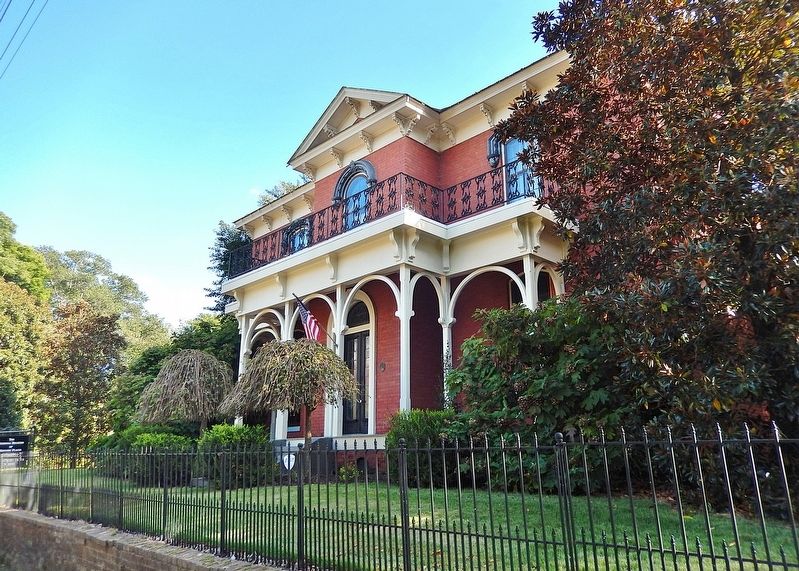
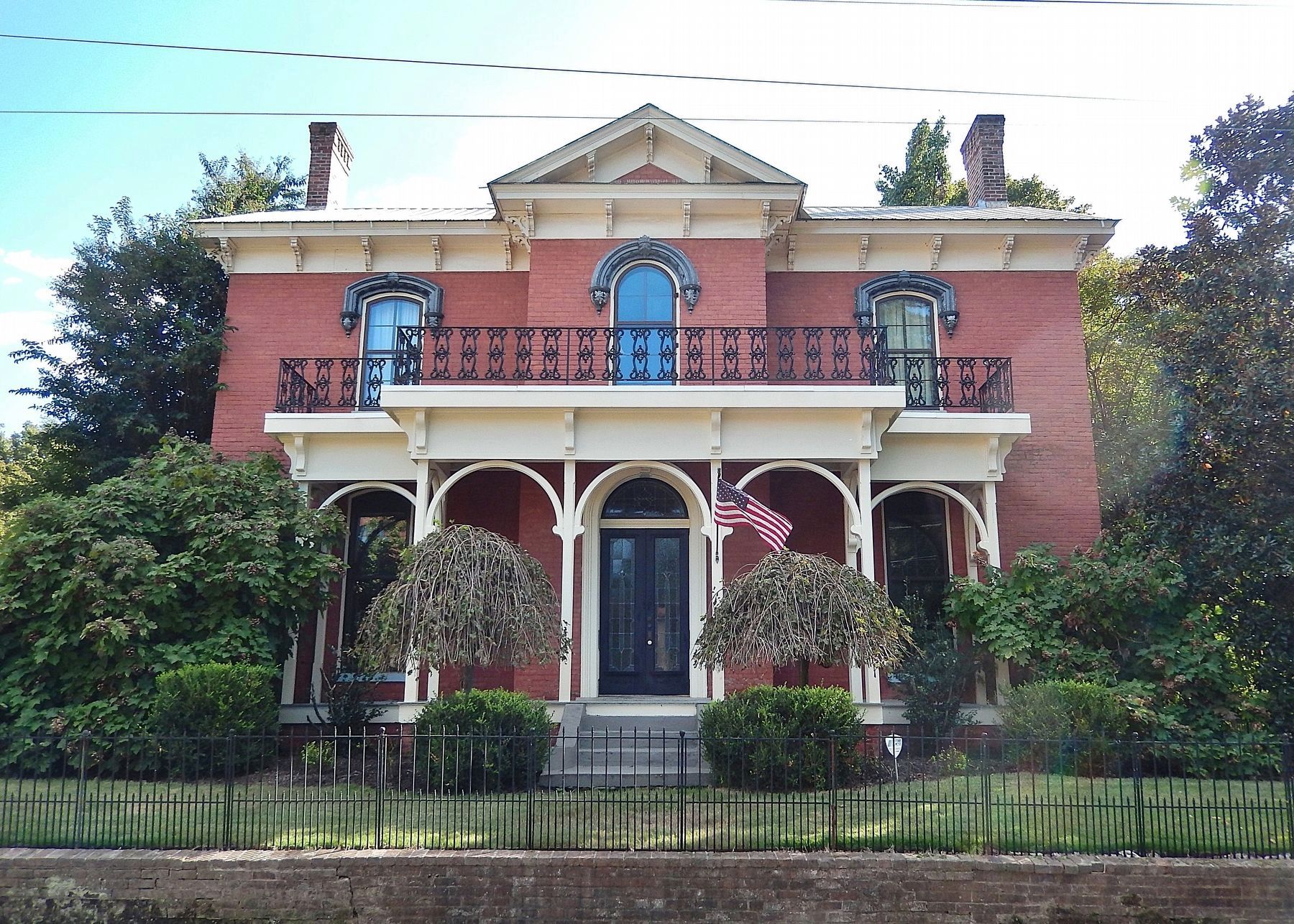
The William Kirby Walsh House was built between 1873 and 1875 as a two-story, three-bay, load-bearing brick masonry, center hall I-house with Italianate influence. The original structure was only one room in depth. Soon after, if not immediately after the construction of the main block, a two-story rear ell was added to the house along the Cumberland Street frontage. Constructionof the ell also included a two-story, wood-framed rear porch along with a one-story, two-room brick "detached" kitchen wing running east of the ell.Photographed by Cosmos Mariner, September 29, 20252. W.K. Walsh House MarkerThe marker is on the front lawn of the William Kirby Walsh House.The original house is a side-gable block with endwall chimneys. Its front (north) facade has a slightly projecting center bay topped with a front-facing pedimented gable end. The deep boxed cornice and entablature are decorated with regularly spaced, built-up scroll-sawn brackets. The original roof was covered with wooden shingles. The recent restoration brought sheet metal roofing to the house. The exterior red brick of the house was originally unpainted; the brick was painted in the ca. 1930s and remains painted today. The upper-story windows of the (front) Deaderick Street facade are outfitted with stuccoed hoods, leafed keystones, and label molds. The entrance is set in a semi-circular arched reveal; it contains a single-light, double-leaf Queen Anne door topped by a fixed-light semi-circular fanlight.
The interior of the Walsh House possesses high-styled trim finishes that remain largely unaltered in spite of alterations for its use as a boarding house. The entrance of the main block
leads to a stair hall containing a two-run, U-shaped stair. The stair has a highly decorated, turned and bracketed balustrade, paneled newels with turned finials, and a wide molded mahogany railing. A curious feature of the hall is a tall, divided door at the middle landing, apparently built originally as a very tall window and altered to a door when the side ell and rear porch were added to the property in the late 1870s.Photographed by Cosmos Mariner, September 29, 20253. Tennessee Historical Commission Marker(on right side of front entrance)
W. K. Walsh House
CA. 1873
National Register of Historic PlacesThe Walsh House is significant for its association with the life and career of William Kirby Walsh (1813-1880), a major figure in mercantile, real estate and banking interests in Jackson, Tennessee in the decades immediately following the Civil War. The property is also architecturally significant as an example of the Italianate style. The quality and exuberance of this house reflected Walsh's important station in the Jackson community at the time of its construction between 1873 and 1875. The significance of William Kirby Walsh in commerce is due to Walsh's important contributions to the prosperity shared in the Jackson economy during the short period between the end of the Civil War and the Yellow Fever epidemics
of 1878 and 1879. Apart from his own business activities as a wholesale grocer and lumber dealer, Walsh was a locally important speculator and developer of real estate in the "new" residential subdivisions to the north and west of the core of Downtown Jackson. Walsh is most notably remembered for his venture with partners J.W. Anderson and Dr. B.R. Harris in forming the Jackson Savings Bank (renamed First National Bank of Jackson in 1874). Walsh served on the Board of Directors from its inception in 1872; he served as its President from 1879 until his death in 1880. The Walsh House is the only historic structure remaining in Jackson that is associated with Walsh during his life and career: this structure served as Walsh's home during the height of his career.Photographed by Cosmos Mariner, September 29, 20254. William Kirby Walsh House (northwest elevation)The Walsh House is one of the few surviving examples of an upper-middle class Italianate dwelling remaining in Jackson today. The quality of its surviving original design, details, and materials is readily apparent, reflective of the prosperity shared by Walsh during the "boom" years of the 1870s; its rehabilitation in 1992 has returned important design traits compromised in previous
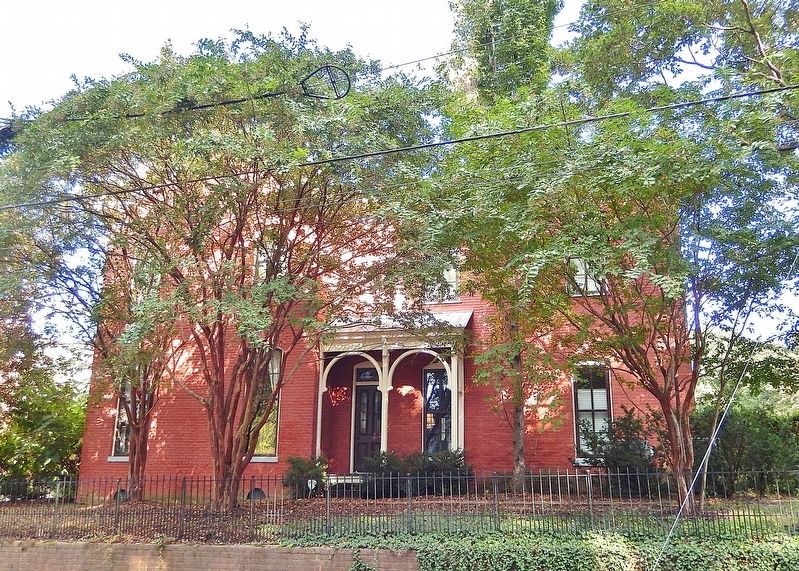
alterations. There are four other Italianate houses of comparable age in Jackson. All five houses share characteristics of brick masonry construction, corbeled window hoods, and bracketed cornices, among other similarities. There does not appear to be evidence that may link these structures by association with a common architect or builder. However, the fact that all are contemporaries of one another suggests that the Italianate was a favored style in the period of new-found prosperity in the Jackson of the 1870s.Photographed by Cosmos Mariner, September 29, 20255. William Kirby Walsh House (west elevation)


Related markers. Click here for a list of markers that are related to this marker.
Also see . . . William Kirby Walsh House (Wikipedia).
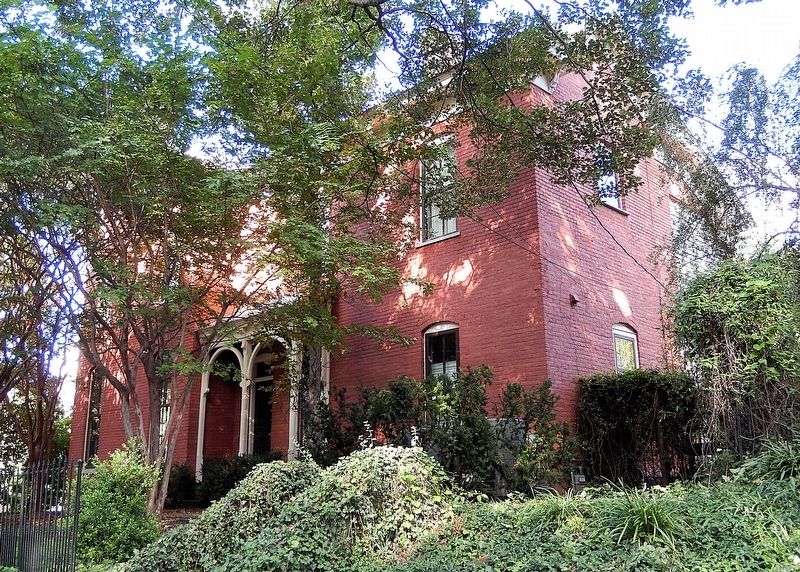
Excerpt: The William Kirby Walsh House was built in 1873-1875 for William Kirby Walsh, a co-founder of the First National Bank of Jackson. It was inherited by his daughter Jennie, who lived here with her husband, Benton O. Sullivan, the part-owner of Sullivan, McCall & Co., a clothing business. The house remained in the Walsh-Sullivan family until Jennie's death in 1935, when it was remodeled into four separate apartments. It has been listed on the National Register(Submitted on April 6, 2026, by Cosmos Mariner of Cape Canaveral, Florida.)of Historic Places since September 10, 1993.Photographed by Cosmos Mariner, September 29, 20256. William Kirby Walsh House (southwest elevation)
Credits. This page was last revised on April 6, 2026. It was originally submitted on April 3, 2026, by Cosmos Mariner of Cape Canaveral, Florida. This page has been viewed 29 times since then. Photos: 1. submitted on April 5, 2026, by Cosmos Mariner of Cape Canaveral, Florida. 2, 3, 4, 5, 6, 7. submitted on April 6, 2026, by Cosmos Mariner of Cape Canaveral, Florida.
