Zellerau in Würzburg, Bavaria, Germany — Central Europe
Festung Marienberg
⎯⎯⎯
Marienberg Fortress
Photographed by James Hulse, July 14, 2025
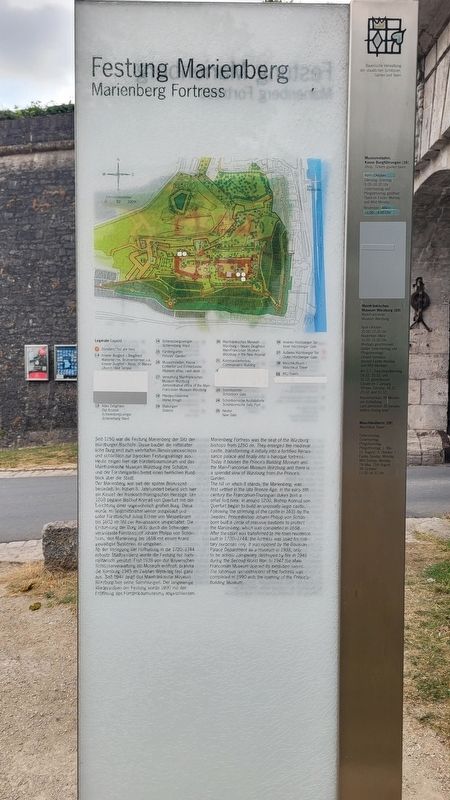
1. Festung Marienberg / Marienberg Fortress Marker

Seit 1250 war die Festung Marienberg der Sitz der Würzburger Bischöfe. Diese bauten die mittelalterliche Burg erst zum wehrhaften Renaissanceschloss und schließlich zur barocken Festungsanlage aus. Heute zeigen hier das Fürstenbaumuseum und das Mainfränkische Museum Würzburg ihre Schätze, und der Fürstengarten bietet einen herrlichen Rundblick über die Stadt.
Der Marienberg war seit der späten Bronzezeit besiedelt. Im frühen 8. Jahrhundert befand sich hier ein Kastell der fränkisch-thüringischen Herzöge. Um 1200 begann Bischof Konrad von Querfurt mit der Errichtung einer ungewöhnlich großen Burg. Diese wurde im Spätmittelalter weiter ausgebaut und unter Fürstbischof Julius Echter von Mespelbrunn bis 1603 im Stil der Renaissance umgestaltet. Die Erstürmung der Burg 1631 durch die Schweden veranlasste Fürstbischof Johann Philipp von Schönborn, den Marienberg bis 1658 mit einem Kranz gewaltiger Bastionen zu umgeben.
Ab der Verlegung der Hofhaltung in die 1720-1744 erbaute Stadtresidenz wurde die Festung nur mehr militärisch genutzt. Erst 1938 von der Bayerischen Schlösserverwaltung als Museum eröffnet, brannte die Kernburg 1945 im Zweiten Weltkrieg fast ganz aus. Seit 1947 zeigt das Mainfränkische Museum Würzburg hier seine Sammlungen. Der langwierige Wiederaufbau der Festung wurde 1990 mit der Eröffnung des Fürstenbaumuseums abgeschlossen.
Marienberg Fortress was the seat of the Würzburg bishops from 1250 on. They enlarged the medieval castle, transforming it initially into a fortified Renaissance palace and finally into a baroque fortress. Today it houses the Prince's Building Museum and the Main-Franconian Museum Würzburg and there is a splendid view of Würzburg from the Prince's Garden.
The hill on which it stands, the Marienberg, was first settled in the late Bronze
this page online
After the court was transferred to the town residence built in 1720-1744, the fortress was used for military purposes only. It was opened by the Bavarian Palace Department as a museum in 1938, only to be almost completely destroyed by fire in 1945 during the Second World War. In 1947 the Main-Franconian Museum opened its exhibition rooms. The laborious reconstruction of the fortress was completed in 1990 with the opening of the Prince's Building Museum.
Erected by Bavarian Administration of State Palaces, Gardens and Lakes.
Topics. This historical marker is listed in this topic list: Forts and Castles. A significant historical year for this entry is 1250.
Location. 49° 47.411′ N, 9° 55.128′ E. Marker is in Würzburg, Bayern (Bavaria). It is in Zellerau. It is on Marienberg
Photographed by James Hulse, July 14, 2025
2. Festung Marienberg / Marienberg Fortress Marker
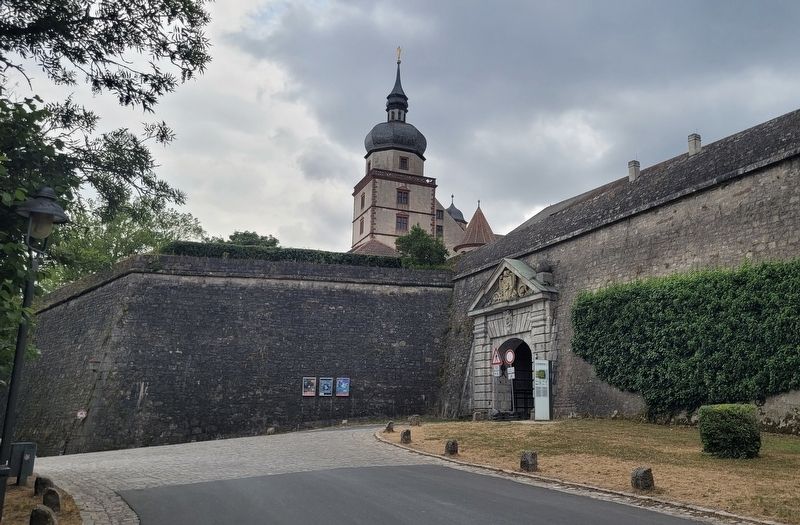
The view of the marker outside the gate entrance to the fortress.

Regionally, this marker is in German Franconia and on the Romantic Road. Globally, it is in Europe, the European Union, Atlantic Europe, Central Europe, the Schengen Area, Western Europe, and the Western World. Historically, it finds itself in what was once the Holy Roman Empire and also the former West Germany.
Other nearby markers. At least 8 other markers are within walking distance of this marker: Zum Gedenken an die Gefallenen / In Memory of the Fallen (a few steps from this marker); The Lower Main Mill (approx. 0.7 kilometers away); Gasthof zum Hirschen / The Inn of the Stag (approx. 0.8 kilometers away); Geschichte des Anwesens / History of this property (approx. 0.8 kilometers away); Norbert Glanzberg (approx. 0.8 kilometers away); Old Cranes (approx. 0.8 kilometers away); Hof Castell (approx. 0.8 kilometers away); Hof "Zum Stachel" / The Mace Inn (approx. 0.8 kilometers away). Touch for a list and map of all markers in Würzburg.
Photographed by James Hulse, July 14, 2025
3. Festung Marienberg / Marienberg Fortress Marker
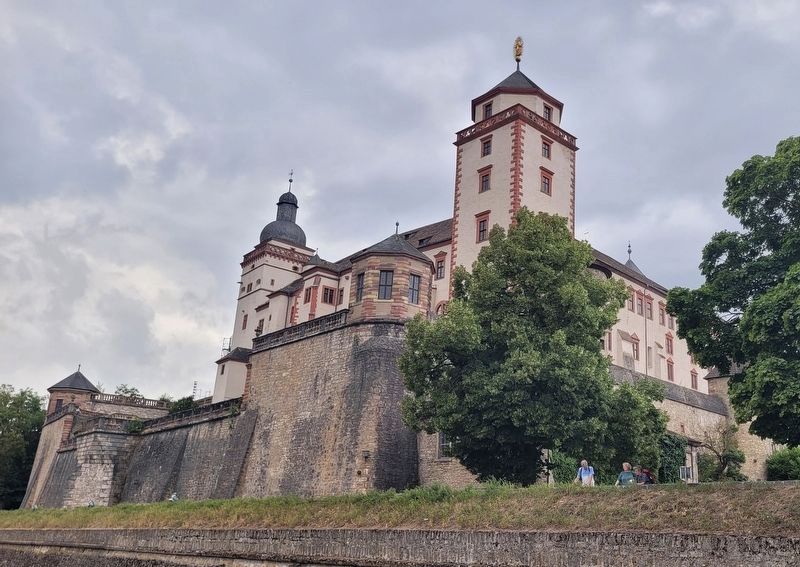
The front view of the fortress from the northeast corner of the fortress grounds.

Photographed by James Hulse, July 14, 2025
4. Festung Marienberg / Marienberg Fortress Marker
The view of the fortress from the Main River.
Credits. This page was last revised on April 5, 2026. It was originally submitted on April 4, 2026, by James Hulse of Medina, Texas. This page has been viewed 18 times since then. Photos: 1, 2, 3, 4. submitted on April 5, 2026, by James Hulse of Medina, Texas.
