
Clapham in Lambeth in Greater London, England, United Kingdom — Northwestern Europe (the British Isles)
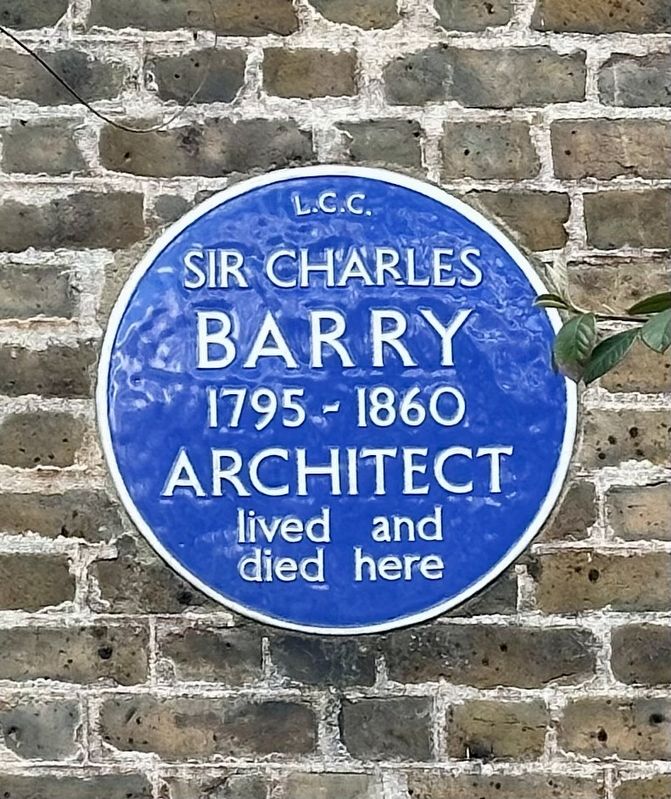
Sir Charles Barry
Photographed by Andrew Ruppenstein, March 28, 2026
1. Sir Charles Barry Marker
Sir Charles Barry
1795-1860
Architect
lived and died here
Erected 1950 by London County Council.
Topics. This historical marker is listed in this topic list: Architecture. A significant historical date for this entry is May 12, 1860.
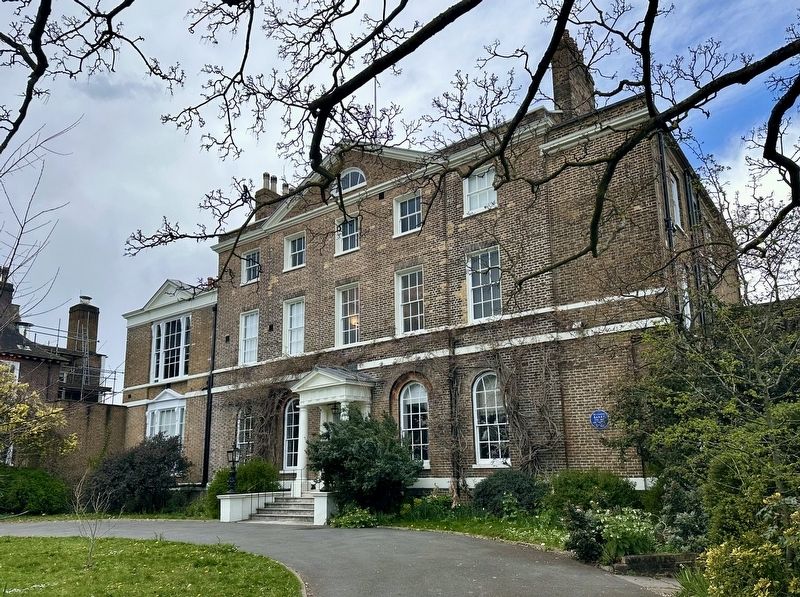
Location. 51° 27.721′ N, 0° 8.738′ W. Marker is in Lambeth, England, in Greater London. It is in Clapham. It is at the intersection of Clapham Common North Side and The Chase, on the right on Clapham Common North Side. Touch for map. Marker is at or near this postal address: 29 Clapham Common North Side, Lambeth, England SW4 0RL, United Kingdom. Touch for directions.

Regionally, this marker is in the Greater South East. Globally, it is on the Atlantic Ocean, in the North Atlantic Region, in Europe, in Atlantic Europe, on one of the British Isles, in the Western World, and in the Anglosphere. Historically, it finds itself in what was once the Roman Empire.
Other nearby markers. At least 8 other markers are within walking distance of this marker: Marie Kendall (within shouting distance of this marker); Graham Greene (about 150 meters away, measured in a direct line); Clapham Parochial School
this page online
Also see . . . Charles Barry (Wikipedia). Overview:
Sir Charles Barry FRS RA (23 May 1795 – 12 May 1860) was an English architect best known for his role in the rebuilding of the Palace of Westminster (also known as the Houses of Parliament) in London during the mid-19th century, but also responsible for numerous other buildings and gardens. He is known for his major contribution to the use of Italianate architecture in Britain, especially the use of the Palazzo as basis for the design of country houses, city mansions and public buildings. He also developed the Italian Renaissance garden style for the many gardens he designed around country houses.(Submitted on April 4, 2026.)
Photographed by Andrew Ruppenstein, March 28, 2026
2. Sir Charles Barry home and marker
Credits. This page was last revised on April 4, 2026. It was originally submitted on April 4, 2026, by Andrew Ruppenstein of Lamorinda, California. This page has been viewed 8 times since then. Photos: 1, 2. submitted on April 4, 2026, by Andrew Ruppenstein of Lamorinda, California.
