Central Business District in New Orleans in Orleans Parish, Louisiana — The American South (West South Central)
James Surls
Me, Knife, Diamond and Flower
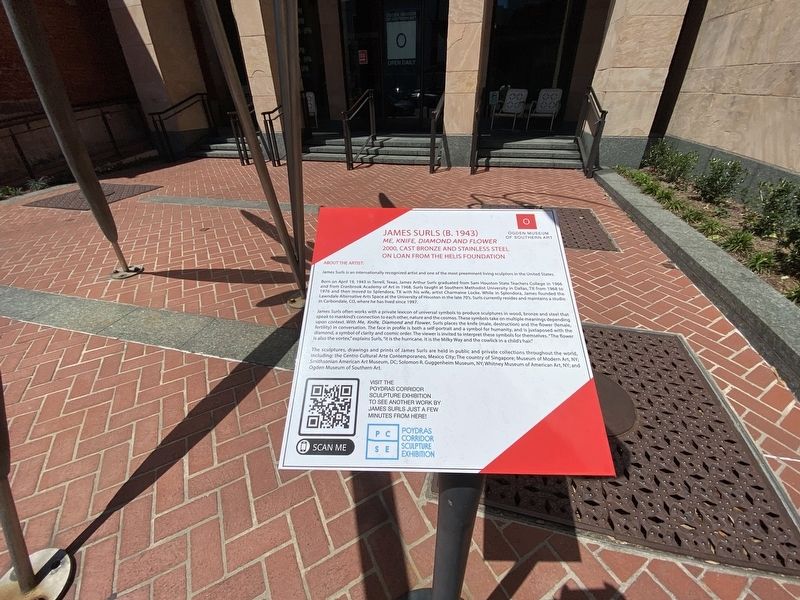
Photographed by Cajun Scrambler, April 12, 2025
1. James Surls Marker
Me, Knife, Diamond and Flower
2000 Cast Bronze and Stainless Steel
On loan from the Helis Foundation
James Surls is an internationally recognized artist and one of the most preeminent living sculptors in the United States.
Born on April 19, 1943 in Terrell, Texas, James Arthur Surls graduated from Sam Houston State Teachers College in 1966 and from Cranbrook Academy of Art in 1968. Surls taught at Southern Methodist University in Dallas, TX from 1968 to 1976 and then moved to Splendora, TX with his wife, artist Charmaine Locke. While in Splendora, James founded the Lawndale Alternative Arts Space at the University of Houston in the late 70's. Surls currently resides and maintains a studio in Carbondale, CO, where he has lived since 1997.
James Surls often works with a private lexicon of universal symbols to produce sculptures in wood, bronze and steel that speak to mankind's connection to each other, nature and the cosmos. These symbols take on multiple meanings depending upon context. With Me, Knife, Diamond and Flower, Surls places the knife (male, destruction) and the flower (female, fertility)
this page online
The sculptures, drawings and prints of James Surls are held in public and private collections throughout the world, including: the Centro Cultural Arte Contemporaneo, Mexico City; The country of Singapore; Museum of Modern Art, NY; Smithsonian American Art Museum, DC; Solomon R. Guggenheim Museum, NY; Whitney Museum of American Art, NY; and Ogden Museum of Southern Art.
Erected by Poydras Corridor Sculpture Exhibition.
Topics. This historical marker is listed in this topic list: Arts, Letters, Music.
Location. 29° 56.615′ N, 90° 4.268′ W. Marker is in New Orleans, Louisiana, in Orleans Parish. It is in the Central Business District. It is on Camp Street. Touch for map. Marker is at or near this postal address: 900 Camp St,
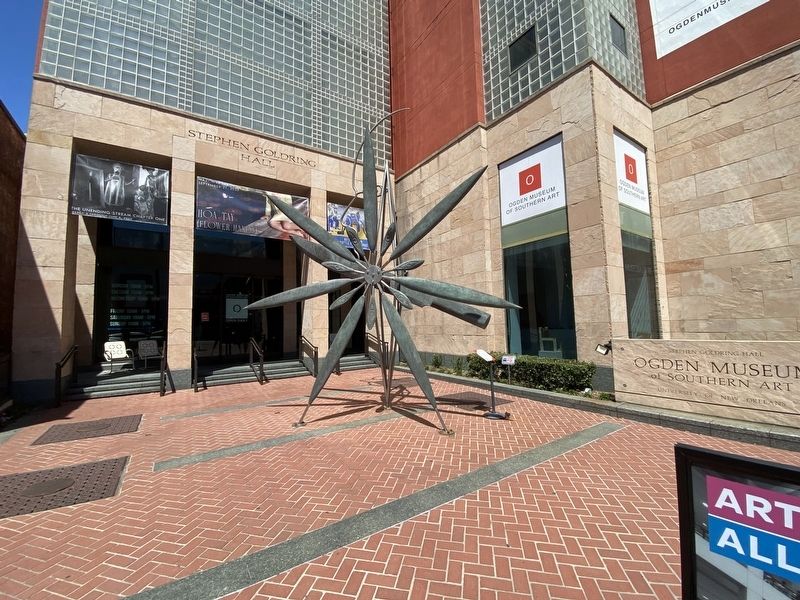
Photographed by Cajun Scrambler, April 12, 2025
2. James Surls Marker

Regionally, this marker is in one of Louisiana’s River Parishes. It is also in the American South, specifically in the Deep South, on the Gulf Coast, and in the Great River Road Region. Globally, it is in North America, a Gulf of Mexico state, the Western Hemisphere, the Western World, and the Anglosphere. Historically, it finds itself in what was once New Spain, the Viceroyalty of New France, the territory of the Mississippian Culture, the Louisiana Purchase, one of the Confederate States of America, and the Antebellum South.
Other nearby markers. At least 8 other markers are within walking distance of this marker: 8 in. Columbaid Cannon (a few steps from this marker); Confederate Memorial Hall (a few steps from this marker); Memorial Hall (a few steps from this marker); Atlantic Wall Fragments (about 300 feet away, measured in a direct line); The Beginning (about 300 feet away); Julia Row (about 800 feet away); Starting Point of the First Traditional New Orleans Mardi Gras Parade (approx. 0.2 miles away); The 747 (approx. 0.2 miles away). Touch for a list and map of all markers in New Orleans.
Other markers no longer nearby. Robert E. Lee (was about 400 feet away but has been permanently removed); St. Charles Line (was about 500 feet away but has been confirmed missing).
Credits. This page was last revised on April 5, 2026. It was originally submitted on April 5, 2026, by Cajun Scrambler of Assumption, Louisiana. This page has been viewed 19 times since then. Photos: 1, 2. submitted on April 5, 2026, by Cajun Scrambler of Assumption, Louisiana.
