Schwandorf, Bavaria, Germany — Central Europe
Hierl Haus
⎯⎯⎯
Hierl House
Photographed by James Hulse, March 20, 2026
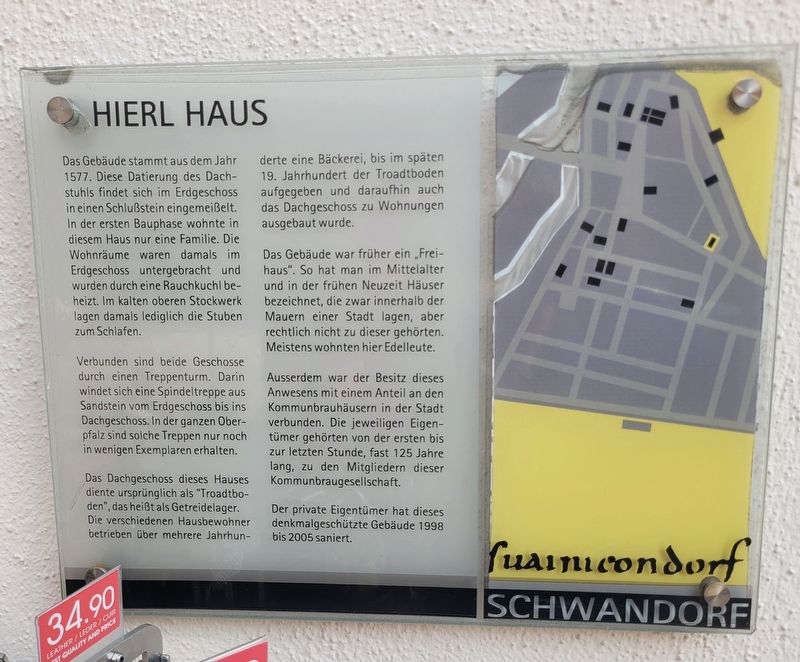
1. Hierl Haus / Hierl House Marker

Das Gebäude stammt aus dem Jahr 1577. Diese Datierung des Dachstuhls findet sich im Erdgeschoss in einen Schlussstein eingemeißelt. In der ersten Bauphase wohnte in diesem Haus nur eine Familie. Die Wohnräume waren damals im Erdgeschoss untergebracht und wurden durch eine Rauchküche beheizt. Im kalten oberen Stockwerk lagen damals lediglich die Stuben zum Schlafen.
Verbunden sind beide Geschosse durch einen Treppenturm. Darin windet sich eine Spindeltreppe aus Sandstein vom Erdgeschoss bis ins Dachgeschoss. In der ganzen Oberpfalz sind solche Treppen nur noch in wenigen Exemplaren erhalten.
Das Dachgeschoss dieses Hauses diente ursprünglich als „Troadtboden“, das heißt als Getreidelager. Die verschiedenen Hausbewohner betrieben über mehrere Jahrhunderte eine Bäckerei, bis im späten 19. Jahrhundert der Troadtboden aufgegeben und daraufhin auch das Dachgeschoss zu Wohnungen ausgebaut wurde.
Das Gebäude war früher ein „Freihäus“. So hat man im Mittelalter und in der frühen Neuzeit Häuser bezeichnet, die zwar innerhalb der Mauern einer Stadt lagen, aber rechtlich nicht zu dieser gehörten. Meistens wohnten
this page online
Außerdem war der Besitz dieses Anwesens mit einem Anteil an den Kommunbrauhäusern in der Stadt verbunden. Die jeweiligen Eigentümer gehörten von der ersten bis zur letzten Stunde, fast 125 Jahre lang, zu den Mitgliedern dieser Kommunbraugesellschaft.
Der private Eigentümer hat dieses denkmalgeschützte Gebäude von 1998 bis 2005 saniert.
The building dates from 1577. This dating of the roof structure is carved into a keystone on the ground floor. In its earliest phase, only one family lived in the house. The living quarters were located on the ground floor and were heated by a smoke kitchen. The cold upper floor contained only rooms for sleeping.
The two floors are connected by a stair tower. Within it, a spiral staircase made of sandstone winds from the ground floor up to the attic. Such staircases are now rare throughout the Upper Palatinate.
The attic of this house originally served as a “Troadtboden,” meaning a grain storage loft. Over several centuries, the occupants operated a bakery, until in the late 19th century the grain loft was abandoned and the attic was converted into
Photographed by James Hulse, March 20, 2026
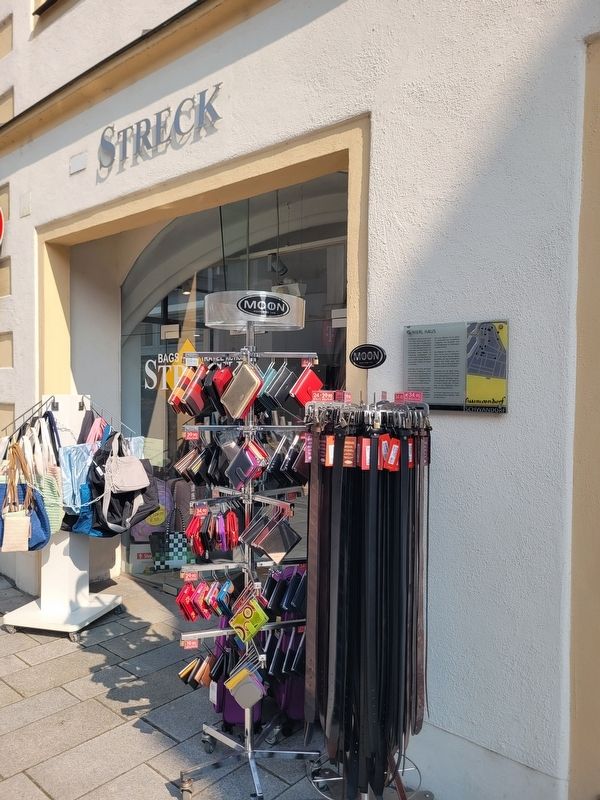
2. Hierl Haus / Hierl House Marker
The marker is located in front of a store.
The building was formerly a “Freihäus.” In the Middle Ages and early modern period, this term referred to houses located within a city’s walls but not legally belonging to it. Such houses were usually inhabited by members of the nobility.
Ownership of this property was also tied to a share in the communal brew houses of the town. The successive owners belonged, for nearly 125 years, to the members of this communal brewing society.
The private owner restored this listed historic building between 1998 and 2005.
Topics. This historical marker is listed in this topic list: Notable Buildings. A significant historical year for this entry is 1577.
Location. 49° 19.717′ N, 12° 6.481′ E. Marker is in Schwandorf, Bayern (Bavaria). It is at the intersection of Friedrich-Ebert-Straße and Spitzwegstraße, on the right when traveling north on Friedrich-Ebert-Straße. Touch for map. Marker is at or near this postal address: Friedrich-Ebert-Str 15, Schwandorf BY 92421, Germany. Touch for directions.

Regionally, it is in Europe, the European Union, Atlantic Europe, Central Europe, the Schengen Area, Western Europe, and the
Photographed by James Hulse
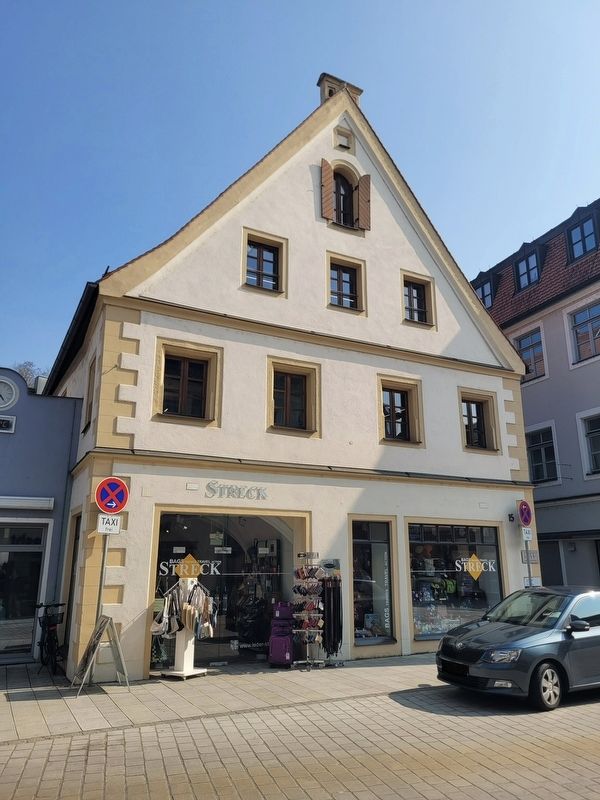
3. Hierl Haus / Hierl House Marker
The view of the building with the marker hidden behind the rack of belts.
Other nearby markers. At least 8 other markers are within walking distance of this marker: Jakob Friedmann (a few steps from this marker); Bruno Friedmann (a few steps from this marker); Amanda Friedmann (a few steps from this marker); Georg Friedmann (a few steps from this marker); Lilian Berta Friedmann (a few steps from this marker); Gustav Karl (within shouting distance of this marker); Ernestine Kohner (within shouting distance of this marker); Camilla Karl (within shouting distance of this marker). Touch for a list and map of all markers in Schwandorf.
Credits. This page was last revised on April 8, 2026. It was originally submitted on April 7, 2026, by James Hulse of Medina, Texas. This page has been viewed 17 times since then. Photos: 1, 2, 3. submitted on April 8, 2026, by James Hulse of Medina, Texas.
