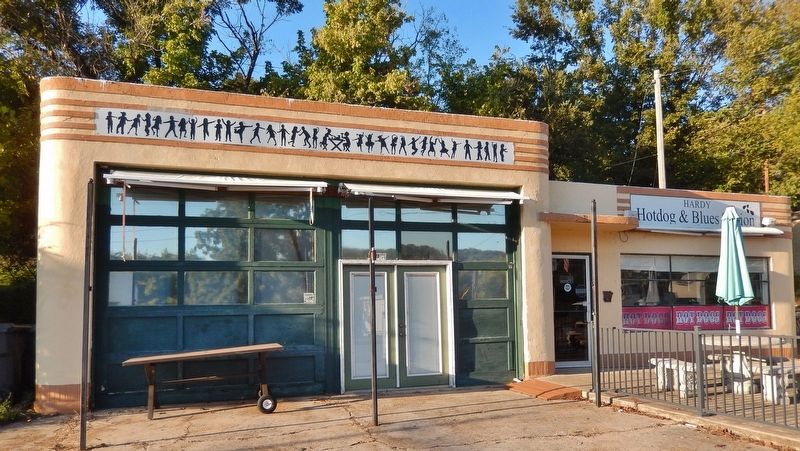
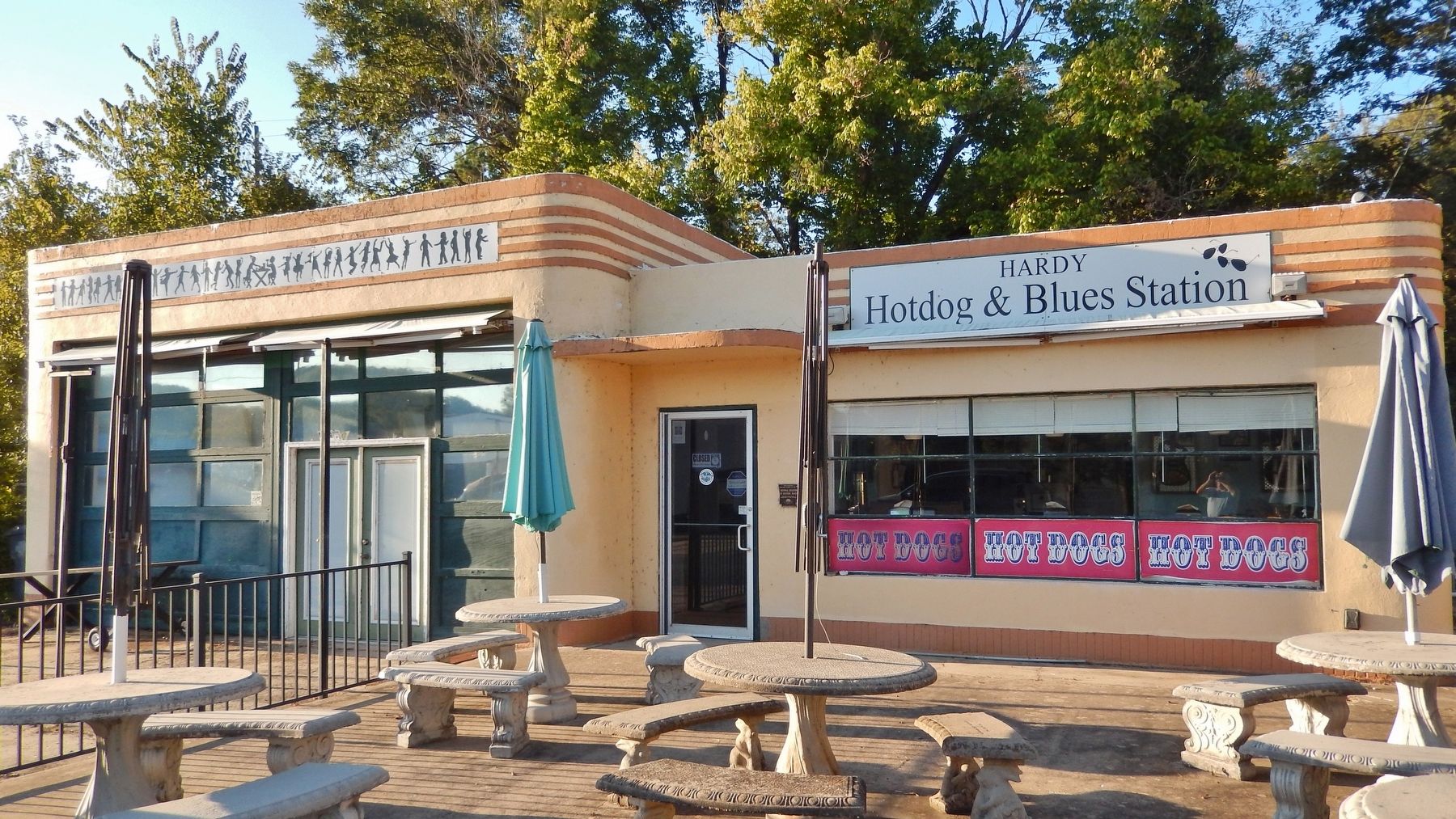
Art Moderne Service Station
302 East Main Street
| — | Hardy Downtown Historic District | — |
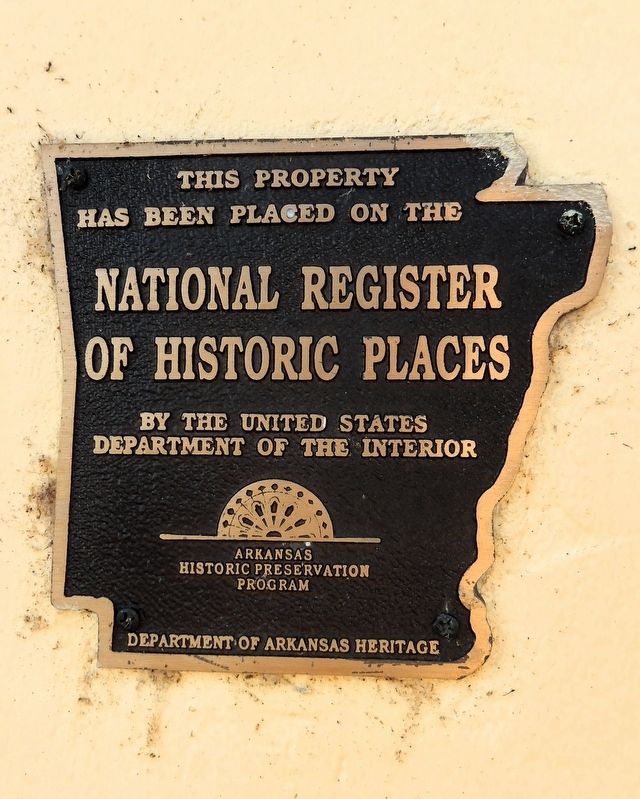
This property has been placed on the
National Register of Historic Places
by the United States Department of the Interior
Erected by Arkansas Historic Preservation Program, Department of Arkansas Heritage.
Topics and series. This historical marker is listed in these topic lists: Architecture • Industry & Commerce • Notable Buildings. In addition, it is included in the National Register of Historic Places (NRHP) series list. A significant historical year for this entry is 1949.
Location. 36° 18.953′ N, 91° 28.775′ W. Marker is in Hardy, Arkansas, in Sharp County. It is on Main Street (Business U.S. 63) just east of Kelly Avenue, on the left when traveling east. The marker is mounted directly on the front/south facade of the subject building. Touch for map. Marker is at or near this postal address: 302 East Main Street, Hardy AR 72542, United States of America. Touch for directions.

Regionally, this marker is on the Ozark Plateau. It is also in the American South, specifically in the Upper South, and in the Ozarks. Globally, it is in North America, the Western Hemisphere, the Western World, and the Anglosphere.
this page online
Other nearby markers. At least 8 other markers are within walking distance of this marker: Sharp County Court House (about 300 feet away, measured in a direct line); Thompson Store (about 500 feet away); Johnston Drug Store Building (about 500 feet away); Veterans Memorial (about 600 feet away); Snow Building (about 600 feet away); Tompkins Motor Company Building (about 600 feet away); 126 East Main Street (about 600 feet away); Sam Young Building (about 700 feet away). Touch for a list and map of all markers in Hardy.
Regarding Art Moderne Service Station. Contributing property, Hardy Downtown Historic District, National Register of Historic Places № 95001121.
From the National Register Nomination prepared by Kenneth Story, Arkansas Historic Preservation Program, 8/8/1995:
The intact historic fabric of downtown Hardy includes storefront buildings, separate commercial structures of various types and vintages, and a small number of significantresidential buildings that are included because of their role in the unique character of Hardy's historic commercial district. The historic buildings range from one to three stories in height. Most of the buildings are of masonry construction, with brick and native stone being the materials of choice. A few wood frame buildings survive, as do some historic formed concrete block structures. The stone buildings frequently display grapevine mortaring and are built of fieldstone. The brick buildings are usually of red brick, though some buff brick buildings are found also, and their parapets often contain a simple, recessed signage panel.Photographed by Cosmos Mariner, September 26, 20252. Art Moderne Service Station MarkerThe marker is on the right side of the front entrance.The historic core of Hardy, Arkansas is located on the north bank of the Spring River, with its commercial axis formed by the railroad tracks (first the Kansas City, Ft. Scott and Memphis Railroad, then the St. Louis and San Francisco (“Frisco”) and now the Burlington and Northern) and Main Street, both of which run parallel to the river. The community of Hardy was founded in the early 1880s, after the arrival of the railroad, and grew to become the county seat of the northern district of Sharp County
in 1891, with the new courthouse being completed by 1894. By the turn of the century Hardy became a rather busy resort town, largely due to the popularity of the recreational and fishing opportunities afforded by the Spring River.Photographed by Cosmos Mariner, September 26, 20253. Art Moderne Service Station (southwest elevation)A side-effect of the early twentieth century development of Hardy as a resort community was the construction of various types of buildings designed to shelter the resulting service industries. Such construction included general mercantile buildings, hotels, gas stations and tourist courts. This was particularly true during the period after World War I, with the dramatic growth in popularity of the automobile. The growth and expansion of downtown Hardy continued throughout the 1920’s but slowed during the Depression and World War II.
The Hardy Historic Commercial District remains one of the last examples of the small resort community in Arkansas and how it developed. Historical accounts of other resort communities throughout the state — most of which have long since disappeared — relate how many resort communities began simply as settlements organized around a spring or river and composed largely of private
farmsteads. These communities took on a resort character only after the dramatic growth nationally of the spa "craze" and the widely held belief that waters — particularly mineral waters — held medicinal qualities that could heal any number of maladies and afflictions.Photographed by Cosmos Mariner, September 26, 20254. Art Moderne Service Station (southeast elevation)

Also see . . .
1. Hardy Downtown Historic District Walking Tour (arkansasheritage.com).
(By Rachel Silva, 6/11/2016) Excerpt:(Submitted on April 8, 2026, by Cosmos Mariner of Cape Canaveral, Florida.)
Art Moderne service station, 302 East Main Street (today: Hardy Hot Dog & Blues Station)
The present Art Moderne-style service station was constructed in 1949. The Art Moderne style became popular in the 1930s and imitated the design of modern machines, emphasizing the importance of new technology. Buildings in the style usually featured rounded corners, flat roofs, and horizontal grooves or lines in the walls.This was Ralph Hall’s Service Station, followed by Carpenter’s, Lute’s, and Josh Oiler’s stations, and Wilson’s Texaco. It was then owned by Mary Jo Higginbotham and used as storage for Higginbotham Funeral Home next door. The station was restored in 2013.
2. Hardy Downtown Historic District (Wikipedia).
Excerpt: The Hardy Downtown Historic District encompasses most of the central business district of the resort community of Hardy, Arkansas. It extends along Main Street, between Church and Cope Streets, and includes a few buildings on adjacent streets. Hardy was founded as a railroad town in the 1880s but grew by the end of the 19th century into a resort community, serving as commercial center for vacationers from Memphis, Tennessee. The district was listed on the National Register of Historic Places in 1995.(Submitted on April 8, 2026, by Cosmos Mariner of Cape Canaveral, Florida.)
Credits. This page was last revised on April 8, 2026. It was originally submitted on April 7, 2026, by Cosmos Mariner of Cape Canaveral, Florida. This page has been viewed 21 times since then. Photos: 1, 2, 3, 4. submitted on April 8, 2026, by Cosmos Mariner of Cape Canaveral, Florida.
