Schwandorf, Bavaria, Germany — Central Europe
Stadtmauerturm
⎯⎯⎯
City Wall Tower
Photographed by James Hulse, March 20, 2026
1. Stadtmauerturm / City Wall Tower Marker

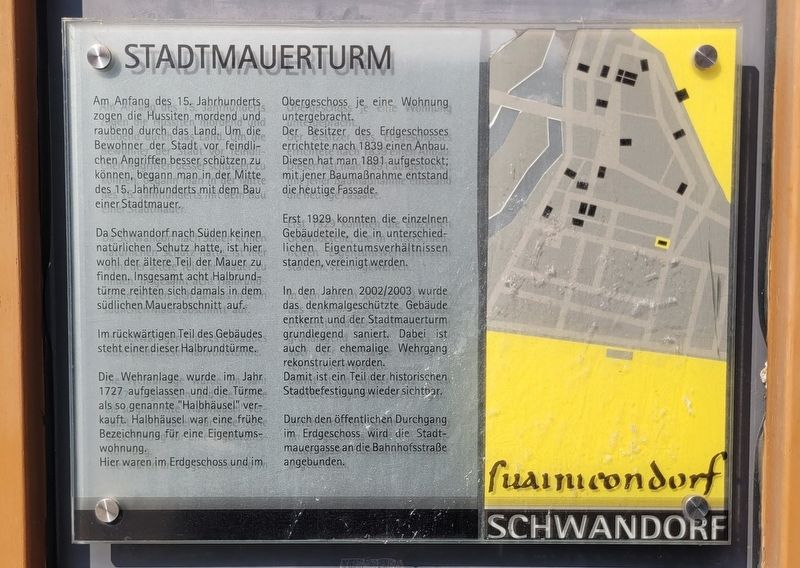
Am Anfang des 15. Jahrhunderts zogen die Hussiten mordend und raubend durch das Land. Um die Bewohner der Stadt vor feindlichen Angriffen besser schützen zu können, begann man in der Mitte des 15. Jahrhunderts mit dem Bau einer Stadtmauer.
Da Schwandorf nach Süden keinen natürlichen Schutz hatte, ist hier wohl der ältere Teil der Mauer zu finden. Insgesamt acht Halbrundtürme reihten sich damals in dem südlichen Mauerabschnitt auf.
Im rückwärtigen Teil des Gebäudes steht einer dieser Halbrundtürme.
Die Wehranlage wurde im Jahr 1727 aufgelassen und die Türme als sogenannte „Halbhäuser“ verkauft. „Halbhäusel“ war eine frühe Bezeichnung für eine Eigentumswohnung. Hier waren im Erdgeschoss und im Obergeschoss je eine Wohnung untergebracht.
Der Besitzer des Erdgeschosses errichtete nach 1839 einen Anbau. Diesen hat man 1891 aufgestockt; mit jener Baumaßnahme entstand die heutige Fassade. Erst 1929 konnten die einzelnen Gebäudeteile, die in unterschiedlichen Eigentumsverhältnissen standen, vereinigt werden.
In den Jahren 2002/2003 wurde das denkmalgeschützte Gebäude entkernt und der Stadtmauerturm
this page online
Durch den öffentlichen Durchgang im Erdgeschoss wird die Stadtmauergasse an die Bahnhofstraße angebunden.
At the beginning of the 15th century, the Hussites swept through the land, killing and plundering. To better protect the town’s inhabitants from hostile attacks, construction of a city wall began in the mid-15th century.
Since Schwandorf had no natural protection to the south, the older section of the wall is likely located here. At that time, a total of eight semicircular towers lined the southern section of the wall.
One of these semicircular towers stands in the rear part of the building.
The fortifications were abandoned in 1727, and the towers were sold as so-called “half-houses.” “Halbhäusel” was an early term for a condominium. Here, one apartment was located on the ground floor and one on the upper floor. After 1839, the owner of the ground floor added an extension. This was expanded upward in 1891; this construction created the present
Photographed by James Hulse, March 20, 2026
2. Stadtmauerturm / City Wall Tower Marker
Only in 1929 were the individual parts of the building, which had different owners, united.
In 2002/2003, the listed building was stripped down and the city wall tower was thoroughly restored. The former wall walk was also reconstructed, making part of the historic fortifications visible again.
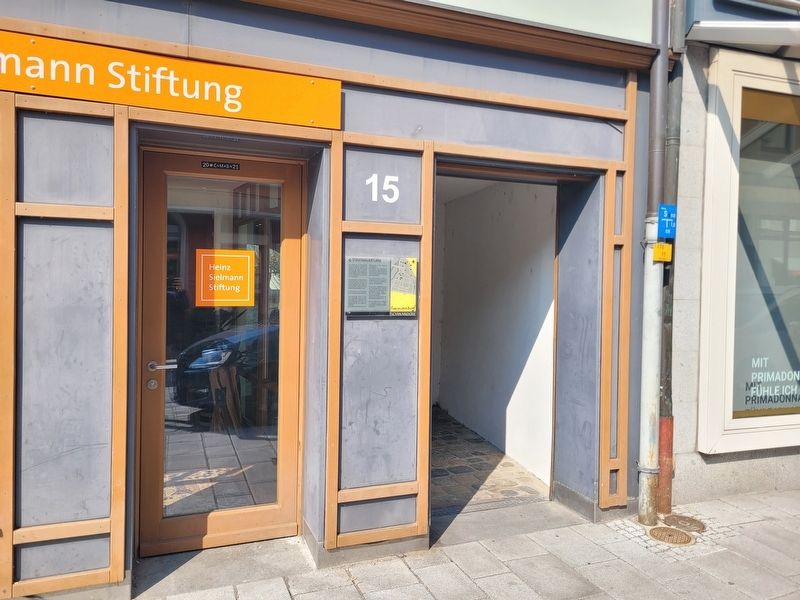
A public passage on the ground floor connects Stadtmauergasse with Bahnhofstraße.
Topics. This historical marker is listed in this topic list: Forts and Castles. A significant historical year for this entry is 1727.
Location. 49° 19.678′ N, 12° 6.426′ E. Marker is in Schwandorf, Bayern (Bavaria). It is at the intersection of Bahnhofstraße and Schwaigerstraße, on the left when traveling south on Bahnhofstraße. Touch for map. Marker is at or near this postal address: Bahnhofstraße 15, Schwandorf BY 92421, Germany. Touch for directions.

Regionally, it is in Europe, the European Union, Atlantic Europe, Central Europe, the Schengen Area, Western Europe, and the Western World. Historically, it finds itself in what was once the Holy Roman Empire and also the former West Germany.
Other nearby markers. At least 8 other markers
Photographed by James Hulse
3. Stadtmauerturm / City Wall Tower Marker
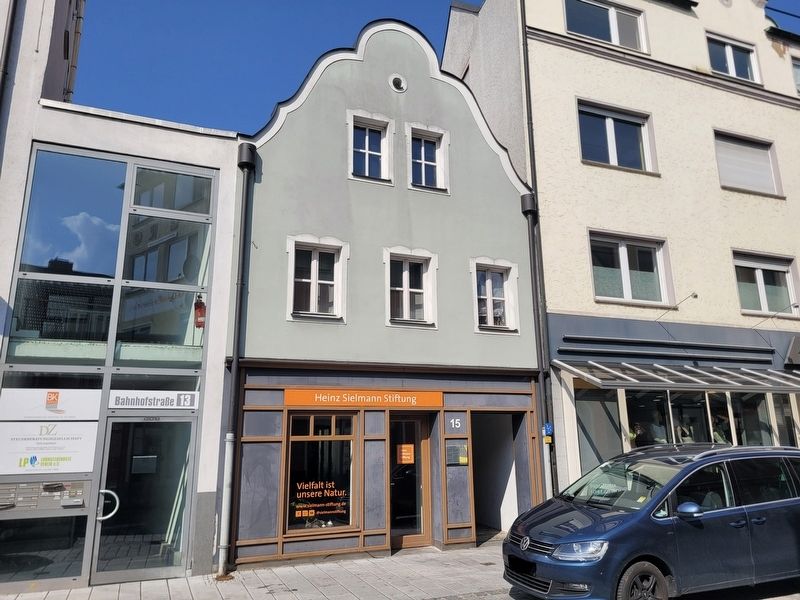
The view of the building along the street.
Credits. This page was last revised on April 9, 2026. It was originally submitted on April 7, 2026, by James Hulse of Medina, Texas. This page has been viewed 12 times since then. Photos: 1, 2, 3. submitted on April 9, 2026, by James Hulse of Medina, Texas.
