
Krondorf in Schwandorf, Bavaria, Germany — Central Europe
Stettner Haus
⎯⎯⎯
Stettner House
Photographed by James Hulse, March 20, 2026
1. Stettner Haus / Stettner House Marker

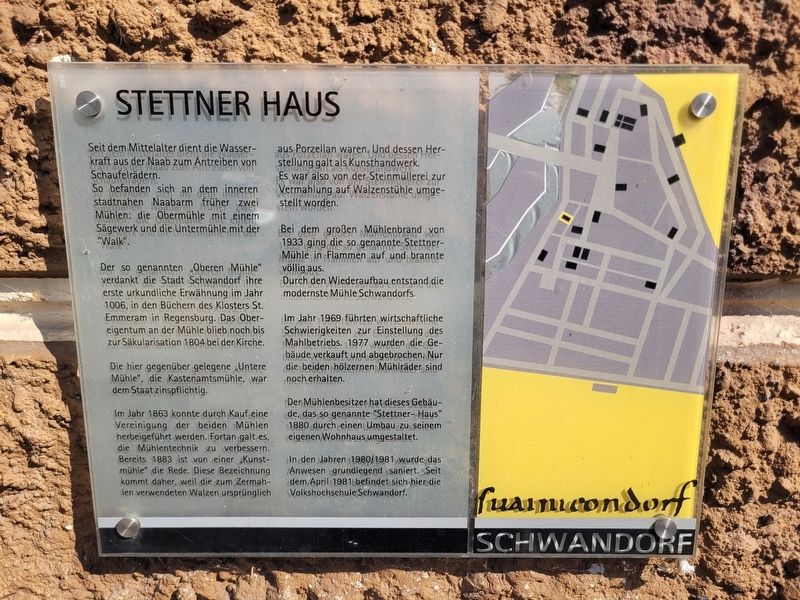
Seit dem Mittelalter dient die Wasserkraft aus der Naab zum Antreiben von Schaufelrädern. So befanden sich an dem innerstädtischen Naabarm früher zwei Mühlen: die Obermühle mit einem Sägewerk und die Untermühle mit der „Walk“.
Der sogenannten „Oberen Mühle“ verdankt die Stadt Schwandorf ihre erste urkundliche Erwähnung im Jahr 1006, in den Büchern des Klosters St. Emmeram in Regensburg. Das Obereigentum an der Mühle blieb noch bis zur Säkularisation 1804 bei der Kirche.
Die hier gegenüber gelegene „Untere Mühle“, die Kastenamtsmühle, war dem Staat zinspflichtig.
Im Jahr 1863 konnte durch Kauf eine Vereinigung der beiden Mühlen herbeigeführt werden. Fortan galt es, die Mühlentechnik zu verbessern. Bereits 1883 ist von einer „Kunstmühle“ die Rede. Diese Bezeichnung kommt daher, weil die zum Zermahlen verwendeten Walzen ursprünglich aus Porzellan waren, und dessen Herstellung galt als Kunsthandwerk. Es war also von der Steinmüllerei zur Vermahlung auf Walzenstühle umgestellt worden.
Bei dem großen Mühlenbrand von 1933 ging die sogenannte Stettner-Mühle in Flammen auf und brannte völlig aus. Durch
this page online
Im Jahr 1969 führten wirtschaftliche Schwierigkeiten zur Einstellung des Mahlbetriebs. 1977 wurden die Gebäude verkauft und abgebrochen. Nur die beiden hölzernen Mühlräder sind noch erhalten.
Der Mühlenbesitzer hat dieses Gebäude, das sogenannte „Stettner-Haus“, 1880 durch einen Umbau zu seinem eigenen Wohnhaus umgestaltet.
In den Jahren 1980/1981 wurde das Anwesen grundlegend saniert. Seit dem April 1981 befindet sich hier die Volkshochschule Schwandorf.
Since the Middle Ages, the water power of the Naab has been used to drive water wheels. Along the inner branch of the Naab within the town there were formerly two mills: the upper mill with a sawmill and the lower mill with a fulling mill.
The so-called “Upper Mill” gave the city of Schwandorf its first documented mention in the year 1006, in the records of St. Emmeram Monastery in Regensburg. Ownership of the mill remained with the Church until the secularization of 1804. The “Lower Mill,” located opposite, known as the Kastenamt mill, was subject to dues to the state.
In 1863, the
Photographed by James Hulse, March 20, 2026
2. Stettner Haus / Stettner House Marker
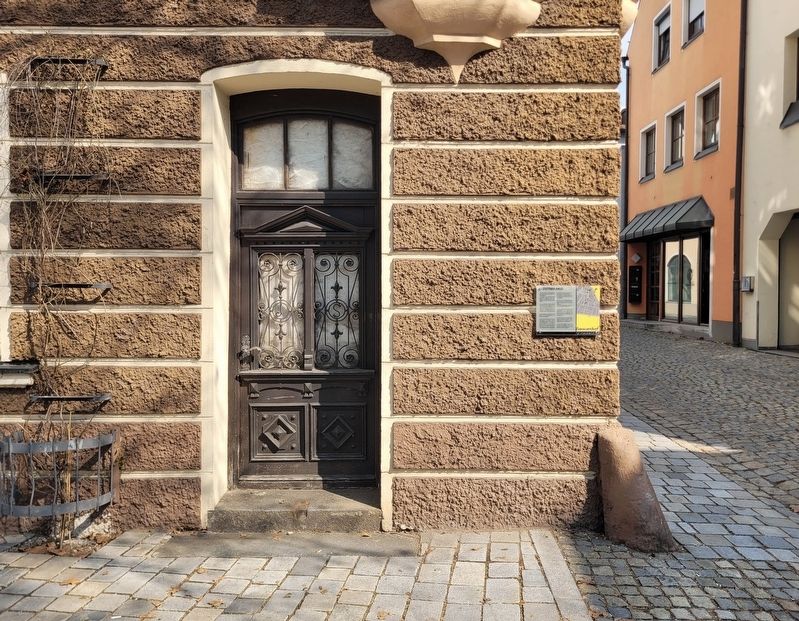
The entrance to the house.
During the great mill fire of 1933, the so-called Stettner Mill was completely destroyed. Its reconstruction resulted in the most modern mill in Schwandorf.
In 1969, economic difficulties led to the closure of milling operations. In 1977, the buildings were sold and demolished. Only the two wooden water wheels remain.
The mill owner converted this building, the so-called “Stettner House,” into his own residence in 1880. In 1980/1981, the property was comprehensively renovated. Since April 1981, it has housed the Schwandorf adult education center.
Topics. This historical marker is listed in this topic list: Notable Buildings. A significant historical month for this entry is April 1981.
Location. 49° 19.798′ N, 12° 6.36′ E. Marker is in Schwandorf, Bayern (Bavaria).
Photographed by James Hulse, March 20, 2026
3. Stettner Haus / Stettner House Marker
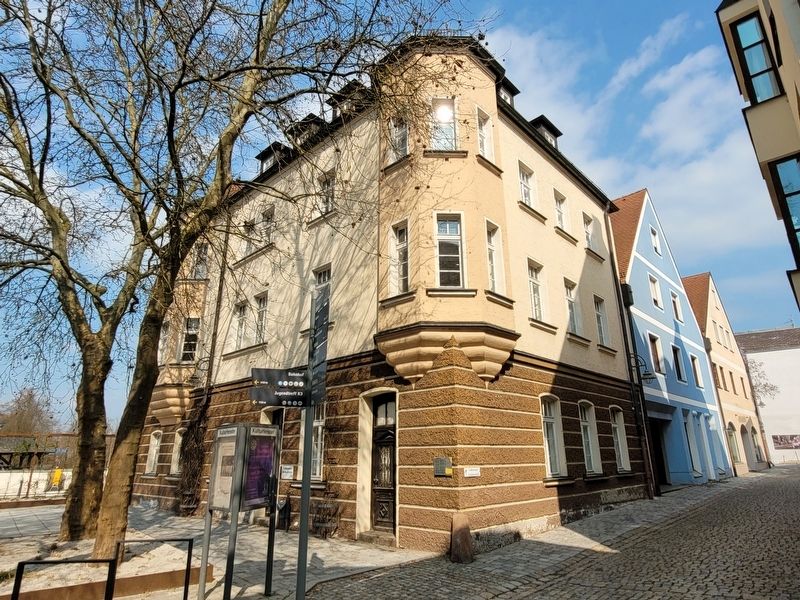
The view of the house from across the street.

Regionally, it is in Europe, the European Union, Atlantic Europe, Central Europe, the Schengen Area, Western Europe, and the Western World. Historically, it finds itself in what was once the Holy Roman Empire and also the former West Germany.
Other nearby markers. At least 8 other markers are within walking distance of this marker: Stadtmuseum / City Museum (within shouting distance of this marker); Hochzeit im Alten Rathaus zu Schwandorf / Wedding at the Old Town Hall of Schwandorf (within shouting distance of this marker); Mühlräder / Mill wheels (within shouting distance of this marker); Hufschmiede / Farrier’s Forge (within shouting distance of this marker); Wasserräder mit langer Geschichte / Water wheels with a long history (within shouting distance of this marker); Stadtschreiberhaus / Town Clerk’s House (within shouting distance of this marker); Färberhaus / Dyer’s House (within shouting distance of this marker); Stadtmauergasse 4 (about 120 meters away, measured in a direct line). Touch for a list and map of all markers in Schwandorf.
Credits. This page was last revised on April 10, 2026. It was originally submitted on April 8, 2026, by James Hulse of Medina, Texas. This page has been viewed 20 times since then. Photos: 1, 2, 3. submitted on April 10, 2026, by James Hulse of Medina, Texas.
