
Krondorf in Schwandorf, Bavaria, Germany — Central Europe
Stadtschreiberhaus
⎯⎯⎯
Town Clerk’s House
Photographed by James Hulse, March 20, 2026
1. Stadtschreiberhaus / Town Clerk’s House Marker

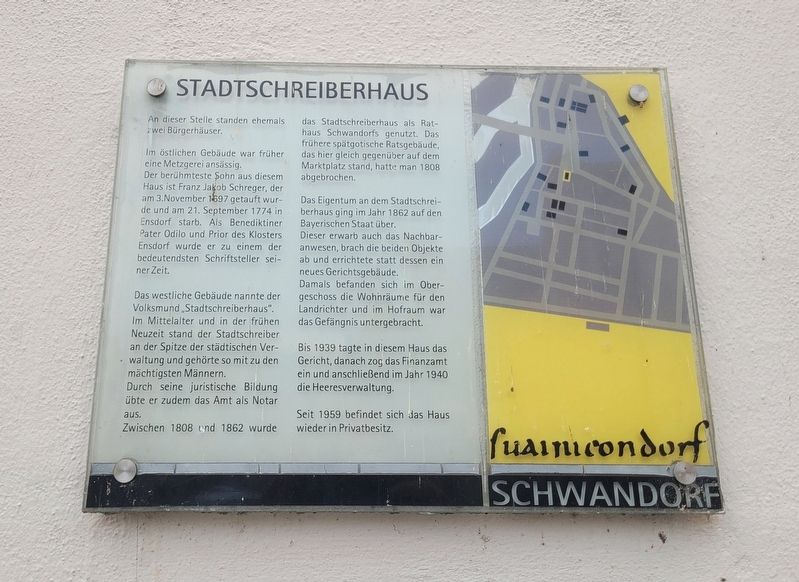
An dieser Stelle standen ehemals zwei Bürgerhäuser.
Im östlichen Gebäude war früher eine Metzgerei ansässig. Der berühmteste Sohn aus diesem Haus ist Franz Jakob Schreger, der am 3. November 1697 getauft wurde und am 21. September 1774 in Ensdorf starb. Als Benediktiner, Pater Odilo und Prior des Klosters Ensdorf wurde er zu einem der bedeutendsten Schriftsteller seiner Zeit.
Das westliche Gebäude nannte der Volksmund „Stadtschreiberhaus“. Im Mittelalter und in der frühen Neuzeit stand der Stadtschreiber an der Spitze der städtischen Verwaltung und gehörte so zu den mächtigsten Männern. Durch seine juristische Bildung übte er zudem das Amt als Notar aus. Zwischen 1808 und 1862 wurde das Stadtschreiberhaus als Rathaus Schwandorfs genutzt. Das frühere spätgotische Ratsgebäude, das hier gleich gegenüber auf dem Marktplatz stand, hatte man 1808 abgebrochen.
Das Eigentum an dem Stadtschreiberhaus ging im Jahr 1862 auf den Bayerischen Staat über. Dieser erwarb auch das Nachbaranwesen, brach die beiden Objekte ab und errichtete stattdessen ein neues Gerichtsgebäude. Damals befanden sich
this page online
Bis 1939 tagte in diesem Haus das Gericht, danach zog das Finanzamt ein und anschließend im Jahr 1940 die Heeresverwaltung.
Seit 1959 befindet sich das Haus wieder in Privatbesitz.
Two town houses once stood on this site.
A butcher’s shop was formerly located in the eastern building. The most famous son of this house is Franz Jakob Schreger, who was baptized on November 3, 1697, and died on September 21, 1774, in Ensdorf. As a Benedictine monk, Father Odilo, and prior of the Ensdorf monastery, he became one of the most important writers of his time.
The western building was popularly known as the “Town Clerk’s House.” In the Middle Ages and early modern period, the town clerk stood at the head of the municipal administration and was therefore among the most powerful men. Because of his legal training, he also served as a notary. Between 1808 and 1862, the Town Clerk’s House was used as Schwandorf’s town hall. The earlier late Gothic town hall, which had stood directly opposite on the market
Photographed by James Hulse, March 20, 2026
2. Stadtschreiberhaus / Town Clerk’s House Marker
Ownership of the Town Clerk’s House passed to the Bavarian state in 1862. The state also acquired the neighboring property, demolished both buildings, and constructed a new courthouse in their place. At that time, the upper floor contained living quarters for the district judge, while the courtyard housed the prison. The court sat in this building until 1939; afterward the tax office moved in, followed by the army administration in 1940.
Since 1959, the building has once again been privately owned.
Topics. This historical marker is listed in this topic list: Notable Buildings. A significant historical date for this entry is September 21, 1774.
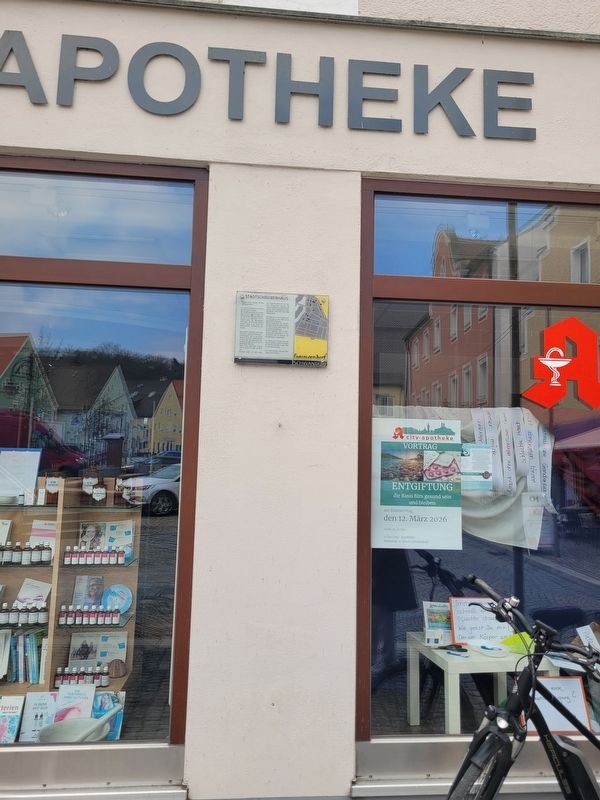
Location. 49° 19.798′ N, 12° 6.407′ E. Marker is in Schwandorf, Bayern (Bavaria). It is in Krondorf. It is at the intersection of Marktplatz and Rathausstraße, on the right when traveling south on Marktplatz. Touch for map. Marker is at or near this postal address: Marktpl 28, Schwandorf BY 92421, Germany. Touch for directions.

Regionally, it is in Europe, the European Union, Atlantic Europe, Central Europe, the Schengen Area, Western Europe, and the
Photographed by James Hulse, March 20, 2026
3. Stadtschreiberhaus / Town Clerk’s House Marker
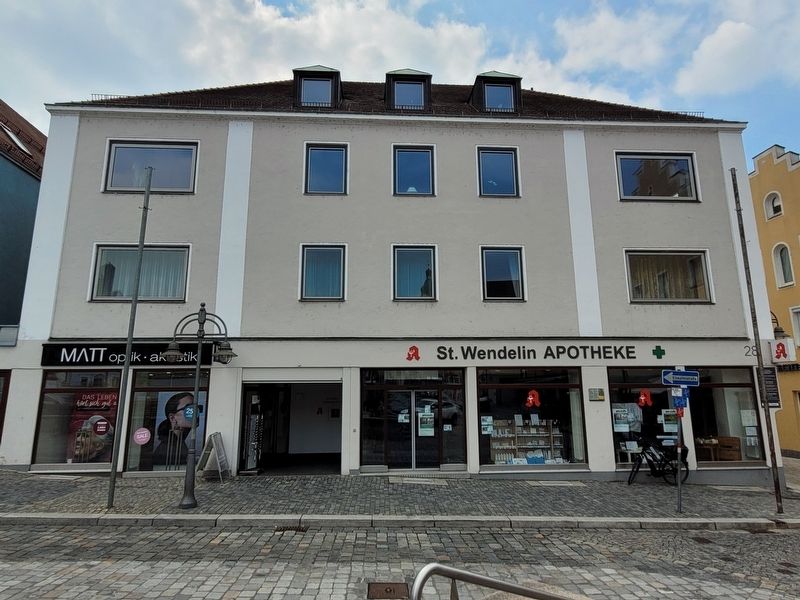
The view of the builinpg from across the street.
Other nearby markers. At least 8 other markers are within walking distance of this marker: Stadtmuseum / City Museum (within shouting distance of this marker); Hochzeit im Alten Rathaus zu Schwandorf / Wedding at the Old Town Hall of Schwandorf (within shouting distance of this marker); Stettner Haus / Stettner House (within shouting distance of this marker); Gasthof zur Post / Inn “Zur Post” (within shouting distance of this marker); Hufschmiede / Farrier’s Forge (about 90 meters away, measured in a direct line); Färberhaus / Dyer’s House (about 90 meters away); Mühlräder / Mill wheels (about 90 meters away); Wasserräder mit langer Geschichte / Water wheels with a long history (about 90 meters away). Touch for a list and map of all markers in Schwandorf.
Credits. This page was last revised on April 10, 2026. It was originally submitted on April 8, 2026, by James Hulse of Medina, Texas. This page has been viewed 13 times since then. Photos: 1, 2, 3. submitted on April 10, 2026, by James Hulse of Medina, Texas.
