
Krondorf in Schwandorf, Bavaria, Germany — Central Europe
Hufschmiede
⎯⎯⎯
Farrier’s Forge
Photographed by James Hulse, March 20, 2026
1. Hufschmiede / Farrier’s Forge Marker

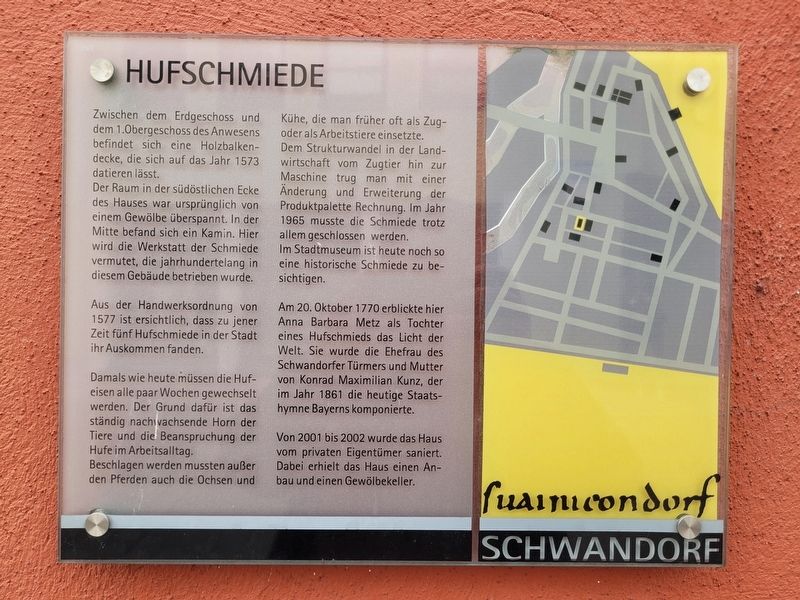
Zwischen dem Erdgeschoss und dem 1. Obergeschoss des Anwesens befindet sich eine Holzbalkendecke, die sich auf das Jahr 1573 datieren lässt. Der Raum in der südöstlichen Ecke des Hauses war ursprünglich von einem Gewölbe überspannt. In der Mitte befand sich ein Kamin. Hier wird die Werkstatt der Schmiede vermutet, die jahrhundertelang in diesem Gebäude betrieben wurde.
Aus der Handwerksordnung von 1577 ist ersichtlich, dass zu jener Zeit fünf Hufschmiede in der Stadt ihr Auskommen fanden.
Damals wie heute müssen die Hufeisen alle paar Wochen gewechselt werden. Der Grund dafür ist das ständig nachwachsende Horn der Tiere und die Beanspruchung der Hufe im Arbeitsalltag. Beschlagen werden mussten außer den Pferden auch die Ochsen und Kühe, die man früher oft als Zugoder als Arbeitstiere einsetzte. Dem Strukturwandel in der Landwirtschaft vom Zugtier hin zur Maschine trug man mit einer Änderung und Erweiterung der Produktpalette Rechnung. Im Jahr 1965 musste die Schmiede trotz allem geschlossen werden. Im Stadtmuseum ist heute noch so eine historische Schmiede zu besichtigen.
Am 20. Oktober
this page online
Von 2001 bis 2002 wurde das Haus vom privaten Eigentümer saniert. Dabei erhielt das Haus einen Anbau und einen Gewölbekeller.
Between the ground floor and the first floor of the property is a wooden beam ceiling that can be dated to 1573. The room in the southeastern corner of the house was originally covered by a vaulted ceiling. A fireplace stood in the center. This is believed to have been the smithy workshop, which operated in this building for centuries.
The guild regulations of 1577 show that at that time five farriers made a living in the town.
Then as now, horseshoes had to be replaced every few weeks. This is due to the continuous growth of the animals’ hooves and the strain placed on them in daily work. In addition to horses, oxen and cows also had to be shod, as they were often used as draft and working animals. The shift in agriculture from draft
Photographed by James Hulse, March 20, 2026
2. Hufschmiede / Farrier’s Forge Marker
On October 20, 1770, Anna Barbara Metz was born here as the daughter of a farrier. She later became the wife of the Schwandorf town tower keeper and the mother of Konrad Maximilian Kunz, who composed the present Bavarian state anthem in 1861.
From 2001 to 2002, the house was renovated by a private owner. During this work, an extension and a vaulted cellar were added.
Topics. This historical marker is listed in this topic list: Notable Buildings. A significant historical date for this entry is October 20, 1770.
Location. 49° 19.771′ N, 12° 6.348′ E. Marker is in Schwandorf, Bayern (Bavaria). It is in Krondorf. It is at the intersection of Breite Straße and Rathausstraße, on the right when traveling south on Breite Straße. Touch for map. Marker is at or near this postal address: Breite Str 27, Schwandorf BY 92421, Germany. Touch for directions.

Regionally, it is in Europe, the European Union, Atlantic Europe, Central Europe, the Schengen
Photographed by James Hulse, March 20, 2026
3. Hufschmiede / Farrier’s Forge Marker
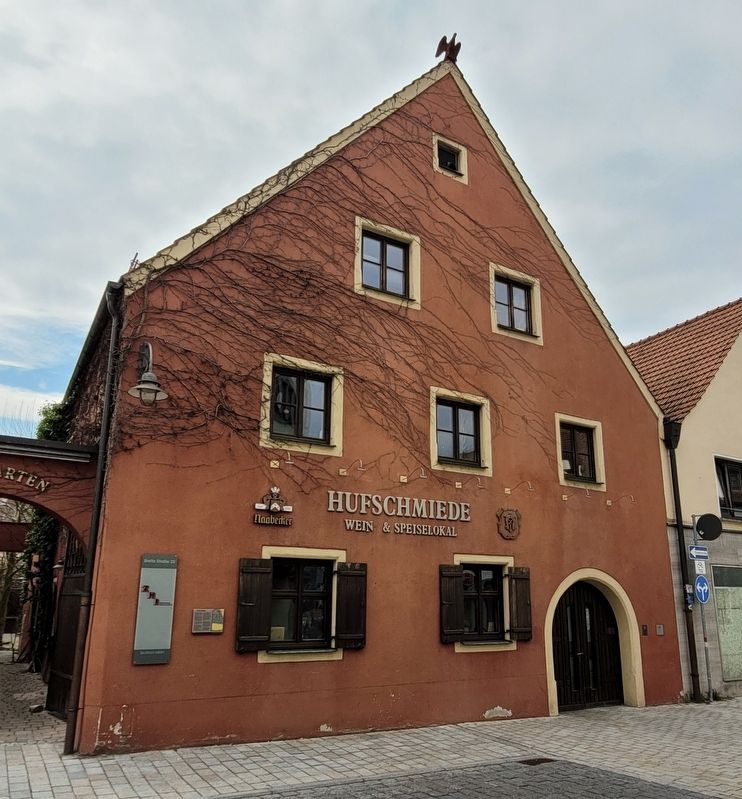
The view of the house from across the street.
Other nearby markers. At least 8 other markers are within walking distance of this marker: Färberhaus / Dyer’s House (a few steps from this marker); Hochzeit im Alten Rathaus zu Schwandorf / Wedding at the Old Town Hall of Schwandorf (within shouting distance of this marker); Stadtmuseum / City Museum (within shouting distance of this marker); Stettner Haus / Stettner House (within shouting distance of this marker); Stadtmauergasse 4 (within shouting distance of this marker); Mühlräder / Mill wheels (about 90 meters away, measured in a direct line); Stadtschreiberhaus / Town Clerk’s House (about 90 meters away); Wasserräder mit langer Geschichte / Water wheels with a long history (about 90 meters away). Touch for a list and map of all markers in Schwandorf.
Credits. This page was last revised on April 10, 2026. It was originally submitted on April 8, 2026, by James Hulse of Medina, Texas. This page has been viewed 14 times since then. Photos: 1, 2, 3. submitted on April 10, 2026, by James Hulse of Medina, Texas.
