
Krondorf in Schwandorf, Bavaria, Germany — Central Europe
Marktplatz 21
Photographed by James Hulse, March 20, 2026
1. Marktplatz 21 Marker

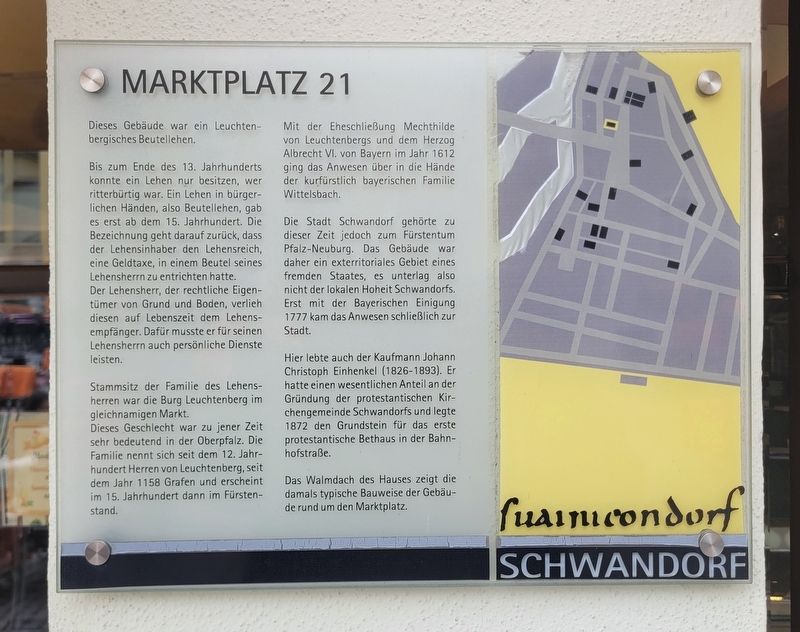
Dieses Gebäude war ein Leuchtenbergisches Beutellehen.
Bis zum Ende des 13. Jahrhunderts konnte ein Lehen nur besitzen, wer ritterbürtig war. Ein Lehen in bürgerlichen Händen, also ein Beutellehen, gab es erst ab dem 15. Jahrhundert. Die Bezeichnung geht darauf zurück, dass der Lehensinhaber den Lehenszins, eine Geldtaxe, in einem Beutel seines Lehensherrn zu entrichten hatte. Der Lehensherr, der rechtliche Eigentümer von Grund und Boden, verlieh diesen auf Lebenszeit dem Lehensempfänger. Dafür musste dieser seinem Lehensherrn auch persönliche Dienste leisten.
Stammsitz der Familie des Lehensherrn war die Burg Leuchtenberg im gleichnamigen Markt. Dieses Geschlecht war zu jener Zeit sehr bedeutend in der Oberpfalz. Die Familie nennt sich seit dem 12. Jahrhundert Herren von Leuchtenberg, seit dem Jahr 1158 Grafen und erscheint im 15. Jahrhundert dann im Fürstenstand.
Mit der Eheschließung Mechthilde von Leuchtenbergs und dem Herzog Albrecht VI. von Bayern im Jahr 1612 ging das Anwesen über in die Hände der kurfürstlich bayerischen Familie Wittelsbach. Die Stadt Schwandorf gehörte zu dieser Zeit
this page online
Hier lebte auch der Kaufmann Johann Christoph Einhenkel (1826–1893). Er hatte einen wesentlichen Anteil an der Gründung der protestantischen Kirchengemeinde Schwandorfs und legte 1872 den Grundstein für das erste protestantische Bethaus in der Bahnhofstraße.
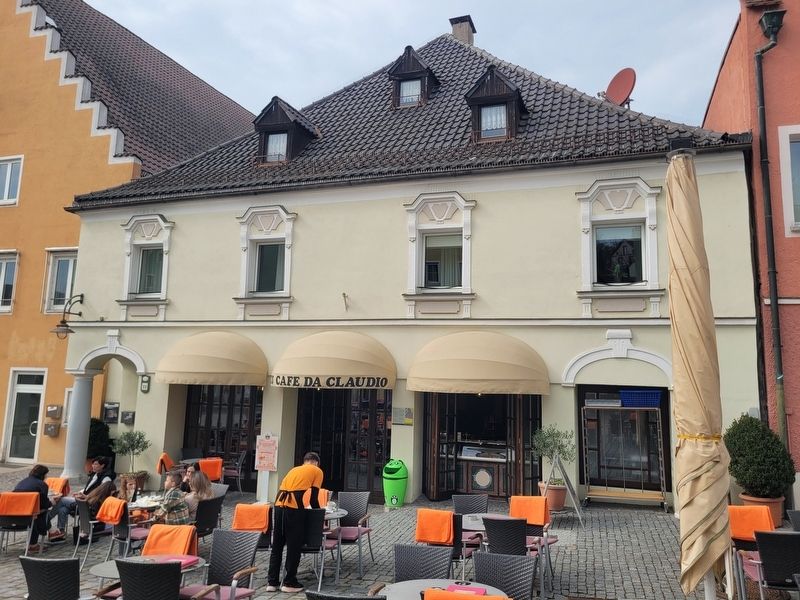
Das Walmdach des Hauses zeigt die damals typische Bauweise der Gebäude rund um den Marktplatz.
This building was a Leuchtenberg fief held as a “Beutellehen.”
Until the end of the 13th century, only those of knightly birth could hold a fief. A fief in the hands of commoners—known as a “Beutellehen”—only appeared from the 15th century onward. The term derives from the fact that the fief holder had to pay the feudal dues, a monetary tax, into a pouch (“Beutel”) belonging to the lord. The feudal lord, the legal owner of the land, granted it for life to the recipient of the fief. In return, the holder had to render
Photographed by James Hulse, March 20, 2026
2. Marktplatz 21 Marker
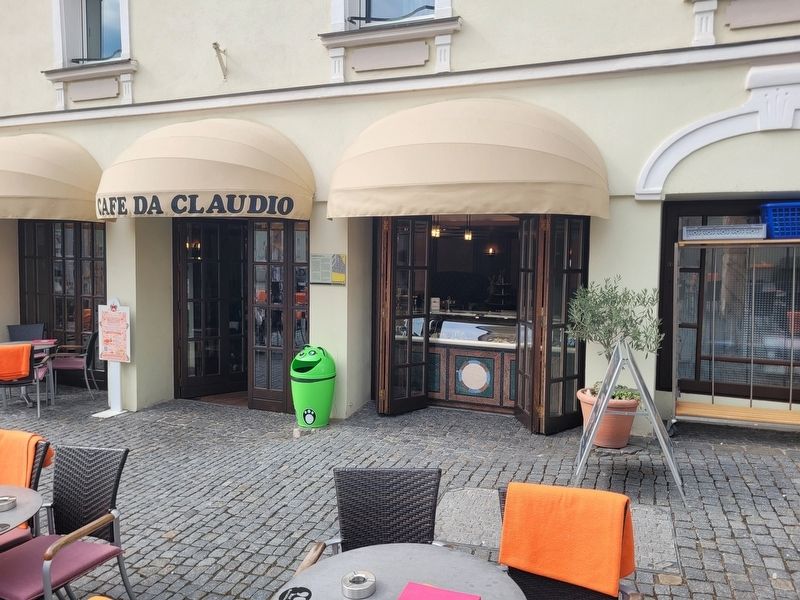
The view of the marker in front of a restaurant.
The ancestral seat of the lord’s family was Leuchtenberg Castle in the market town of the same name. At that time, this family was highly significant in the Upper Palatinate. From the 12th century they were known as the Lords of Leuchtenberg, from 1158 as counts, and in the 15th century they rose to princely rank. With the marriage of Mechthilde of Leuchtenberg and Duke Albrecht VI of Bavaria in 1612, the property passed into the hands of the electoral Bavarian Wittelsbach family.
At that time, however, Schwandorf belonged to the Principality of Palatinate-Neuburg. The building was therefore an extraterritorial property of a foreign state and was not subject to Schwandorf’s local authority. Only with the Bavarian unification of 1777 did the property finally come under the city’s jurisdiction.
The merchant Johann Christoph Einhenkel (1826–1893) also lived here. He played a significant role in founding the Protestant parish of Schwandorf and laid the foundation stone in 1872 for the first Protestant prayer house on Bahnhofstraße.
The hipped roof of the house reflects the typical architectural
Photographed by James Hulse, March 20, 2026
3. Marktplatz 21 Marker
The view of the building from the street.
Topics. This historical marker is listed in this topic list: Notable Buildings.
Location. 49° 19.839′ N, 12° 6.473′ E. Marker is in Schwandorf, Bayern (Bavaria). It is in Krondorf. It is at the intersection of Marktplatz and Max-Kunz-Gasse, on the left when traveling north on Marktplatz. Touch for map. Marker is at or near this postal address: Marktpl 21, Schwandorf BY 92421, Germany. Touch for directions.

Regionally, it is in Europe, the European Union, Atlantic Europe, Central Europe, the Schengen Area, Western Europe, and the Western World. Historically, it finds itself in what was once the Holy Roman Empire and also the former West Germany.
Other nearby markers. At least 8 other markers are within walking distance of this marker: Der Oberpfälzer Jakobsweg / The Upper Palatinate Way of St. James (within shouting distance of this marker); Geburtsstätte verdienter Männer / Birthplace of Distinguished Men (within shouting distance of this marker); Kirche St. Jakob / St. James Church (within shouting distance of this marker); Pflegehof / Administrative Court Estate (about 90 meters away, measured in a direct line); Gasthof zur Post / Inn “Zur Post” (about 90 meters away); Spitalkirche / Hospital Church (about 90 meters away); Pfarrhof St. Jakob / Parish House of St. Jakob (about 90 meters away); Stadtschreiberhaus / Town Clerk’s House (about 120 meters away). Touch for a list and map of all markers in Schwandorf.
Credits. This page was last revised on April 11, 2026. It was originally submitted on April 8, 2026, by James Hulse of Medina, Texas. This page has been viewed 16 times since then. Photos: 1, 2, 3. submitted on April 11, 2026, by James Hulse of Medina, Texas.
