McDonald in Washington County, Pennsylvania — The American Northeast (Mid-Atlantic)
McDonald's Railroad Freight Station
⎯⎯⎯
A View of South McDonald Street
Photographed by Mike Wintermantel, April 13, 2026
1. McDonald's Railroad Freight Station / A View of South McDonald Street Marker
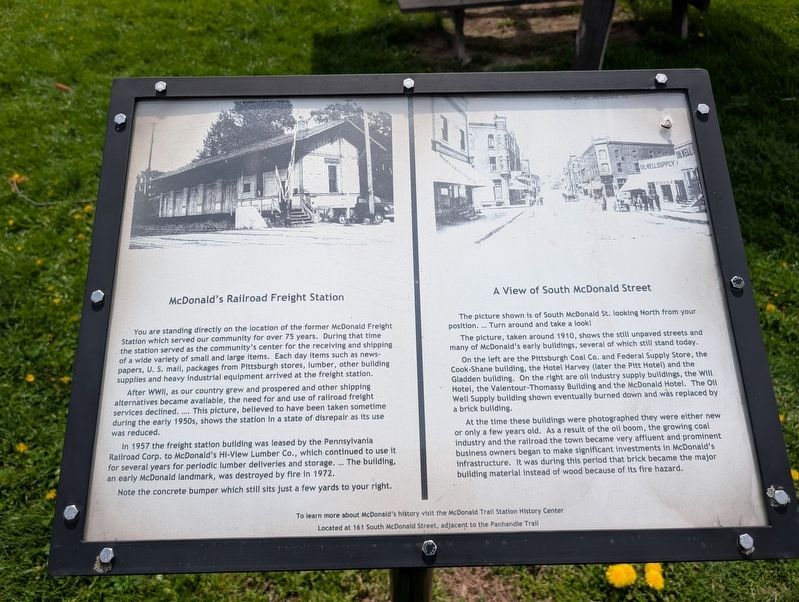
You are standing directly on the location of the former McDonald Freight Station which served our community for over 75 years. During that time the station served as the community's center for the receiving and shipping of a wide variety of small and large items. Each day items such as newspapers, U. S. mall, packages from Pittsburgh stores, lumber, other building supplies and heavy industrial equipment arrived at the freight station.
After WWI, as our country grew and prospered and other shipping. alternatives became available, the need for and use of railroad freight services declined. This picture, believed to have been taken sometime during the early 1950s, shows the station in a state of disrepair as its use was reduced.
In 1957 the freight station building was leased by the Pennsylvania Railroad Corp. to McDonald's Hi-View Lumber Co., which continued to use it for several years for periodic lumber deliveries and storage. The building, an early McDonald landmark, was destroyed by fire in 1972.
Note the concrete bumper which still sits just a few yards to your right.
A View of South McDonald Street
The
this page online
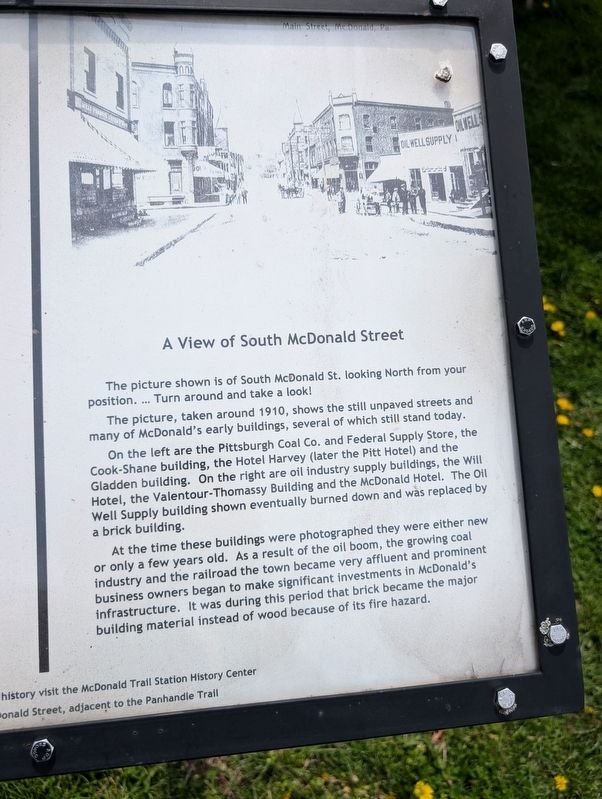
The picture, taken around 1910, shows the still unpaved streets and many of McDonald's early buildings, several of which still stand today.
On the left are the Pittsburgh Coal Co. and Federal Supply Store, the Cook-Shane building, the Hotel Harvey (later the Pitt Hotel) and the Gladden building. On the right are oil industry supply buildings, the Will Hotel, the Valentour-Thomassy Building and the McDonald Hotel. The Oil Well Supply building shown eventually burned down and was replaced by a brick building.
At the time these buildings were photographed they were either new or only a few years old. As a result of the oil boom, the growing coal industry and the railroad the town became very affluent and prominent business owners began to make significant investments in McDonald's Infrastructure. It was during this period that brick became the major building material instead of wood because of its fire hazard.
Topics. This historical marker is listed in these topic lists: Industry & Commerce • Railroads & Streetcars. A significant historical year for this entry is 1957.
Location. 40° 22.033′ N,

Photographed by Mike Wintermantel, April 13, 2026
2. McDonald's Railroad Freight Station Marker

Regionally, this marker is in Greater Pittsburgh. It is also in the American Northeast, in the Mid-Atlantic, in Appalachia, and specifically in Northern Appalachia. Globally, it is in North America, the Western Hemisphere, the Western World, and the Anglosphere. Historically, it finds itself in what was once the Haudenosaunee (Iroquois) Confederacy and also one of the original Thirteen Colonies.
Other nearby markers. At least 8 other markers are within walking distance of this marker: Tillinghast Machine Shop / McCarty Lumber Yard (a few steps from this marker); McDonald's West Bound Passenger Train Station / McDonald's East Bound Passenger Train Station (within shouting distance of this marker); Jay Livingston (within shouting distance of this marker); Wilson Mill Covered Bridge (within shouting distance of this marker); Oil Well Fire (approx.
Photographed by Mike Wintermantel, April 13, 2026
3. A View of South McDonald Street Marker
Photographed by Mike Wintermantel, April 13, 2026
4. McDonald's Railroad Freight Station / A View of South McDonald Street Marker
Credits. This page was last revised on May 4, 2026. It was originally submitted on April 13, 2026, by Mike Wintermantel of Pittsburgh, Pennsylvania. This page has been viewed 20 times since then. Photos: 1, 2, 3, 4. submitted on April 13, 2026, by Mike Wintermantel of Pittsburgh, Pennsylvania. • Bill Pfingsten was the editor who published this page.
