Scotland in St. Mary's County, Maryland — The American Northeast (Mid-Atlantic)
Buoys and Beacons of the Chesapeake Bay
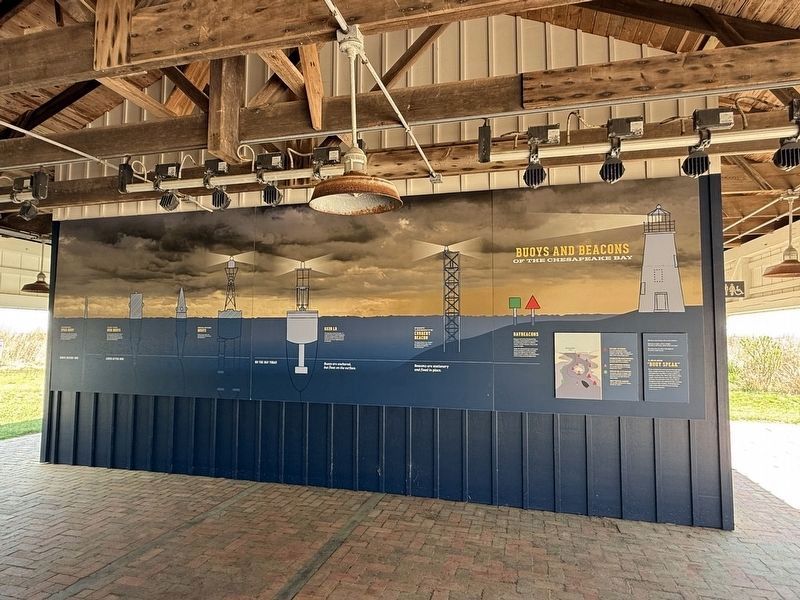
Photographed by Devry Becker Jones (CC0), April 11, 2026
1. Buoys and Beacons of the Chesapeake Bay Marker
Buoys before 1950
Wooden Spar Buoy
Until the 1950s, spar buoys—like the replica behind you—dominated the Chesapeake Bay. Buoys like these were repaired in the shed where you now stand. We still use spars—now they are made of steel.
Added after 1950
Can and Nun Buoys
Can and nun buoys made of steel replaced the Chesapeake Bay's spar buoys by the 1950s. The larger can and nun buoys were used to mark major channel junctions and major harbors like Baltimore.
Skeleton Buoys
Skeleton buoys on piles were larger lighted buoys that marked channel junctions.
On the Bay Today
Buoys are anchored, but float on the surface.
Beacons are stationery and fixed in place.
6X20 LR
This large buoy is a channel marker. "L" stands for lit and "R" means this buoy has a radio. An example sits just outside this buoy shed. Similar in structure, the 7X17 LR is the most common lighted buoy on the bay today
Point Lookout's Current Beacon
This electric beacon was installed just off the Point in 1965, when the lighthouse's light was decommissioned.
Daybeacons
Because much of the Chesapeake Bay is shallow, simple daybeacons
this page online
Today, the Chesapeake Bay and its many tributaries feature a variety of smaller buoys, both lighted and non-lighted, skeleton towers on piles, unilt daybeacons and surviving unmanned lighthouses.
"Red right returning" is an old saying that helps mariners remember to keep red markers on the right, or starboard side, when returning to port.
Starboard (or right) markers are red, triangular in shape and painted with even numbers.
Unlit starboard markers are usually tapered, in a shape known as a "nun."
Portside (or left) markers are green, square in shape, and marked with odd numbers that decrease as you get closer to open water.
Unlit portside markers are usually cylindrical in shape, known as "cans."
Mariners can always rely on the wisdom:
"Red sky at night, sailors' delight.
Red sky in the morning, sailors take warning."
But they also use Aidsd to Navigation to chart a safe course.
Learn "Buoy Speak"
Buoys and beacons communicate through their colors, height and shape. Some are equipped with lights

Photographed by Devry Becker Jones (CC0), April 11, 2026
2. Several markers on display in the open-air shed
Erected by Maryland Park Service; Maryland Department of Natural Resources.
Topics. This historical marker is listed in this topic list: Communications. A significant historical year for this entry is 1950.
Location. 38° 2.312′ N, 76° 19.323′ W. Marker is in Scotland, Maryland, in St. Mary's County. It is on Point Lookout Road (Maryland Route 5) 2.3 miles south of 3rd Way, on the right when traveling east. Touch for map. Marker is at or near this postal address: 10344 Point Lookout Rd, Scotland MD 20687, United States of America. Touch for directions.

Regionally, this marker is in Southern Maryland. It is also in the American South, specifically in the Upper South, in the Mid-Atlantic, in the Tidewater, in the Chesapeake Bay Region, and on the Eastern Seaboard. Globally, it is in the North Atlantic Region, North America, the Western Hemisphere, the Western World, and the Anglosphere. Historically, it finds itself in what was once one of the original Thirteen Colonies and also the Antebellum South.
Other nearby markers. At least 8 other markers are within walking distance of this marker: Keeping the Buoys Seaworthy (here, next to this marker); Rough Treatment (here, next to this marker); It Takes More Than Lighthouses… (here, next to this marker); New Buoy Technology (here, next to this marker); The Wooden Spar Buoy (a few steps from this marker); The Bay Is a Sunken River (a few steps from this marker); From Buoys to Barracks (a few steps from this marker); The Fog Bell Tower (a few steps from this marker). Touch for a list and map of all markers in Scotland.
Credits. This page was last revised on April 15, 2026. It was originally submitted on April 15, 2026, by Devry Becker Jones of Washington, District of Columbia. This page has been viewed 21 times since then. Photos: 1. submitted on April 15, 2026, by Devry Becker Jones of Washington, District of Columbia. 2. submitted on April 14, 2026, by Devry Becker Jones of Washington, District of Columbia.
