Cottage Grove in Lane County, Oregon — The American West (Northwest)
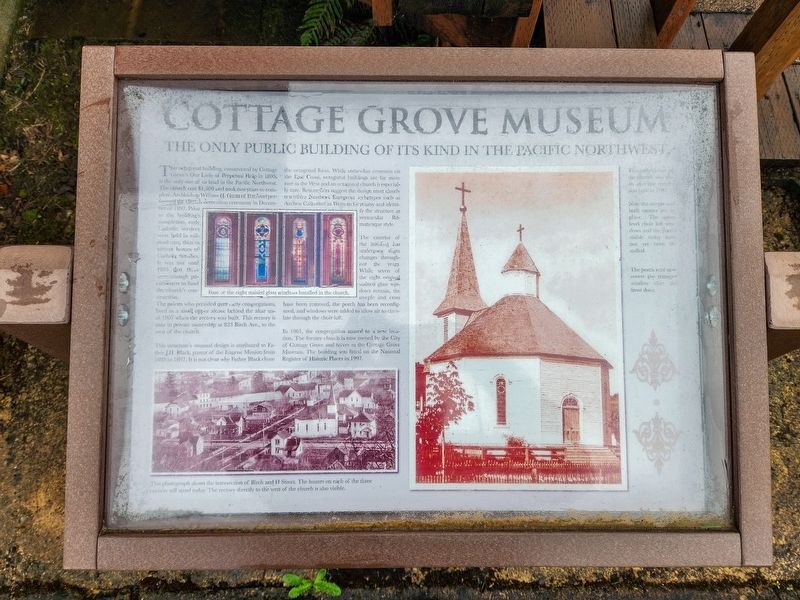
Cottage Grove Museum
The Only Public Building of its Kind in the Pacific Northwest
Photographed by Douglass Halvorsen, April 11, 2026
1. Cottage Grove Museum Marker
The priests who presided over early congregations, lived in a small, upper alcove behind the altar until 1907 when the rectory was built. The rectory is now in private ownership at 823 Birch Ave., to the west of the church.
This structure’s unusual design is attributed to Father J.H. Black, pastor of the Eugene Mission from 1895 to 1897. It is not clear why father Black chose the octagonal form. While somewhat common on the East Coast, octagonal buildings are far more rare in the West and an octagonal church is especially rare. Researchers suggest the design most closely resembles Northern European
this page online
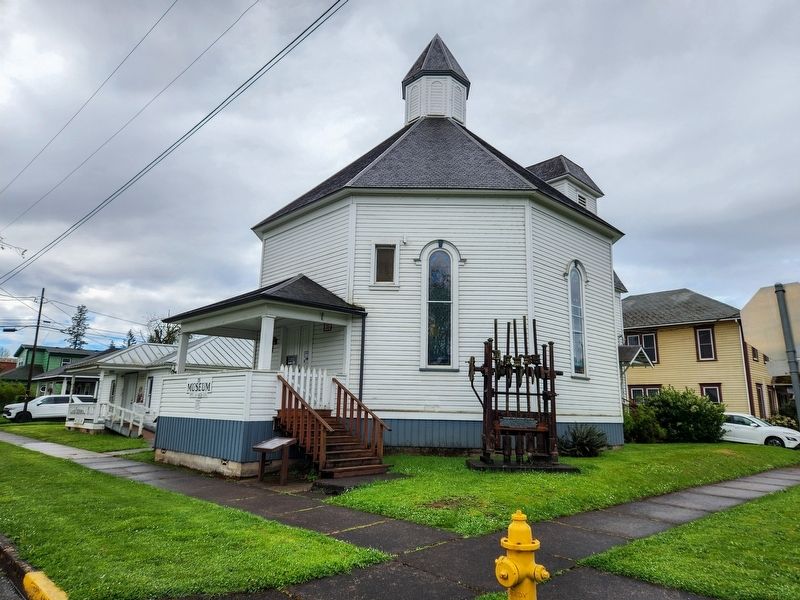
The exterior of the building has undergone slight changes throughout the years. While seven of the eight original stained glass windows remain, the steeple and cross have been removed, the porch has been reconfigured, and the windows were added to allow air to circulate through the choir loft.
In 1961, the congregation moved to a new location. The former church is now owned by the City of Cottage Grove and serves as the Cottage Grove Museum. The building was listed on the National Register of Historic Places in 1997.
[Captions]
Four of the eight stained glass windows installed in the church.
This photograph shows the intersection of Birch and H Street. The houses on each of the three corners still stand today. The rectory directly west of the church is also visible.
This early picture of the church was taken after the rectory was built in 1907. Note the steeple and both crosses are in place. The upper level choir loft windows and the porch visible today have not yet been installed. The porch now covers the
Photographed by Douglass Halvorsen, April 11, 2026
2. Cottage Grove Museum Marker
Erected by Cottage Grove Museum.
Topics and series. This historical marker is listed in this topic list: Religion & Religious Structures. In addition, it is included in the National Register of Historic Places (NRHP) series list. A significant historical year for this entry is 1895.
Location. 43° 47.948′ N, 123° 3.895′ W. Marker is in Cottage Grove, Oregon, in Lane County. It is at the intersection of North H Street and Birch Avenue, on the left when traveling south on North H Street. Touch for map. Marker is at or near this postal address: 147 N H Street, Cottage Grove OR 97424, United States of America. Touch for directions.

Regionally, this marker is in Oregon’s Willamette Valley. It is also on the American Pacific Coast, in the Pacific Northwest, and in the Lewis & Clark Corridor. Globally, it is in North America, in the Cascade Range, on the Ring of Fire, in the Pacific Rim, in the Western Hemisphere, in the Western World, and in the Anglosphere.
Other nearby markers. At least 8 other markers are within walking distance of this marker: The Knott Mine Gold Ore Stamp Mill

Photographed by Douglass Halvorsen, April 11, 2026
3. Cottage Grove Museum
Also see . . . Our Lady of Perpetual Help Roman Catholic Church. National Register of Historic Places Registration Form Statement of Significance:
Our Lady of Perpetual Help Roman Catholic Church, informally knovm as St. Mary's, was dedicated on December 5, 1897. It is a particularly significant building for its octagonal form. Although octagonal structures are not uncommon in 19th century Oregon architecture, an octagonal church is unusual. Emeritus Professor Philip Dole, of the Department of Historic Preservation in the School of Architecture and Allied Arts at the University of Oregon, has stated that this building is the only public building of its kind in the Pacific Northwest. The church remains largely intact and meets National Register Criterion C for architecture due to its unique octagonal form. It is also significant for its craftsmanship in representing the work of skilled local carpenters.(Submitted on April 17, 2026, by Douglass Halvorsen of Klamath Falls, Oregon.)
Cottage Grove experienced a substantial growth period in the late 1880s and 1890s. This was due in part to being located in the heart of lumber country as well as being situated on the Oregon and California Railroad line which came to Cottage Grove on July 7, 1872. With the railroad came an end to the isolation of Cottage Grove. The gold mining boom of the 1890s was also a factor in the growth of Cottage Grove. Our Lady of Perpetual Help dates from this growth period.
Early Catholic services, prior to the building of the church were first held in railroad cars, then private homes of Catholic families. F.S. Beck was the first pastor of Eugene in 1887 and ministered to the Catholics of Cottage Grove. It was not until 1895 that there were enough members and funds to build a church.
Credits. This page was last revised on April 17, 2026. It was originally submitted on April 17, 2026, by Douglass Halvorsen of Klamath Falls, Oregon. This page has been viewed 31 times since then. Photos: 1, 2, 3. submitted on April 17, 2026, by Douglass Halvorsen of Klamath Falls, Oregon. • Andrew Ruppenstein was the editor who published this page.
