Point Loma in San Diego in San Diego County, California — The American West (Pacific Coastal)
Why Portuguese and Spanish Plaques?

Photographed by Connor Olson, March 31, 2026
1. Why Portuguese and Spanish Plaques? Marker
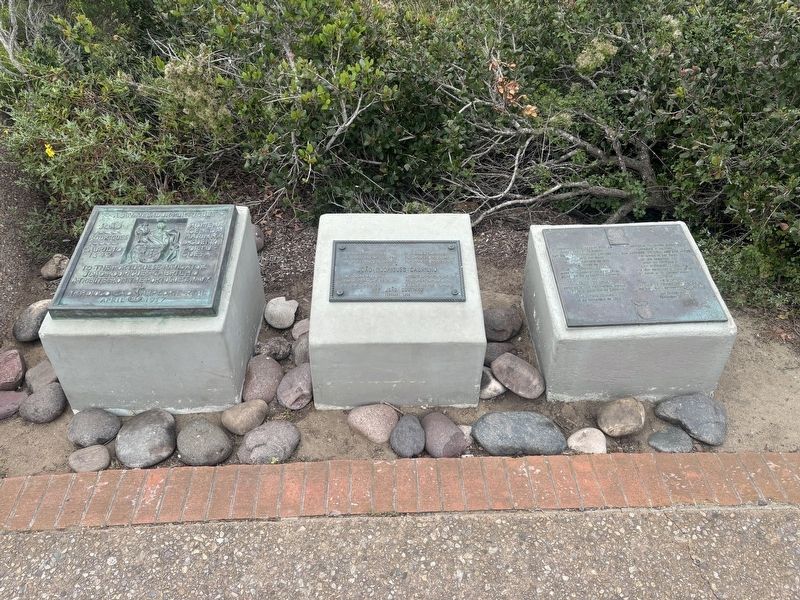
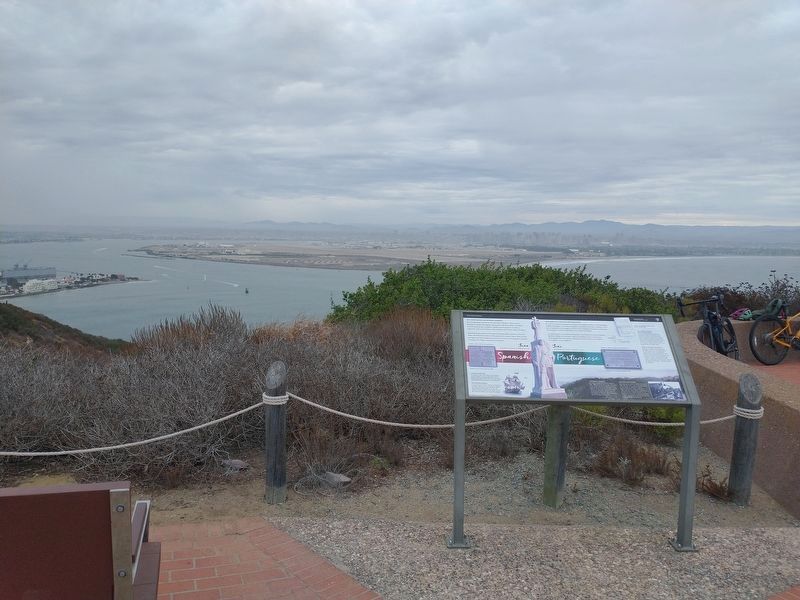
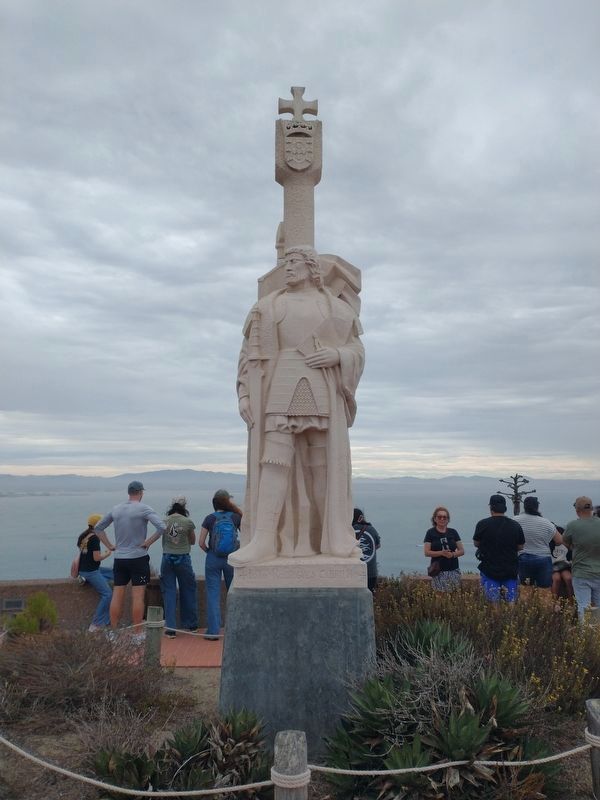
Monuments are symbols of the past and shape public memory. They also reflect the beliefs and values of the people who created them. What would this statue and these plaques mean to you if you were Portuguese? Spanish? A member of a Native American community?
Captions:
Installed in 2003, a gift by the Spanish Navy
A SPANISH EXPEDITION The Viceroy ot New Spain, Antonio de Mendoza, selected Cabrillo to lead an exploration of the Pacific coast. Cabrillo sailed into San Diego harbor under the Spanish flag aboard the San Salvador.
installed in 1988, Portuguese statue rededication
NOT CARVED IN STONE:
HOW HISTORY EVOLVES
For years, people thought Cabrillo was Portuguese based on a historical record written a generation after Cabrillo died. In 2015, a historian stumbled across Cabrillo's name in this legal document dated February 12, 1552. In it, Cabrillo identifies himself as "a native of Palma de Micer Gilio," now Palma del Rio in Cordoba, Spain.
A COMMUNITY TRADITION San Diego held the first Cabrillo Festival in 1892. Members of the Portuguese community in San Diego have been supporting Cabrillo National Monument since the 1930s. Cabrillo Festival, Inc. has held a festival since 1964 honoring the Mexican, Native American, Portuguese and Spanish cultures that are a part of the Age of Exploration.
(Spanish text not transcribed)
Erected by National
this page online
Topics. This historical marker is listed in this topic list: Exploration. A significant historical year for this entry is 1615.
Location. 32° 40.443′ N, 117° 14.344′ W. Marker is in San Diego, California, in San Diego County. It is in Point Loma. It is on Cabrillo Memorial Drive. Touch for map. Marker is at or near this postal address: 1800 Cabrillo Memorial Drive, San Diego CA 92106, United States of America. Touch for directions.

Regionally, this marker is in California’s Peninsular Ranges. It is also in the American Borderlands and on the Pacific Coast. Globally, it is in North America, on the Ring of Fire, on the Pacific Rim, in the Western Hemisphere, in the Western World, and in the Anglosphere. Historically, it finds itself in what was once New Spain and also Mexico’s Alta California.
Other nearby markers. At least 8 other markers are within walking distance of this marker: João Rodrigues Cabrilho 1542 (here, next to this marker); In Homage to the Spanish Expedition (here, next to this marker); Beyond Their Known World (within shouting distance of this marker); Stephen Tyng Mather
Photographed by Connor Olson, March 31, 2026
2. Why Portuguese and Spanish Plaques?
Another marker is no longer nearby. Cabrillo’s Ships (was within shouting distance of this marker but has been reported to have been replaced with another marker now near it).
Photographed by Tom Bosse, September 6, 2026
3. Why Portuguese and Spanish Plaques? Marker
Photographed by Tom Bosse, September 6, 2026
4. João Rodriguez Cabrillo Statue
Credits. This page was last revised on September 16, 2026. It was originally submitted on April 17, 2026, by Connor Olson of Menomonee Falls, Wisconsin. This page has been viewed 20 times since then. Photos: 1, 2. submitted on April 17, 2026, by Connor Olson of Menomonee Falls, Wisconsin. 3, 4. submitted on September 14, 2026, by Tom Bosse of Jefferson City, Tennessee. • Andrew Ruppenstein was the editor who published this page.
