Lambeth in Greater London, England, United Kingdom — Northwestern Europe (the British Isles)
St Mark’s Church
Photographed by Andrew Ruppenstein, February 26, 2026
1. St Mark’s Church Marker - Panel One
(Panel One)
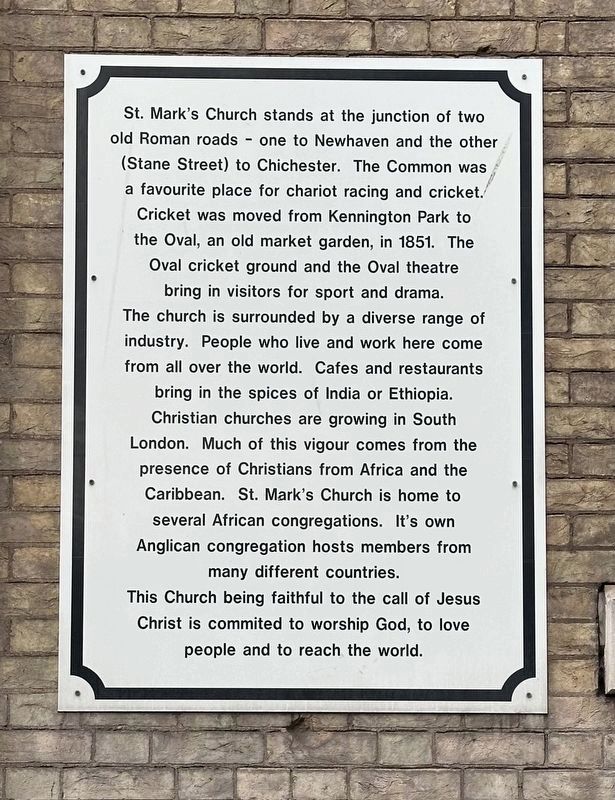
St. Mark's Church stands at the junction of two old Roman roads one to Newhaven and the other (Stane Street) to Chichester. The Common was a favourite place for chariot racing and cricket. Cricket was moved from Kennington Park to the Oval, an old market garden, in 1851. The Oval cricket ground and the Oval theatre bring in visitors for sport and drama.
The church is surrounded by a diverse range of industry. People who live and work here come from all over the world. Cafes and restaurants bring in the spices of India or Ethiopia.
Christian churches are growing in South London. Much of this vigour comes from the presence of Christians from Africa and the Caribbean. St. Mark's Church is home to several African congregations. It's own Anglican congregation hosts members from many different countries.
This Church being faithful to the call of Jesus Christ is commited to worship God, to love people and to reach the world.
(Panel Two)
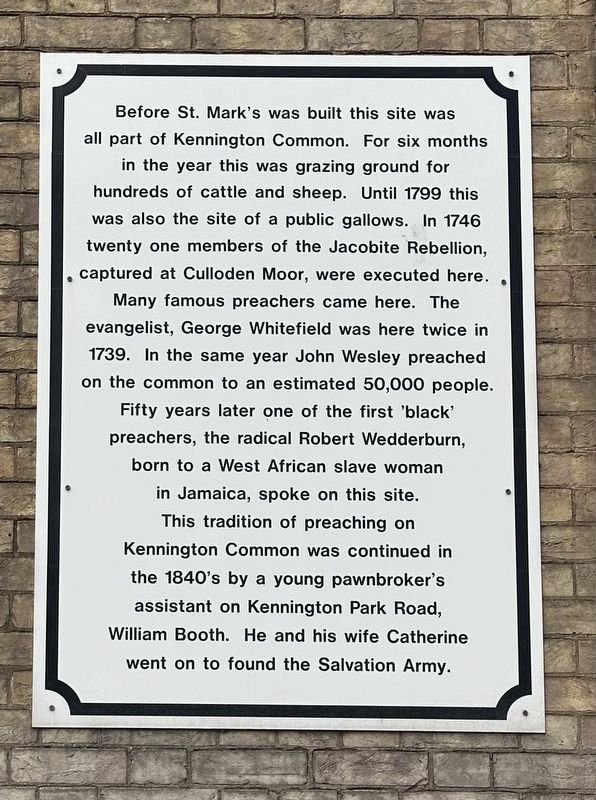
Before St. Mark's was built this site was all part of Kennington Common. For six months in the year this was grazing ground for hundreds of cattle and sheep. Until 1799
this page online
Many famous preachers came here. The evangelist, George Whitefield was here twice in 1739. In the same year John Wesley preached on the common to an estimated 50,000 people.
Fifty years later one of the first 'black' preachers, the radical Robert Wedderburn, born to a West African slave woman in Jamaica, spoke on this site.
This tradition of preaching on Kennington Common was continued in the 1840's by a young pawnbroker's assistant on Kennington Park Road, William Booth. He and his wife Catherine went on to found the Salvation Army.
(Panel Three)
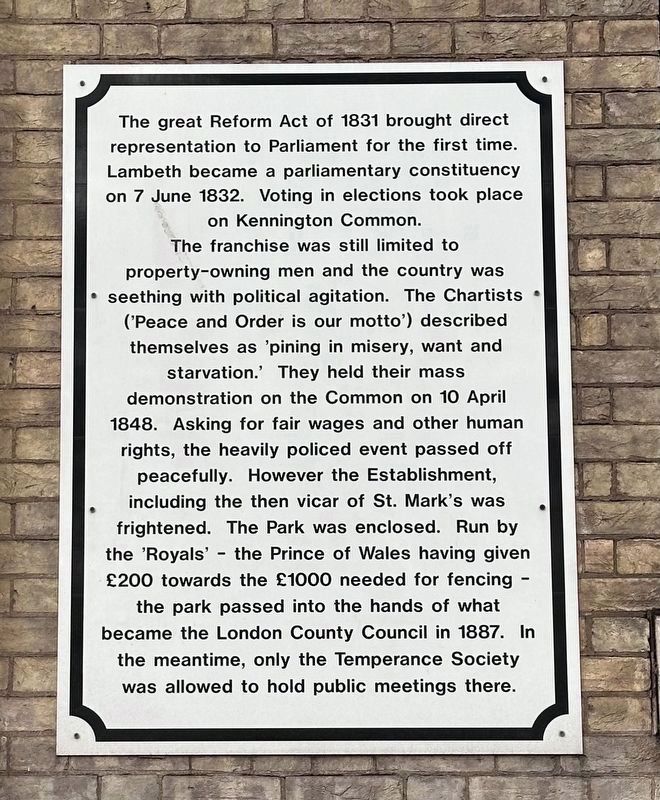
The great Reform Act of 1831 brought direct representation to Parliament for the first time. Lambeth became a parliamentary constituency on 7 June 1832. Voting in elections took place on Kennington Common.
Limited to property-owning men, the franchise led to widespread unrest, with Chartists gathering for a major, peaceful demonstration on the Common on 10 April 1848 demanding fair wages and rights. Despite the peaceful nature
Photographed by Andrew Ruppenstein, February 26, 2026
2. St Mark’s Church Marker - Panel Two
(Panel Four)
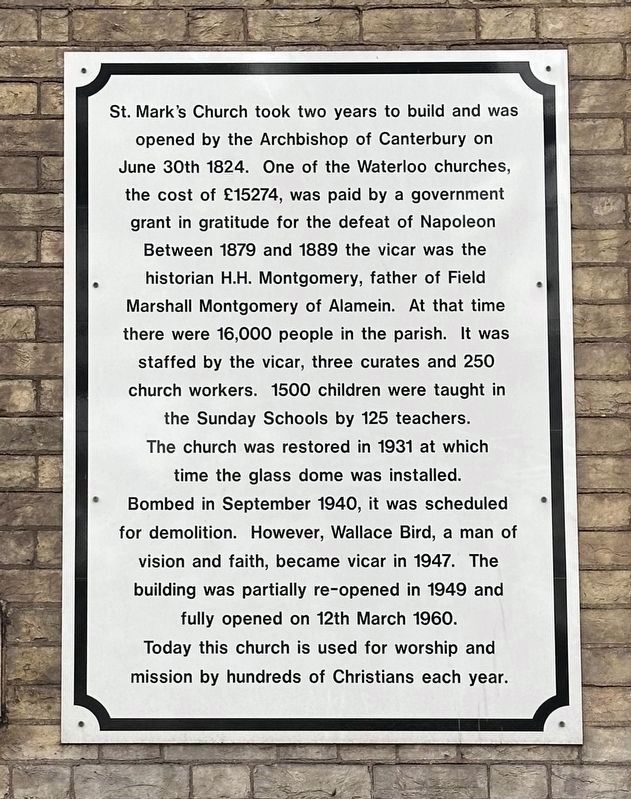
St. Mark’s Church took two years to build and was opened by the Archbishop of Canterbury on June 30th 1824. One of the Waterloo churches, the cost of £15274, was paid by a government grant in gratitude for the defeat of Napoleon.
Between 1879 and 1889 the vicar was the historian H.H. Montgomery, father of Field Marshall Montgomery of Alamein. At that time there were 16,000 people in the parish. It was staffed by the vicar, three curates and 250 church workers. 1500 children were taught in the Sunday Schools by 125 teachers.
The church was restored in 1931 at which time the glass dome was installed. Bombed in September 1940, it was scheduled for demolition. However, Wallace Bird, a man of vision and faith, became
Photographed by Andrew Ruppenstein, February 26, 2026
3. St Mark’s Church Marker - Panel Three
Today this church is used for worship and mission by hundreds of Christians each year.
Topics. This historical marker is listed in this topic list: Religion & Religious Structures. A significant historical date for this entry is March 12, 1960.
Location. 51° 28.888′ N, 0° 6.701′ W. Marker is in Lambeth, England, in Greater London. It is on Camberwell New Road near Kennington Park Road, on the right when traveling east. Touch for map. Marker is at or near this postal address: 337 Kennington Park Road, Lambeth, England SE5 0AT, United Kingdom. Touch for directions.

Regionally, this marker is in the Greater South East. Globally, it is on the Atlantic Ocean, in the North Atlantic Region, in Europe, in Atlantic Europe, on one of the British Isles, in the Western World, and in the Anglosphere. Historically, it finds itself in what was once the Roman Empire.
Other nearby markers. At least 8 other markers are within walking distance of this marker: St. Mark’s Churchyard (within shouting distance of this marker); The First Test Match (about
Photographed by Andrew Ruppenstein, February 26, 2026
4. St Mark’s Church Marker - Panel Four
Also see . . . Kennington, St Mark (Diocese of Southwark). (Submitted on April 21, 2026.)
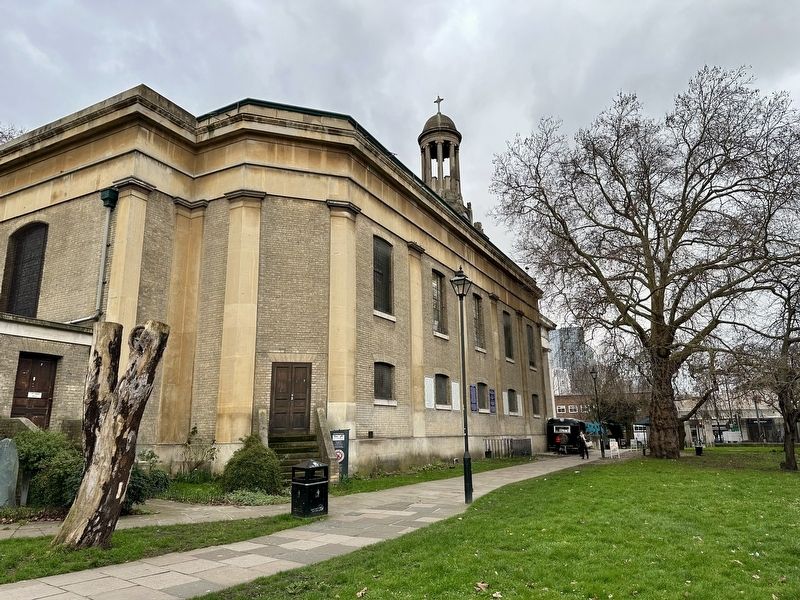
Photographed by Andrew Ruppenstein, February 26, 2026
5. St Mark’s Church Marker - the four panels are mounted to the north side of the church
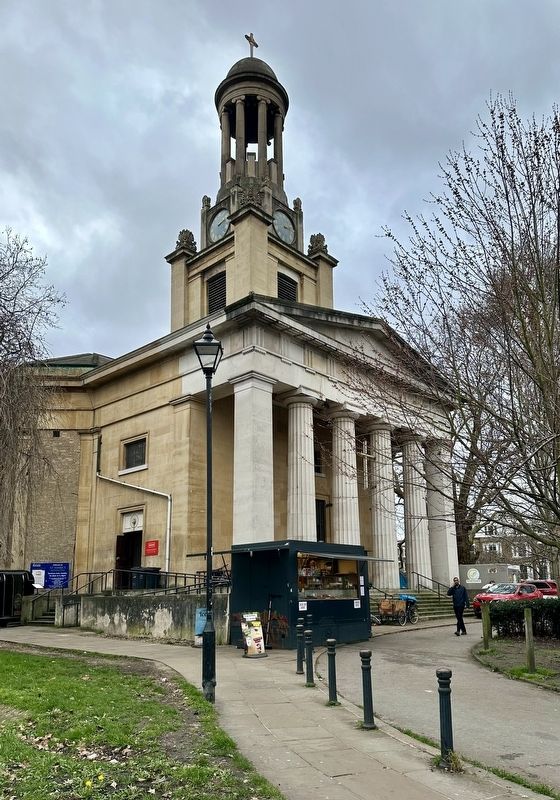
Photographed by Andrew Ruppenstein, February 26, 2026
6. St Mark’s Church (front or east side)
Credits. This page was last revised on April 21, 2026. It was originally submitted on April 18, 2026, by Andrew Ruppenstein of Lamorinda, California. This page has been viewed 31 times since then. Photos: 1, 2. submitted on April 18, 2026, by Andrew Ruppenstein of Lamorinda, California. 3, 4. submitted on April 21, 2026, by Andrew Ruppenstein of Lamorinda, California. 5, 6. submitted on April 18, 2026, by Andrew Ruppenstein of Lamorinda, California.
