
Hollywood in St. Mary's County, Maryland — The American Northeast (Mid-Atlantic)
The Cooper
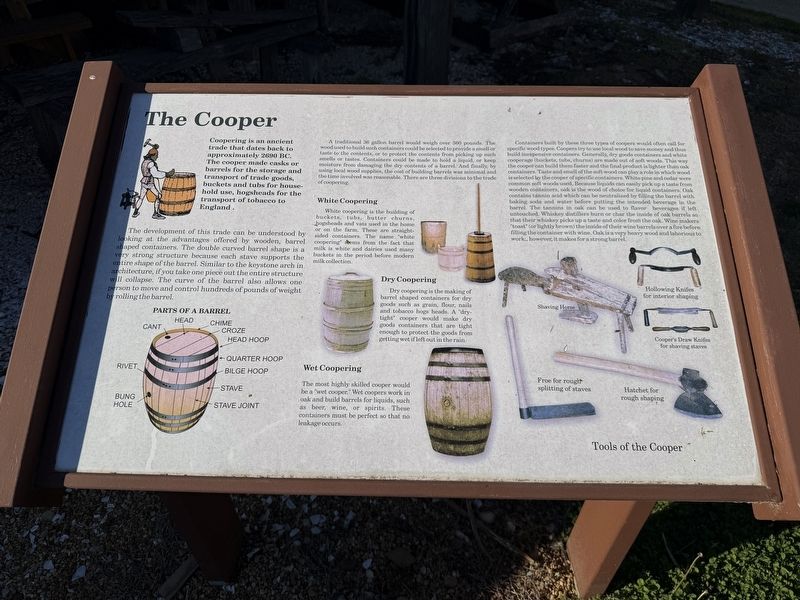
Coopering is an ancient trade that dates back to approximately 2690 BC. The cooper made casks or barrels for the storage and transport of trade goods, buckets and tubs for household use, hogsheads for the transport of tobacco to England.
The development of this trade can be understood by looking at the advantages offered by wooden, barrel-shaped containers. The double curved barrel shape is a very strong structure because each stave supports the entire shape of the barrel. Similar to the keystone arch in architecture, if you take one piece out of the entire structure will collapse. The curve of the barrel also allows one person to move and control hundreds of pounds of weight by rolling the barrel.
A traditional 36 gallon barrel would weigh over 360 pounds. The wood used to build such containers could be selected to provide a smell or taste to the contents, or to protect the contents from picking up such smells or tastes. Containers could be made to hold a liquid, or keep moisture from damaging the dry contents of a barrel. And finally, by using local wood supplies, the cost of building barrels was minimal and the
this page online
White Coopering
White coopering is the building of buckets, tubs, butter churns, hogsheads and vats used in the home or on the farm. These are straight-sided containers. The name "white coopering" stems from the fact that milk is white and dairies used many buckets in the period before modern milk collection.
Dry Coopering
Dry coopering is the making of barrel shaped containers for dry goods such as grain, flour, nails and tobacco hogs heads. A "dry-tight" cooper would make dry goods containers that are tight enough to protect the goods from getting wet if left out in the rain.
Wet Coopering
The most highly skilled cooper would be a "wet cooper." Wet coopers work in oak and build barrels for liquids, such as beer, wine, or spirits. These containers must be perfect so that no leakage occurs.
Containers built by these three types of coopers would often call for specific wood types. Coopers try to use local wood to save money and thus build inexpensive containers. Generally, dry goods containers and white cooperage (buckets, tubs, churns)
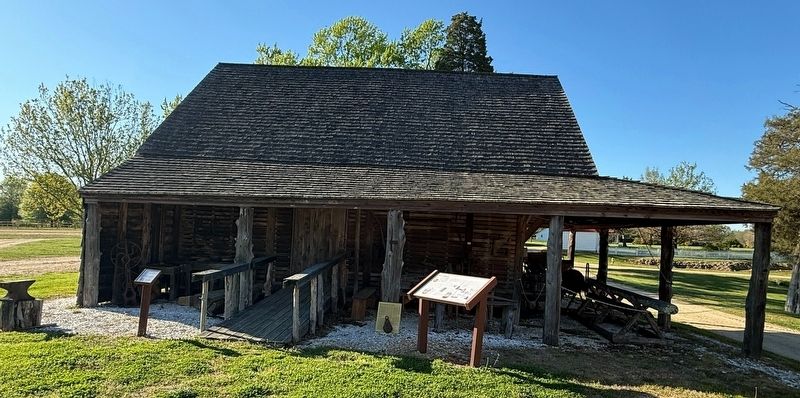
Topics. This historical marker is listed in this topic list: Industry & Commerce. A significant historical year for this entry is 2690 BCE.
Location. 38° 22.53′ N, 76° 32.56′ W. Marker is in Hollywood, Maryland, in St. Mary's County. It is on Sotterley Lane north of Sotterley Wharf Road, on the right when traveling west. Touch for map. Marker is at or near this postal address: 44296 Sotterley Ln, Hollywood MD 20636, United States of America. Touch for directions.

Regionally, this marker is in Southern Maryland. It is also in the American South, specifically in the Upper South, in the Mid-Atlantic, in the Tidewater, in the Chesapeake Bay Region, and on the Eastern Seaboard. Globally, it is in the North Atlantic Region, North America, the Western Hemisphere, the Western World, and the Anglosphere. Historically, it finds itself in what was once one of the original Thirteen Colonies and also the Antebellum South.
Other nearby markers. At least 8 other markers are within walking distance of this marker: Blacksmithing (here, next to this marker); The Sotterly Corn Crib (here, next to this marker); Sotterley's Early Days (a few steps from this marker); Wheelwright (a few steps from this marker); Building a Horse Drawn Wagon (a few steps from this marker); Sotterley's Economy (a few steps from this marker); Sotterley Plantation (a few steps from this marker); War Touches Sotterley (within shouting distance of this marker). Touch for a list and map of all markers in Hollywood.
Credits. This page was last revised on April 18, 2026. It was originally submitted on April 18, 2026, by Devry Becker Jones of Washington, District of Columbia. This page has been viewed 13 times since then. Photos: 1, 2. submitted on April 18, 2026, by Devry Becker Jones of Washington, District of Columbia.
