Berliner Innenstadt in Mitte, Germany — Northeast German Plain (The European Plain)
Riesen & Wunder
Photographed by James Hulse, March 7, 2026
1. Riesen & Wunder Marker

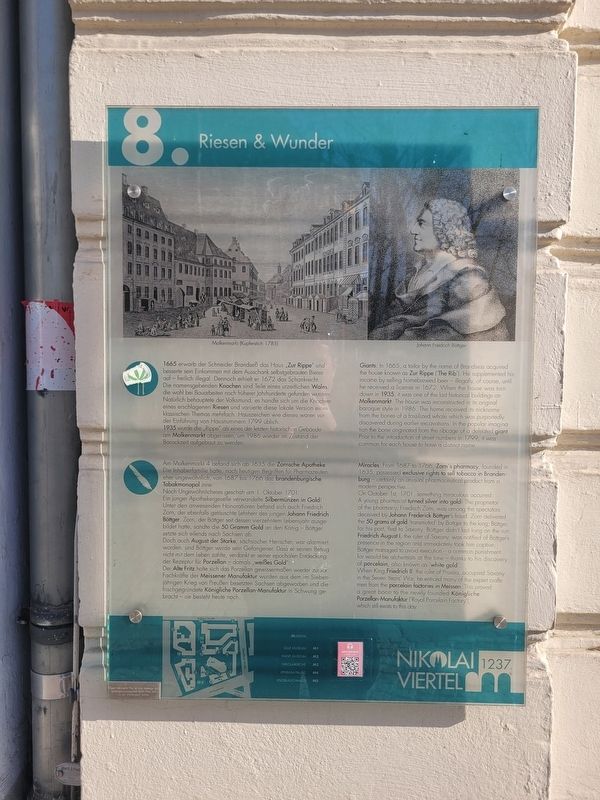
1665 erwarb der Schneider Brandseß das Haus „Zur Rippe“ und besserte sein Einkommen mit dem Ausschank selbstgebrauten Bieres auf, freilich illegal. Dennoch erhielt er 1672 das Schankrecht. Die namensgebenden Knochen sind Teile eines urzeitlichen Wales, die wohl bei Bauarbeiten früherer Jahrhunderte gefunden wurden. Der Volksmund behauptete, es handle sich um die Knochen eines erschlagenen Riesen und variierte diese lokale Version eines klassischen Themas mehrfach. Hauszeichen wie dieses waren vor der Einführung von Hausnummern 1799 üblich. 1935 wurde die „Rippe“ als eines der letzten historischen Gebäude am Molkenmarkt abgerissen, um 1986 wieder im Zustand der Barockzeit aufgebaut zu werden.
Am Molkenmarkt 4 befand sich ab 1635 die Zornsche Apotheke. Die Inhaberfamilie hatte, nach heutigen Begriffen für Pharmazeuten eher ungewöhnlich, von 1687 bis 1766 das brandenburgische Tabakmonopol inne. Noch Ungewöhnlicheres geschah am 1. Oktober 1701: Ein junger Apothekergeselle verwandelte Silbermünzen in Gold! Unter den anwesenden Honoratioren befand sich auch Friedrich Zorn, der ebenfalls getäuschte Lehrherr
this page online
Molkenmarkt (Kupferstich 1785)
Johann Friedrich Böttger
Giants: In 1665, a tailer by the name of Brandsess acquired the house known as Zur Rippe ('The Rib'). He supplemented his income by selling homebrewed beer illegally, of course, until he received a license in 1672. When the house was torn down in 1935, it was one of the last historical buildings on Molkenmarkt. The house was reconstructed
Photographed by James Hulse, March 7, 2026
2. Riesen & Wunder Marker
Miracles: From 1687 to 1766, Zorn's pharmacy, founded in 1635, possessed exclusive rights to sell tobacco in Brandenburg - certainly an unusual pharmaceutical product from a modern perspective. On October 1st, 1701, something miraculous occurred: A young pharmacist turned silver into gold! The proprietor of the pharmacy, Friedrich Zorn, was among the spectators deceived by Johann Frederick Böttger's fraud. Zorn delivered the 50 grams of gold 'transmuted' by Böttger to the king; Böttger, for his part, fled to Saxony. Böttger didn't last long on the run: Friedrich August I, the ruler of Saxony, was notified of Böttger's presence in the region and immediately took him captive. Böttger managed to avoid execution - a common punishment for would-be alchemists at the time thanks to
Photographed by James Hulse, March 7, 2026
3. Riesen & Wunder Marker
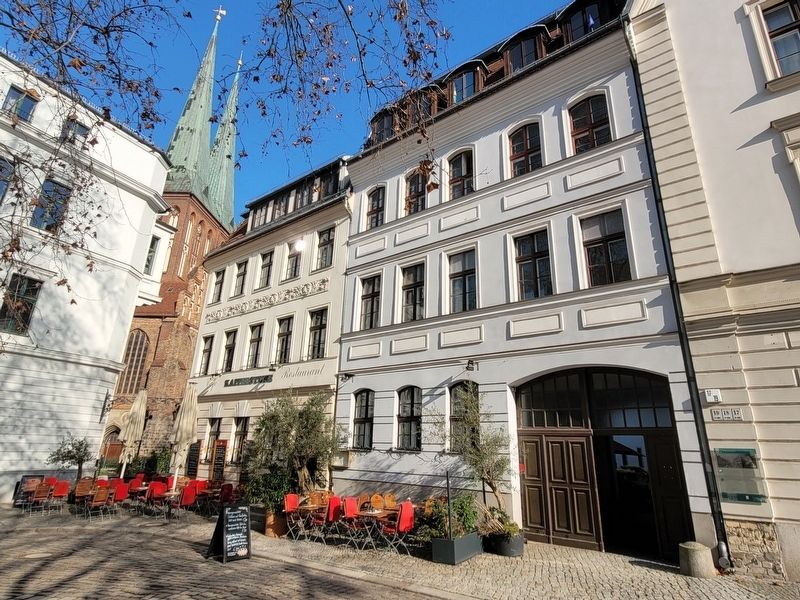
The view of the marker from the street.
Molkenmarkt (Copper Engraving, 1785)
Johann Friedrich Böttger
Erected by Nikolai Viertel 1237. (Marker Number 8.)
Topics. This historical marker is listed in this topic list: Notable Buildings. A significant historical date for this entry is October 1, 1701.
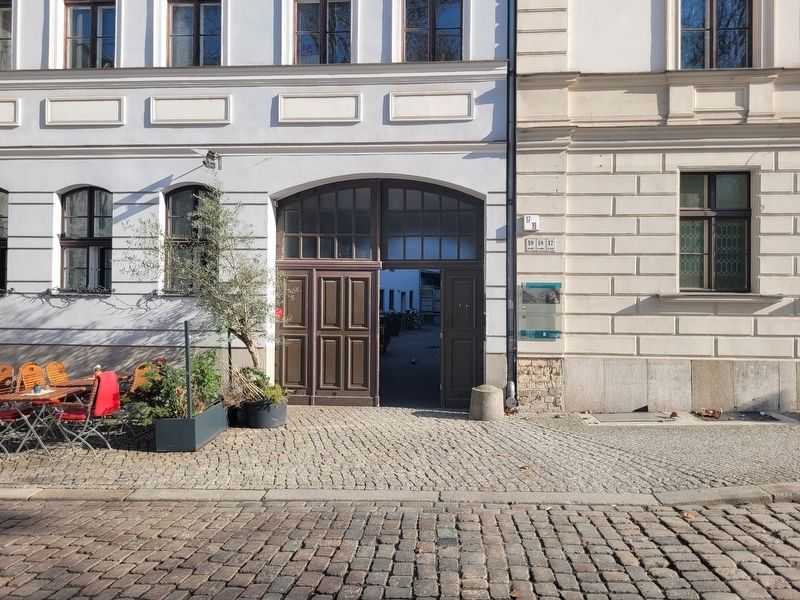
Location. 52° 30.978′ N, 13° 24.467′ E. Marker is in Berlin, in Mitte. It is in Berliner Innenstadt. It is at the intersection of Poststraße and Mühlendamm, on the right when traveling west on Poststraße. Touch for map. Marker is at or near this postal address: Poststraße 19, Berlin 10178, Germany. Touch for directions.

Regionally, it is in Europe, the European Union, Atlantic Europe, Central Europe, the Schengen Area, Western Europe, and the Western World. Historically, it finds itself in what was once the Holy Roman Empire, the former East Germany, and at the Berlin Wall.
Other nearby markers. At least 8 other markers are within walking distance of this marker: Profit & Pogrom (within shouting distance of this marker); Knoblauchhaus & Schuberthaus / Knoblauch House & Schubert House (within shouting distance of this marker); Ephraims Mobilie / Ephraim’s Movable Palace (within shouting distance of this marker); Geschäftshaus / Commercial Building (within shouting distance of this marker); Ephraim-Palais / Ephraim Palace (within shouting distance of this marker); Nikolaikirchplatz: Lessing vs. Preußen / Nikolaikirchplatz: Lessing vs. Prussia (within shouting distance of this marker); Knoblauchhaus / Knoblauch House (within shouting distance of this marker); Museum für Leibesübungen / Museum of Physical Exercise (within shouting distance of this marker). Touch for a list and map of all markers in Berlin.
Credits. This page was last revised on April 22, 2026. It was originally submitted on April 20, 2026, by James Hulse of Medina, Texas. This page has been viewed 22 times since then. Photos: 1, 2, 3. submitted on April 22, 2026, by James Hulse of Medina, Texas.
