Berliner Innenstadt in Mitte, Germany — Northeast German Plain (The European Plain)
Berlins Hauptstadt
⎯⎯⎯
Berlin’s Capital
Photographed by James Hulse, March 7, 2026
1. Berlins Hauptstadt / Berlin’s Capital Marker

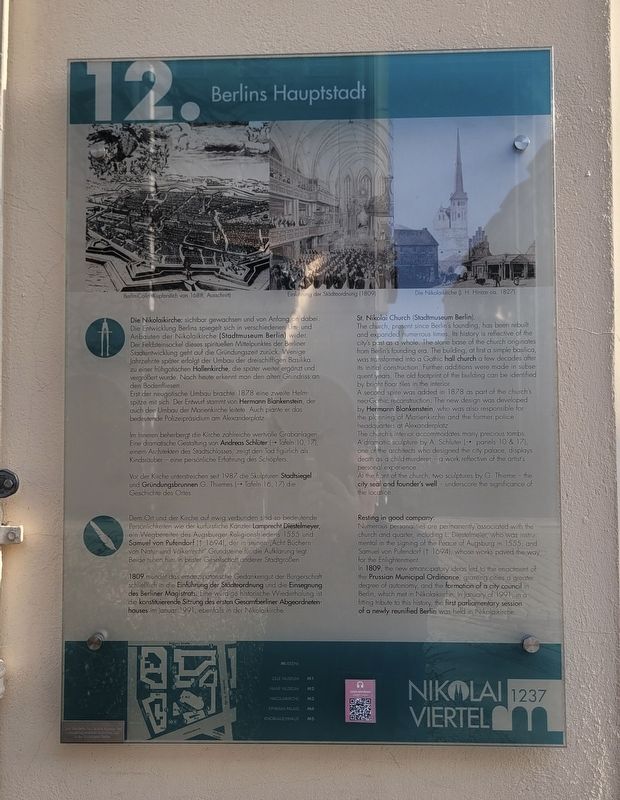
Die Nikolaikirche: sichtbar gewachsen und von Anfang an dabei. Die Entwicklung Berlins spiegelt sich in verschiedenen Um- und Anbauten der Nikolaikirche (Stadtmuseum Berlin) wider. Der Feldsteinsockel dieses spirituellen Mittelpunktes der Berliner Stadtentwicklung geht auf die Gründungszeit zurück. Wenige Jahrzehnte später erfolgt der Umbau der dreischiffigen Basilika zu einer frühgotischen Hallenkirche, die später weiter ergänzt und vergrößert wurde. Noch heute erkennt man den alten Grundriss an den Bodenfliesen.
Erst der neugotische Umbau brachte 1878 eine zweite Helmspitze mit sich. Der Entwurf stammt von Hermann Blankenstein, der auch den Umbau der Marienkirche leitete. Auch plante er das bedeutende Polizeipräsidium am Alexanderplatz.
Im Inneren beherbergt die Kirche zahlreiche wertvolle Grabanlagen. Eine dramatische Gestaltung von Andreas Schlüter (Tafeln 10, 17), einem Architekten des Stadtschlosses, zeigt den Tod figürlich als Kindsräuber – eine persönliche Erfahrung des Schöpfers.
Vor der Kirche unterstreichen seit 1987 die Skulpturen Stadtsiegel und Gründungsbrunnen (G. Thieme, (Tafeln 16, 17) die Geschichte des Ortes.
Dem Ort und der Kirche auf ewig verbunden sind bedeutende Persönlichkeiten wie der kurfürstliche Kanzler Lamprecht Diestelmeyer, ein Wegbereiter des Augsburger Religionsfriedens 1555, und Samuel von Pufendorf († 1694), der in seinen „Acht Büchern von Natur- und Völkerrecht“ Grundsteine für die Aufklärung legte. Beide ruhen hier in bester Gesellschaft anderer Stadtgrößen.
1809 mündet das emanzipatorische Gedankengut der Bürgerschaft schließlich in die Einführung der Städteordnung
this page online
Berlin-Colln (Kupferstich von 1688, Ausschnitt)
Einführung der Städteordnung (1809)
Die Nikolaikirche (J.H. Hintze ca. 1827)
St. Nikolai Church (Stadtmuseum Berlin):
The church, present since Berlin's founding, has been rebuilt and expanded numerous times. Its history is reflective of the city's past as a whole. The stone base of the church originates from Berlin's founding era. The building, at first a simple basilica, was transformed into a Gothic hall church a few decades after its initial construction. Further additions were made in subsequent years. The old footprint of the building can be identified by bright floor tiles in the interior.
A second spire was added in 1878 as part of the church's neo-Gothic reconstruction. The new design was developed by Hermann Blankenstein, who was also responsible for the planning of Marienkirche and the former police headquarters at Alexanderplatz.
The church's interior accommodates many precious tombs. A dramatic sculpture by A. Schlüter (panels 10 & 17), one of the architects who designed the city palace, displays death as a child murderer a work reflective of the artist's personal experience. At the front of the church, two sculptures by C. Thieme - the city seal and founder's well - underscore the significance of the location.
Resting in good company:
Numerous personalities are permanently associated with the church and quarter,
Photographed by James Hulse, March 7, 2026
2. Berlins Hauptstadt / Berlin’s Capital Marker
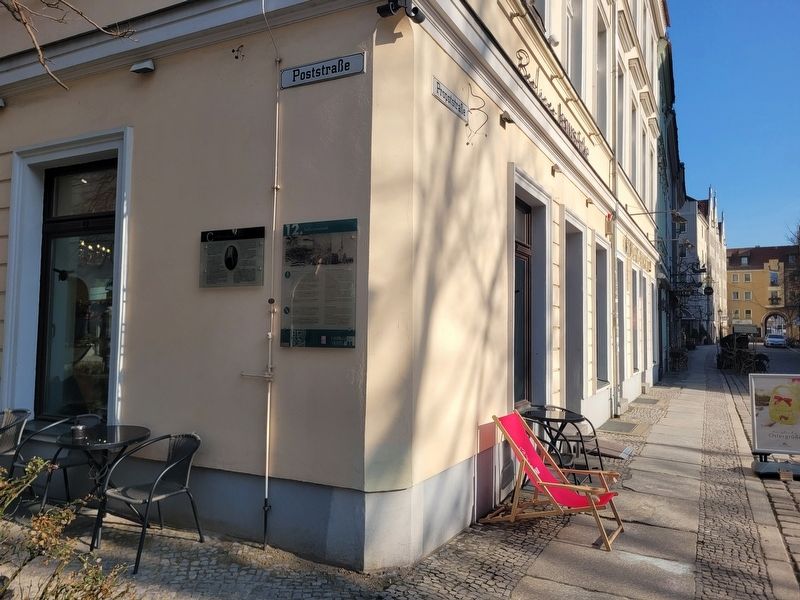
The view of the marker along the corner of the building. The marker on the left is the Carl Hildebrand von Canstein marker.
In 1809, the new emancipatory ideas led to the enactment of the Prussian Municipal Ordinance, granting cities a greater degree of autonomy, and the formation of a city council in Berlin, which met in Nikolaikirche. In January of 1991, in a fitting tribute to this history, the first parliamentary session of a newly reunified Berlin was held in Nikolaikirche.
Berlin-Cölln (copper engraving from 1688, detail)
Introduction of the municipal code (1809)
St. Nicholas Church (J.H. Hintze, ca. 1827)
Erected by Nikolai Viertel 1237. (Marker Number 12.)
Topics. This historical marker is listed in this topic list: Notable Buildings. A significant historical month for this entry is January 1991.
Location. 52° 31.007′ N, 13° 24.395′ E. Marker is in Berlin, in Mitte. It is in Berliner Innenstadt. It is at the intersection of Poststraße and Nikolaikirchpl., on the right when traveling north on Poststraße. Touch for map. Marker is at or near this postal address: Poststraße 26, Berlin 10178, Germany. Touch for directions.

Regionally, it is in Europe, the European Union, Atlantic Europe, Central Europe, the Schengen Area, Western Europe, and the Western World. Historically, it finds itself in what was once the Holy Roman Empire, the former East Germany, and at the Berlin Wall.
Other nearby markers. At least 8 other markers are within walking distance of this marker: Carl Hildebrand von Canstein (here, next to this marker); Zille, Heinrich (a few
Photographed by James Hulse, March 7, 2026
3. Berlins Hauptstadt / Berlin’s Capital Marker
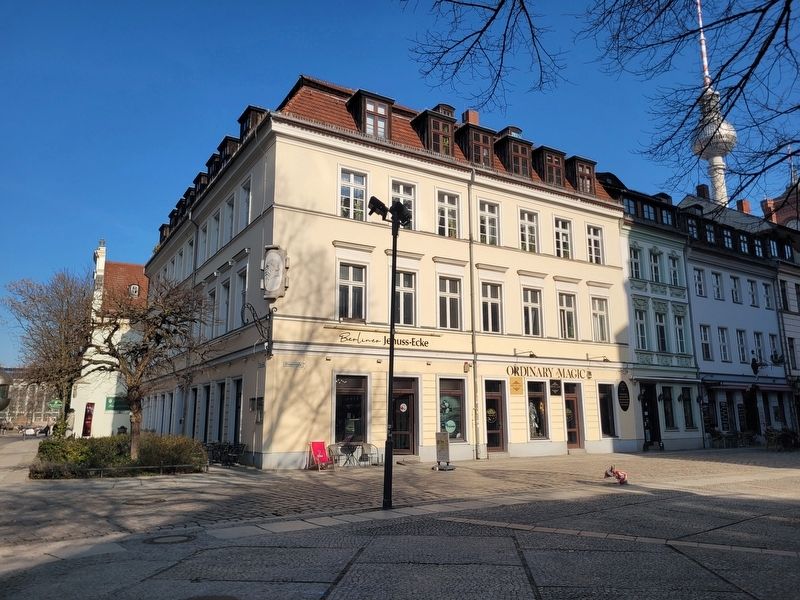
The view of the markers from across the street.
Photographed by James Hulse, March 7, 2026
4. Berlins Hauptstadt / Berlin’s Capital Marker
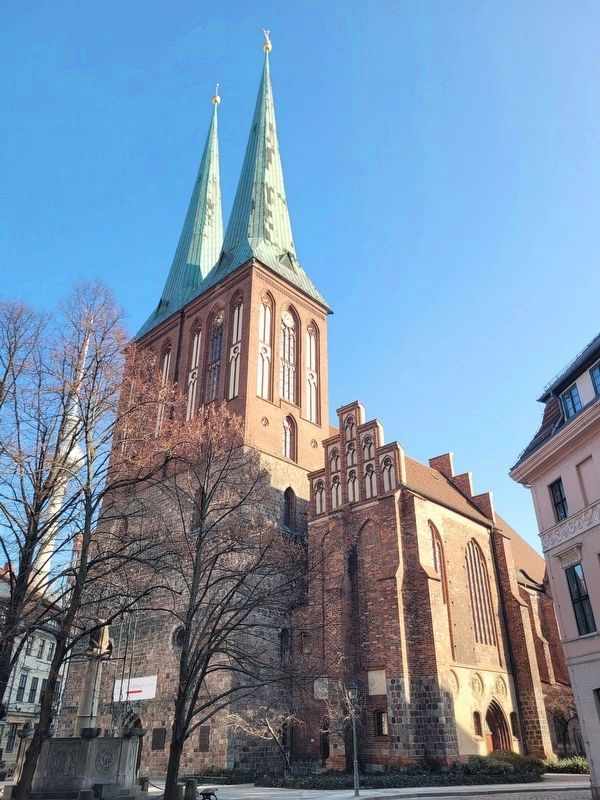
The view of the front of the St. Nikolai Church.
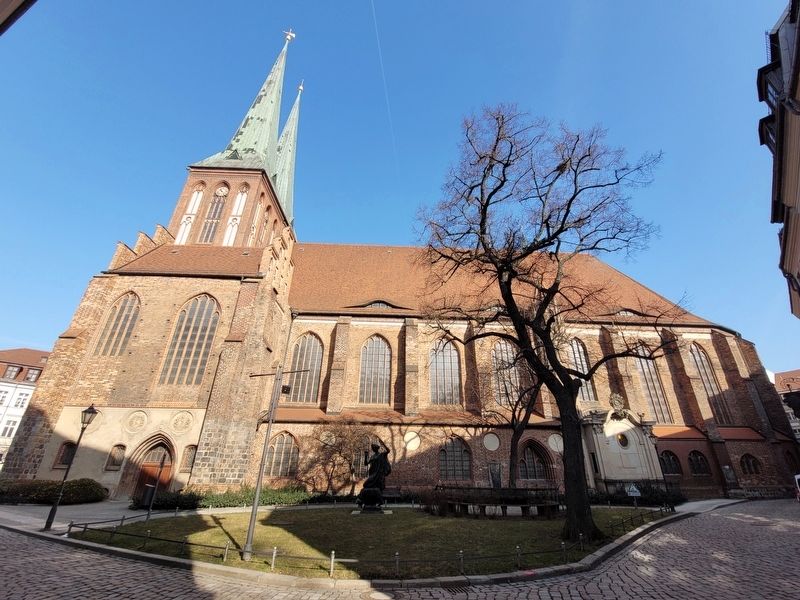
Photographed by James Hulse, March 7, 2026
5. Berlins Hauptstadt / Berlin’s Capital Marker
The view of the side of the St. Nikolai Church.
Credits. This page was last revised on April 23, 2026. It was originally submitted on April 20, 2026, by James Hulse of Medina, Texas. This page has been viewed 17 times since then. Photos: 1, 2, 3, 4, 5. submitted on April 23, 2026, by James Hulse of Medina, Texas.
