Old Town in San Diego in San Diego County, California — The American West (Pacific Coastal)
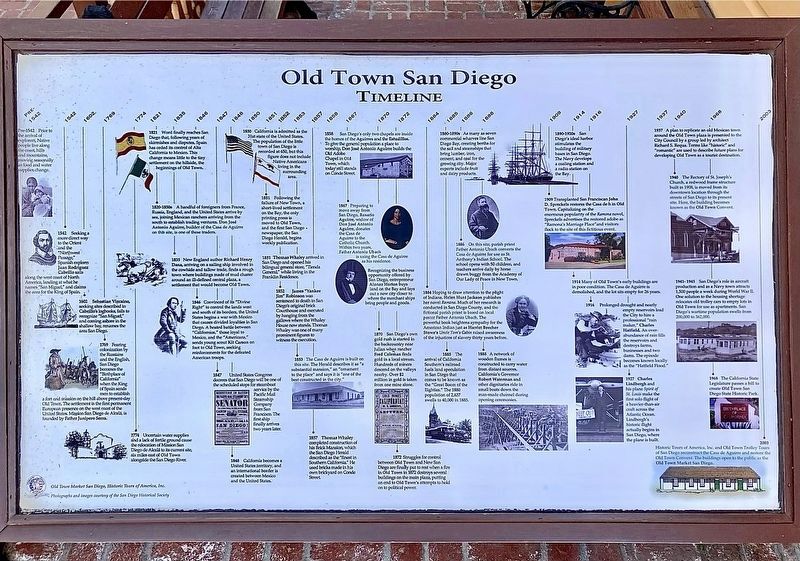
Old Town San Diego Timeline
Photographed by Craig Baker
1. Old Town San Diego Timeline
Pre-1542 - Prior to the arrival of explorers, Native people live along the coast, hills and mountains, moving seasonally as food and water supplies change.
1542 - Seeking a more direct way to the Orient and the "Northwest Passage," Spanish explorer Juan Rodriguez Cabrillo sails along the west coast of North America, landing at what he names "San Miguel," and claims the area for the King of Spain.
1602 - Sebastian Vizcaino, seeking sites described in Cabrillo‘s logbooks, fails to recognize "San Miguel," and coming ashore in the shallow bay, renames the area San Diego.
1769 - Fearing colonization by the Russians and the English, San Diego becomes the "Birthplace of California" when the King of Spain sends men to establish a fort and mission on the hill above present-day Old Town. The settlement is the first permanent European presence on the west coast of the United States. Mission San Diego de Alcalá is founded by Father Junipero Serra.
1774 - Uncertain water supplies and a lack of fertile ground caused the relocation of Mission San Diego de Alcalá to its current site, six miles east of Old Town alongside the San Diego River.
1821 – Word finally reaches San Diego that, following years of skirmishes and disputes, Spain has ceded its control of Alta California to Mexico. This change means
this page online
1820-1850s - A handful of foreigners from France, Russia, England, and the United States arrive by sea, joining Mexican ranchers arriving from the south to establish trading ventures. Don José Antonio Aguirre, builder of the Casa de Aguirre on this site, is one of these traders.
1835 – New England author Richard Henry Dana, arriving on a sailing ship involved in the cowhide and tallow trade, finds a rough town where buildings made of mud cluster around an ill-defined central plaza, a settlement that would become Old Town.
1846 – Convinced of its "Divine Right" to control the lands west and south of its borders, the United States begins a war with Mexico that causes divided loyalties in San Diego. A heated battle between "Californios," those loyal to Mexico, and the "Americans," sends young scout Kit Carson on foot to Old Town, seeking reinforcements for the defeated American troops.
1847 - United States Congress decrees that San Diego will be one of the scheduled stops for steamboat service by the Pacific Mail Steamship Company from San Francisco. The first ship finally arrives two years later.
1848 - California becomes a United States territory, and an international border is created between Mexico and the United States.
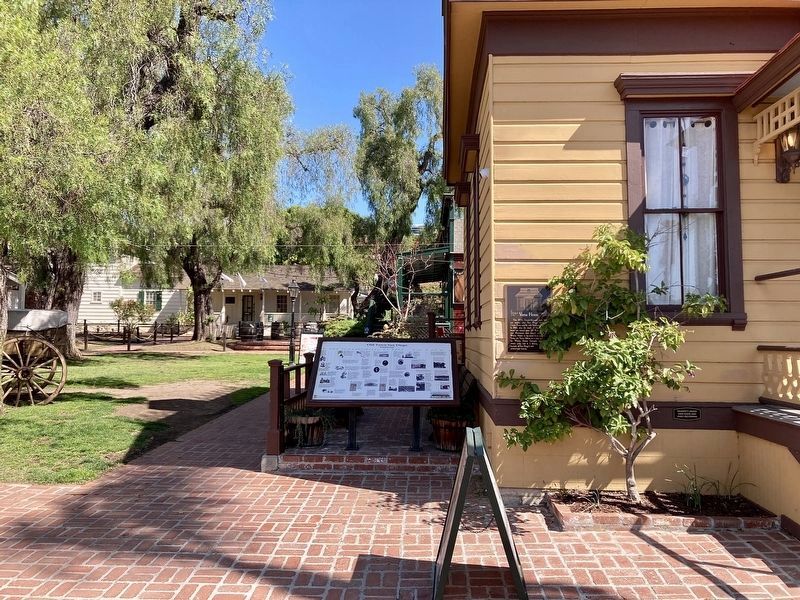
Photographed by Craig Baker, March 9, 2026
2. Old Town San Diego Timeline
1851 - Following the failure of New Town, a short-lived settlement on the Bay, the only printing press is moved to Old Town, and the first San Diego newspaper, the San Diego Herald, begins weekly publication.
1851 - Thomas Whaley arrived in San Diego and opened his bilingual general store, "Tienda General," while living in the Franklin Residence.
1852 - James "Yankee Jim" Robinson was sentenced to death in San Diego‘s original brick Courthouse and executed by hanging from the gallows where the Whaley House now stands. Thomas Whaley was one of many prominent figures to witness the execution.
1853 - The Casa de Aguirre is built on this site. The Herald describes it as "a substantial mansion," an "ornament to the place" and says it is "one of the best constructed in the city."
1857 - Thomas Whaley completed construction of his brick mansion, which the San Diego Herald described as the "finest in Southern California." He used bricks made in his own brickyard on Conde Street.
1858 - San Diego‘s only two chapels are inside the homes of the Aguirres and the Estudillos. To give the general population a place to worship, Don José Antonio Aguirre builds the Old Adobe Chapel in Old Town, which today still stands on Conde Street.
1867 - Preparing to move away from San Diego, Rosario Aguirre, widow of Don Jose Antonio Aguirre, donates the Casa de Aguirre to the Catholic Church. Within two years, father Antonio Ubach is using the Casa de Aguirre as his residence.
Recognizing the business opportunity offered by San Diego, entrepreneur Alonso Horton buys land on the bay and lays out a new city closer to where the merchant ships bring people and goods.
1870 - San Diego’s own gold rush is started in the backcountry near Julian when rancher Fred Coleman finds gold in a local stream. Hundreds of miners descend on the valleys nearby. Over $2 million in gold is taken from one mine alone.
1872 - Struggles for control between Old Town and New San Diego are finally put to rest when a fire in Old Town in 1872 destroys several buildings on the main plaza, putting an end to Old Town’s attempts to hold on to political power.
1880-1890s - As many as seven commercial wharves line San Diego Bay, creating berths for the sail and steamships that bring lumber, iron, cement, and coal for the growing city. Major exports include fruit and dairy products.
1884 - Hoping to draw attention to the plight of Indians, Helen Hunt Jackson publishes her novel Ramona. Much of her research is conducted in San Diego County, and the fictional parish priest is based on local pastor Father Antonio Ubach. The powerful book heightens sympathy for the American Indian just as Harriet Beecher Stowe’s Uncle Tom’s Cabin raised awareness of the injustices of slavery thirty years before.
1885 - The arrival of California Southern’s railroad fuels land speculation in San Diego that comes to be known as the "Great Boom of the Eighties." The 1880 population of 2,637 swells to 40,000 in 1885.
1886 - On this site, parish priest Father Antonio Ubach converts the Casa de Aguirre for use as St. Anthony’s Indian School. The school opens with 50 children, and teachers arrive daily by horse drawn buggy from the Academy of Our Lady of Peace in New Town.
1888 - A network of wooden flumes is constructed to carry water from distant sources. California’s Governor Robert Waterman and other dignitaries ride in small boats down the man-made channel during opening ceremonies.
1890-1920s - San Diego‘s ideal harbor stimulates the building of military bases in San Diego. The Navy develops a coaling station and a radio station on the Bay.
1909 - Transplanted San Franciscan John D. Spreckels restores the Casa de Estudillo in Old Town. Capitalizing on the enormous popularity of the Ramona novel, Spreckels advertises the restored Adobe as "Ramona’s Marriage Place" and visitors flock to the site of this fictitious event.
1914 - Many of Old Town’s early buildings are in poor condition. The Casa de Aguirre is demolished, and the lot sits empty for 26 years.
1916 - Prolonged drought and nearly empty reservoirs lead the City to hire a professional "rain maker," Charles Hatfield. An over-abundance of rain fills the reservoirs and destroys farms, businesses, and two dams. The episode becomes known locally as the "Hatfield Flood."
1927 - Charles Lindbergh and his plane Spirit of St. Louis make the first solo flight of a heavier-than-air craft across the Atlantic Ocean. Lindberg’s historic flight actually begins in San Diego, where the plane is built.
1937 - A plan to replicate an old Mexican town around the Old Town plaza is presented to the City Council by a group led by architect Richard S. Requa. Terms like "historic" and "romantic" are used to describe future plans for developing Old Town as a tourist destination.
1940 - The rectory of Saint Joseph’s Church, a redwood frame structure built in 1908, is moved from its downtown location through the streets of San Diego to its present site. Here, the building becomes known as the Old Town Convent.
1941-1945 - San Diego‘s role in aircraft production and as a Navy town attracts 1,500 people a week during World War II. One solution to the housing shortage relocates old trolley cars to empty lots in Old Town for use as apartments. San Diego‘s wartime population swells from 200,000 to 362,000.
1968 - The California State Legislature passes a bill to create Old Town San Diego State Historic Park.
2003 - Historic Tours of America, Inc. and Old Town Trolley Tours of San Diego reconstruct the Casa de Aguirre and restore the Old Town Convent. The buildings open to the public as the Old Town Market San Diego.
Erected by Old Town Market San Diego, Historic Tours of America, Inc.
Topics. This historical marker is listed in these topic lists: Industry & Commerce • Settlements & Settlers.
Location. 32° 45.163′ N, 117° 11.668′ W. Marker is in San Diego, California, in San Diego County. It is in Old Town. It is on San Diego Avenue east of Harney Street, on the left when traveling east. Touch for map. Marker is at or near this postal address: 2476 San Diego Ave, San Diego CA 92110, United States of America. Touch for directions.

Regionally, this marker is in the Peninsular Ranges. It is also in the American Borderlands and on the Pacific Coast. Globally, it is in North America, on the Ring of Fire, on the Pacific Rim, in the Western Hemisphere, in the Western World, and in the Anglosphere. Historically, it finds itself in what was once New Spain and also Mexico’s Alta California.
Other nearby markers. At least 8 other markers are within walking distance of this marker: Verna House (here, next to this marker); James "Yankee Jim" Robinson (a few steps from this marker); The Whaley House (a few steps from this marker); The Whaley House Courtroom (within shouting distance of this marker); Derby Dike (within shouting distance of this marker); Lt. George H. Derby (within shouting distance of this marker); Derby-Pendleton House (within shouting distance of this marker); Adobe Chapel of The Immaculate Conception (about 400 feet away, measured in a direct line). Touch for a list and map of all markers in San Diego.
More about this marker. Identical timelines are in a few locations in Old Town.
Related marker. Click here for another marker that is related to this marker. — Another, nearly identical Old Town Timeline.
Credits. This page was last revised on April 30, 2026. It was originally submitted on April 20, 2026, by Craig Baker of Sylmar, California. This page has been viewed 32 times since then. Photos: 1, 2. submitted on April 20, 2026, by Craig Baker of Sylmar, California.
