Blue Island in Cook County, Illinois — The American Midwest (Great Lakes)
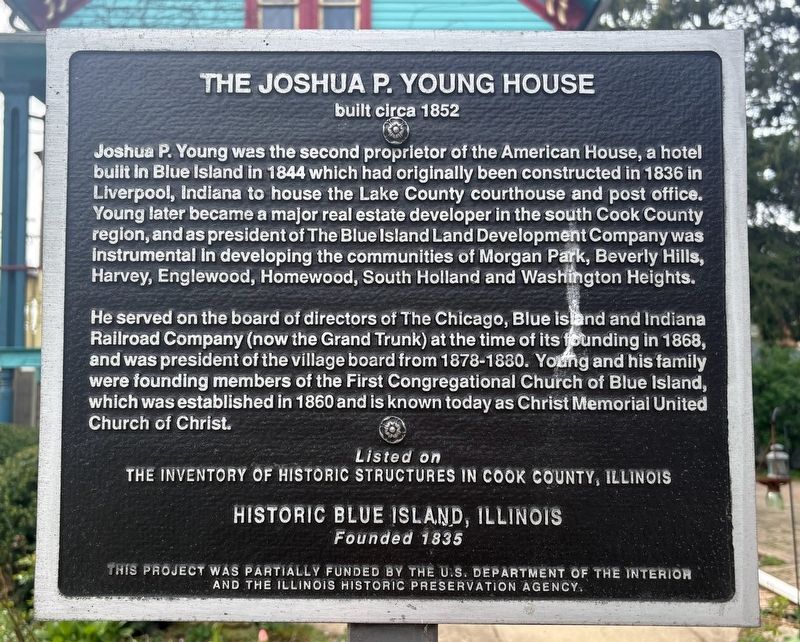
The Joshua P. Young House
built circa 1852
Photographed by Sean P. Flynn, April 19, 2026
1. The Joshua P. Young House Marker
He served on the board of directors of The Chicago, Blue island and Indiana Railroad Company (now the Grand Trunk) at the time of its founding in 1868, and was president of the village board from 1878-1880. Young and his family were founding members of the First Congregational Church of Blue Island, which was established in 1860 and is known today as Christ Memorial United Church of Christ.
Historic Blue Island, Illinois
Founded 1835
This project was supported in part by a Preserve America grant administered by the National Park Service,Department of the Interior
Click or scan to see
this page online
Topics. This historical marker is listed in these topic lists: Notable Buildings • Railroads & Streetcars • Religion & Religious Structures • Settlements & Settlers. A significant historical year for this entry is 1852.
Location. 41° 39.474′ N, 87° 40.909′ W. Marker is on Blue Island, Illinois, in Cook County. It is on High Street east of Greenwood Avenue, on the right when traveling east. Touch for map. Marker is at or near this postal address: 2445 High Street, Blue Island IL 60406, United States of America. Touch for directions.

Regionally, this marker is in Greater Chicago and in the Calumet Region. It is also in the American Midwest. Globally, it is in North America, on the Great Lakes, in the Western Hemisphere, in the Western World, and in the Anglosphere. Historically, it finds itself in what was once the Viceroyalty of New France, the territory of the Mississippian Culture, and the Northwest Territory.
Other nearby markers. At least 8 other markers are within walking distance of this marker: The William Henke House (within shouting distance of this marker); The Alden J. Klein House

Photographed by Sean P. Flynn, April 19, 2026
2. The Joshua P. Young House
Regarding The Joshua P. Young House. Morgan Park, Beverly Hills, Englewood and Washington Heights were all later annexed into the city of Chicago. Blue Island, Harvey, Homewood and South Holland are far southern suburbs of the city with their own municipal governments.
Also see . . . Young House National Register of Historic Places registration form. The Young House was added to the NRHP in 1982. The registration form says that home is also called the McGee House, after the family that owned the home when it was added to the NRHP.
Excerpt: "The McGee House is architecturally significant as one of the oldest, extant examples of a style of building known as 'Chicago cottage'. Built in classic Chicago cottage proportions, the balloon frame of the main one and a half floors rests on a high ground floor. The frame is sheathed in long, narrow horizontal clapboard. The gable ends of the pitched roof face front and rear. Ornamentation surrounds the windows and doors and over-hanging eaves. Large numbers of wood cottages were destroyed in Chicago during the fires of 1871 and 1874, after which laws were passed banning the use of balloon frame within the City limits. The McGee house remains as a prototype of the Chicago cottage."(Submitted on April 20, 2026, by Sean P. Flynn of Oak Park, Illinois.)
Credits. This page was last revised on April 20, 2026. It was originally submitted on April 20, 2026, by Sean P. Flynn of Oak Park, Illinois. This page has been viewed 13 times since then. Photos: 1, 2. submitted on April 20, 2026, by Sean P. Flynn of Oak Park, Illinois.
