
Cottage Grove in Lane County, Oregon — The American West (Northwest)
Stewart and Hinds Building
1907-08
| — | Cottage Grove Downtown Commercial Historic District | — |

Photographed by Douglass Halvorsen, April 11, 2026
1. Stewart and Hinds Building Marker
This property has been placed on the National Register of Historic Places by the United States Department of the Interior and is subject to the provisions of the Oregon Special Assessment Program.
ORS.358.475.565
Topics and series. This historical marker is listed in this topic list: Industry & Commerce. In addition, it is included in the National Register of Historic Places (NRHP) series list.
Location. 43° 47.832′ N, 123° 3.614′ W. Marker is in Cottage Grove, Oregon, in Lane County. It is at the intersection of East Main Street and S 8th Street, on the left when traveling west on East Main Street. Touch for map. Marker is at or near this postal address: 737 E Main Street, Cottage Grove OR 97424, United States of America. Touch for directions.

Regionally, this marker is in Oregon’s Willamette Valley. It is also on the American Pacific Coast, in the Pacific Northwest, and in the Lewis & Clark Corridor. Globally, it is in North America, in the Cascade Range, on the Ring of Fire, in the Pacific Rim, in the Western Hemisphere, in the Western World, and
this page online
Other nearby markers. At least 8 other markers are within walking distance of this marker: Animal House (within shouting distance of this marker); Lena Flaiskey Becker (within shouting distance of this marker); Bank Building (about 400 feet away, measured in a direct line); Old City Hall (about 500 feet away); First National Bank of Cottage Grove (about 500 feet away); Billowing Steam to Bicycles (about 600 feet away); The Centennial Bridge (approx. 0.2 miles away); Bohemia Mining Museum / E Clampus Vitus (approx. 0.2 miles away). Touch for a list and map of all markers in Cottage Grove.
Regarding Stewart and Hinds Building. The Stewart and Hinds Building is not individually listed on the National Register of Historic Places (NRHP) but is a primary contributing building (no. 48) within the Cottage Grove Downtown Commercial Historic District, which was listed on the NRHP in 1993.
Also see . . . National Register of Historic Places Registration Form. Cottage Grove Downtown Commercial Historic District Building Inventory Form Description
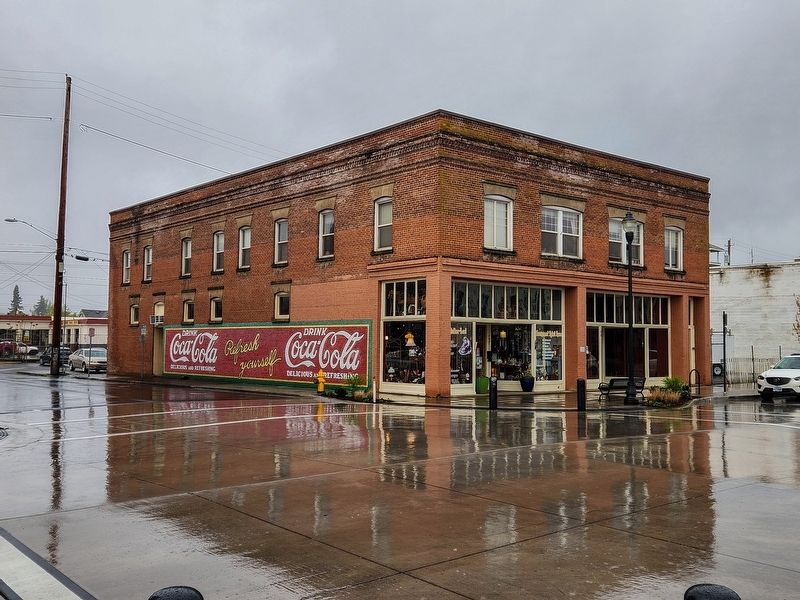
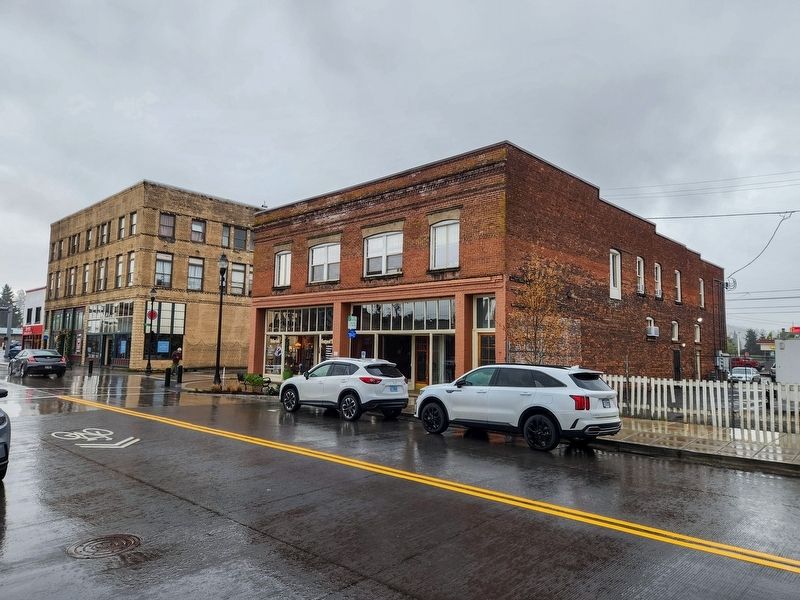
In 1907-1908, Clinton E. Stewart had the Pioneer Hardware Building(Submitted on April 20, 2026, by Douglass Halvorsen of Klamath Falls, Oregon.)built for his father A.J. Stewart. It was constructed as a two-story brick commercial structure and was designed by Eugene architect John Hunzicker. The contractor was H.J. Clark of Grants Pass. The building housed two commercial spaces on the first floor and lodging rooms on the second floor. It was originally known as the Stewart and Hinds Block, or the Stewart Building, depending on local preference. A.J. and Clinton Stewart were farmers, and Fingal Hinds was a local real estate agent. Hinds' involvement in the building has not been ascertained, but it is supposed that he provided financial support. Hardware stores have prevailed in the east half of the building from its inception, the first was Compton-Wallace, who opened for business soon after construction was completed in July of 1908. Subsequent businesses included Rees-Wallace Co. Inc., general merchandise (1910-1911); Knowles and Graber, hardware (1910-1928); and Graber and Getty's Hardware (19??-1952). The Pioneer Hardware Store was in operation from 1952 until 1988 when it was closed by its owner, Mr. A1 Carey. The west half of the building was a furniture store in the earlyPhotographed by Douglass Halvorsen, April 11, 20262. Stewart and Hinds Building Markeryears. The Pioneer Hardware used both commercial spaces for its hardware business. The two commercial spaces are now occupied by the Third Hand Store.Photographed by Douglass Halvorsen, April 11, 20263. Stewart and Hinds Building
The Thompson Hotel (later the Central Hotel), which used to stand to the west of the Stewart Building, provided lodging for miners from the Bohemia mines, and the second floor rooms in the Stewart Building provided for overflow. All visitors ate at the Central Hotel, as there were no cooking facilities in the Stewart Building. The second story doors on the west elevation of the Stewart Building once connected these two structures. In 1947 Dr. Robert Merrick began practice upstairs where Judge John Wells, attorney Maynard Wilson, and Cecil Caldwell's Lumber Co. were already occupying office space. The Caldwell Lumber Company operated from this address from 1947 to 1956.
At the end of each hall there is one toilet enclosure. There was one bath tub, at the end of the east hall, to service the tenants. A historic sign indicates that hot baths cost 25 cents. A Justice of the Peace rented a room for his professional services. The west office complex at the front of the building (secondfloor) is a suite of three rooms, with a central storage closet. The entry door has side lights, there are operable transoms above the doors. Interior finishes are intact. The east office complex is a suite of five rooms with two entry doors from the main hall. The main entry door has side lights. Interior finishes are also intact. All rooms were heated by wood stoves and chimneys are shared between rooms. Access to the second floor is gained by a wide flight of steps from the separate entry door at the west side of the front facade. The stairway is lit by a large transom above the door. Interior rooms are lit by the large light well that extends through the center of the second story. Moisture penetration has destroyed some of the plaster and interior finishes on the second floor.Photographed by Douglass Halvorsen, April 11, 20264. Stewart and Hinds Building
The building remained in the Stewart family until 1989 when Earl Stewart, Clint E. Stewart's son, sold it to Robert Williamson, an attorney in Salem. There is speculation that this was one of the last buildings on Main Street to be built with bricks from the local Hamilton Wallace brickyard, although this has not been substantiated. The building measures 53' x 90', and is very nearly intact, both inside and out. There is some damage to the bricks both on the northwest and southeast comers, and along the west side, probably due to automobile impact. The large painted Coke sign on the east wall of the stmcture originally dates from the late 1920s and has been recently repainted. The building is currently undergoing some remodeling. Carpeting has been laid in the east commercial space. It covers the historic wide board flooring, and the markers that were used to measure chains and lengths of rope. A dividing wall has been constructed and a new bathroom facility will soon be completed. The owner is unsure of what to do with the second floor and may knock out walls, and alter the floor plan to accommodate modern usage as a rental or office spaces. As it exists today it is an outstanding intact example of early 20th century commercial architecture for the city of Cottage Grove.

Credits. This page was last revised on April 22, 2026. It was originally submitted on April 20, 2026, by Douglass Halvorsen of Klamath Falls, Oregon. This page has been viewed 15 times since then. Photos: 1, 2, 3, 4. submitted on April 20, 2026, by Douglass Halvorsen of Klamath Falls, Oregon. • Andrew Ruppenstein was the editor who published this page.
