Berliner Innenstadt in Mitte, Germany — Northeast German Plain (The European Plain)
Hunger vs. Angst
Photographed by James Hulse, March 7, 2026
1. Hunger vs. Angst Marker

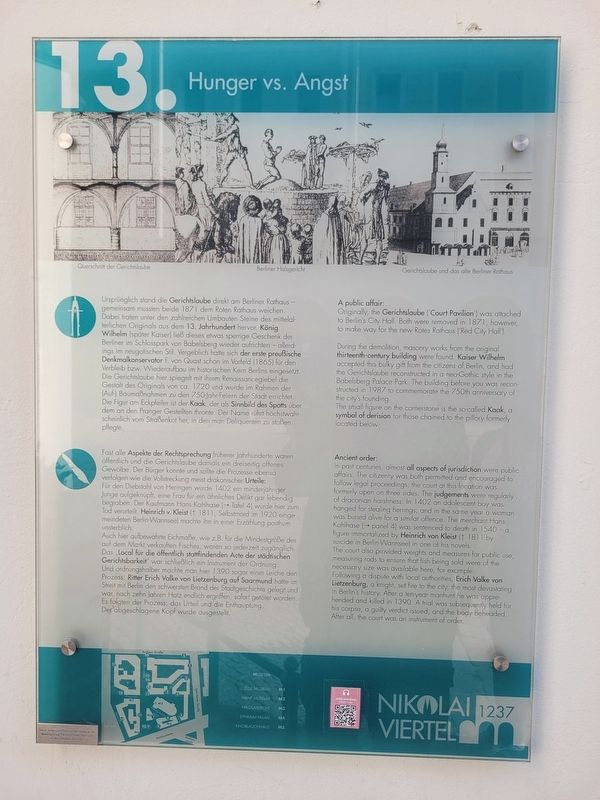
Ursprünglich stand die Gerichtslaube direkt am Berliner Rathaus – gemeinsam mussten beide 1871 dem Roten Rathaus weichen. Dabei traten unter den zahlreichen Umbauten Steine des mittelalterlichen Originals aus dem 13. Jahrhundert hervor. König Wilhelm (später Kaiser) ließ dieses etwas sperrige Geschenk der Berliner im Schlosspark von Babelsberg wieder aufrichten, allerdings im neugotischen Stil. Vergeblich hatte sich der erste preußische Denkmalkonservator F. von Quast schon im Vorfeld (1865) für den Verbleib bzw. Wiederaufbau im historischen Kern Berlins eingesetzt. Die Gerichtslaube hier spiegelt mit ihrem Renaissancegiebel die Gestalt des Originals von ca. 1720 und wurde im Rahmen der (Auf-)Baumaßnahmen zu den 750-Jahr-Feiern der Stadt errichtet. Die Figur am Eckpfeiler ist der Kaak, der als Sinnbild des Spotts über dem an den Pranger Gestellten thronte. Der Name rührt höchstwahrscheinlich vom Straßenkot her, in den man Delinquenten zu stoßen pflegte.
Fast alle Aspekte der Rechtsprechung früherer Jahrhunderte waren öffentlich, und die Gerichtslaube war damals ein dreiseitig offenes Gewölbe. Der Bürger
this page online
Auch hier aufbewahrte Eichmaße, wie z. B. für die Mindestgröße des auf dem Markt verkauften Fisches, waren so jederzeit zugänglich. Das „Local für die öffentlich stattfindenden Akte der städtischen Gerichtsbarkeit“ war schließlich ein Instrument der Ordnung. Und ordnungshalber machte man hier 1390 sogar einer Leiche den Prozess: Ritter Erich Valke von Lietzenburg auf Saarmund hatte im Streit mit Berlin den schwersten Brand der Stadtgeschichte gelegt und war, nach zehn Jahren Hatz endlich ergriffen, sofort getötet worden. Es folgten der Prozess, das Urteil und die Enthauptung. Der abgeschlagene Kopf wurde ausgestellt.
Querschnitt der Gerichtslaube
Berliner Halsgericht
Gerichtslaube und das alte Berliner Rathaus
Photographed by James Hulse, March 7, 2026
2. Hunger vs. Angst Marker
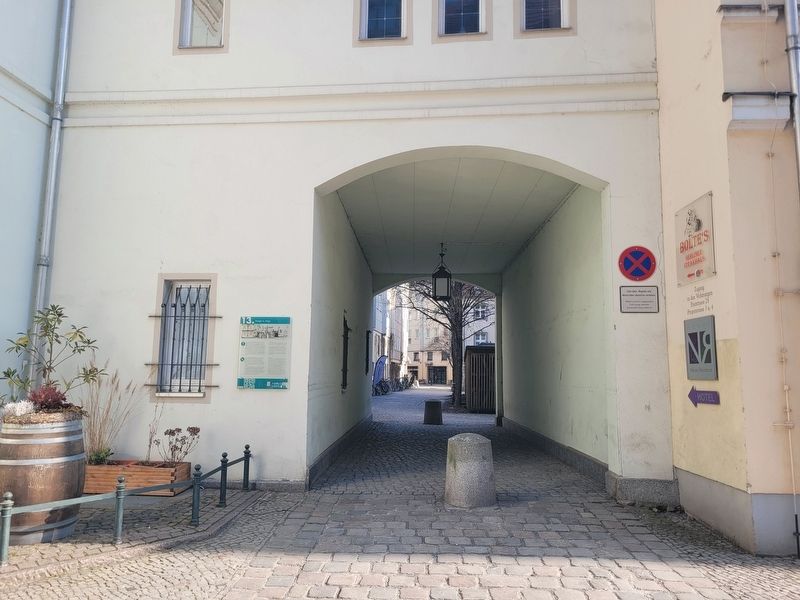
The view of the marker st the left side of the passageway.
Originally, the Gerichtslaube ('Court Pavilion') was attached to Berlin's City Hall. Both were removed in 1871, however, to make way for the new Rotes Rathaus ('Red City Hall').
During the demolition, masonry works from the original thirteenth-century building were found. Kaiser Wilhelm accepted this bulky gift from the citizens of Berlin, and had the Gerichtslaube reconstructed in a neo-Gothic style in the Babelsberg Palace Park. The building before you was reconstructed in 1987 to commemorate the 750th anniversary of the city's founding.
The small figure on the cornerstone is the so-called Kaak, a symbol of derision for those chained to the pillory formerly located below.
Ancient order:
In past centuries, almost all aspects of jurisdiction were public affairs. The citizenry was both permitted and encouraged to follow legal proceedings; the court at this location was formerly open on three sides. The judgements were regularly of dracanian harshness: In 1402 an adolescent boy was hanged for stealing herrings, and in the same year a woman was buried alive for a similar offence. The merchant Hans Kohlhase (→
Photographed by James Hulse, March 7, 2026
3. Hunger vs. Angst Marker
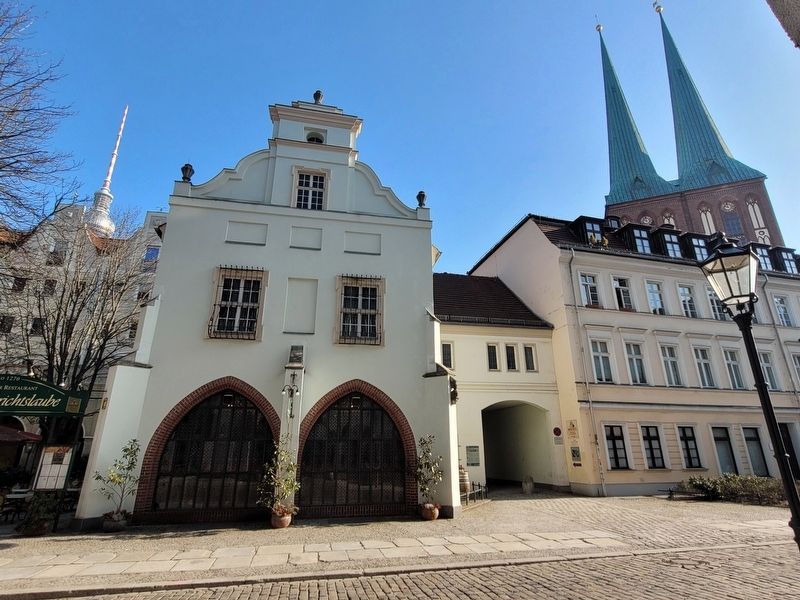
The view of the marker with the St. Nikolai Church in the background.
Cross-section of the Court Pavilion
Berlin Criminal Court
The Court Pavilion and the Old Berlin Town Hall
Erected by Nikolai Viertel 1237. (Marker Number 13.)
Topics. This historical marker is listed in this topic list: Notable Buildings. A significant historical year for this entry is 1871.
Location. 52° 31.021′ N, 13° 24.373′ E. Marker is in Berlin, in Mitte. It is in Berliner Innenstadt. It is at the intersection of Poststraße and Am Nußbaum, on the right when traveling north on Poststraße. Touch for map. Marker is at or near this postal address: Poststraße 28, Berlin 10178, Germany. Touch for directions.

Regionally, it is in Europe, the European Union, Atlantic Europe, Central Europe, the Schengen Area, Western Europe, and the Western World. Historically, it finds itself in what was once the Holy Roman Empire, the former East Germany, and at the Berlin Wall.
Other nearby markers. At least 8 other markers are within walking distance of this marker: Poststraße & Persönlichkeiten / Post Street & Personalities (a few steps from this marker); Zille, Heinrich (within shouting distance of this marker); Carl Gause & Geisterglaube / Carl Gause & Belief in Ghosts (within shouting distance of this marker); Zeittafel der Berliner Geschichte / Timeline of Berlin History (within shouting distance of this marker); Carl Hildebrand von Canstein (within shouting distance of this marker); Berlins Hauptstadt / Berlin’s Capital (within shouting distance of this marker); Nikolaikirche / St. Nicholas Church (within shouting distance of this marker); a different marker also named Nikolaikirche / St. Nicholas Church (within shouting distance of this marker). Touch for a list and map of all markers in Berlin.
Credits. This page was last revised on April 23, 2026. It was originally submitted on April 21, 2026, by James Hulse of Medina, Texas. This page has been viewed 19 times since then. Photos: 1, 2, 3. submitted on April 23, 2026, by James Hulse of Medina, Texas.
