Near Montpelier Station in Orange County, Virginia — The American South (Mid-Atlantic)
Post-Emancipation
Photographed by Craig Swain, September 6, 2009
1. Post-Emancipation Marker
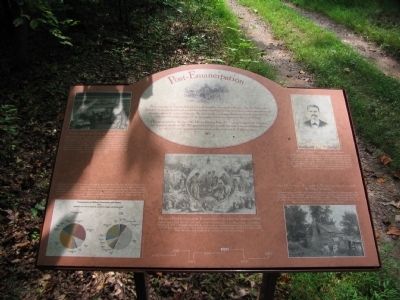
With emancipation, African-Americans found themselves in a complex situation. By law, slavery was abolished, promising freedom and citizenship, but few owned land or had resources to support themselves, and prejudice against them was widespread. Yet, many newly emancipated slaves stayed in the area and took advantage of economic and social ties developed prior to emancipation to obtain a livelihood.
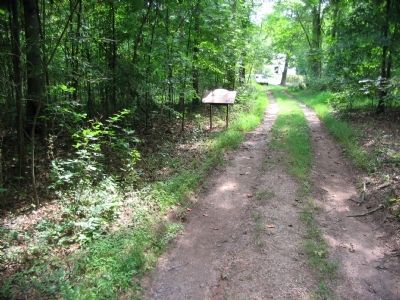
This sign is located at the edge of the 16-acre Gilmore Farm. The Gilmore property ran from this sign to present-day Route 20. The acquisition of land brought African Americans independence and self-sufficiency, confirming their status as new citizens of the American nation.
Harper's Weekly illustration "Emancipation of the Negroes" January 1863
Soon after the Civil War, the 13th, 14th, and 15th amendments to the Constitution were ratified abolishing slavery, defining citizenship to encompass emancipated slaves, and extending voting rights to emancipated slaves. The promise of citizenship, however, was curtailed with the end of Reconstruction, and would not be realized for well over a century.
Interior of freedman's home, Richmond, Virginia
Emancipation
this page online
The great majority of freedmen in Orange County were farm laborers. A comparison of the occupations of African Americans and whites, based on the 1880s census, shows a majority of blacks making their living as laborers while most whites were farmers. Farmers owned land, determined their own production and were able to grow much of the food needed for their families. By contrast, laborers worked as farmhands and were dependent on the farm economy for jobs and income.
Allan Jackson, Orange County freedman
Most newly emancipated slaves stayed in their locality, and worked to create new lives for themselves by establishing homes, earning wages, and reuniting their
Photographed by Craig Swain, September 6, 2009
2. Post-Emancipation Marker
Late 19th-century photograph of African-American farmstead, Richmond, Virginia
For freedmen, one of the most meaningful opportunities offered by emancipation was owning land. Land enabled a family to build their own home and have their own land, giving them some self-sufficiency and security. In western Orange County, within two decades of emancipation, nearly 30 percent of African-American households owned or leased the land on which they had built their homes.
Topics. This historical marker is listed in this topic list: African Americans. A significant historical year for this entry is 1863.
Location. This marker has been replaced by another marker nearby. It was located near 38° 13.626′ N, 78° 10.911′ W. Marker was near Montpelier Station, Virginia, in Orange County. It could be reached from Constitution Highway (State Highway 20), on the right when traveling west. Located on a the Civil War Encampment walking trail on the Montpelier Estate. Touch for map. Marker was in this post office area: Orange VA 22960, United States of America. Touch for directions.

Regionally, this marker was in Northern Virginia and in the Piedmont. It was also in the American South and specifically in the Upper South. Globally, it was in North America, the Western Hemisphere, the Western World, and the Anglosphere. Historically, it found itself in what was once the territory of the Mississippian Culture, one of the original Thirteen Colonies, one of the Confederate States of America, and the Antebellum South.
Other nearby markers. At least 8 other markers are within walking distance of this location: Gilmore Farm: A Freedman's Home (within shouting distance of this marker); Post-Emancipation: A Promise Unfulfilled (within shouting distance of this marker); a different marker also named Gilmore Farm (about 400 feet away, measured in a direct line); Gilmore Family Cemetery (about 400 feet away); Dolley Madison (about 500 feet away); Confederate Encampment (about 500 feet away); a different marker also named Confederate Encampment (approx. ¼ mile away); Montpelier Train Station (approx. 0.3 miles away). Touch for a list and map of all markers in Montpelier Station.
Other markers no longer nearby. Gilmore Farm (was within shouting distance of this marker but has been replaced with another marker now near it); Civil War Encampment (was approx. ¼ mile away but has been replaced with another marker now near it).
Related marker. Click here for another marker that is related to this marker. It replaced this marker in a location just south by the Gilmore Cabin.
Also see . . . The Gilmore Family. Story of the Gilmore Family from the Montpelier web site. (Submitted on November 6, 2009, by Craig Swain of Leesburg, Virginia.)
Additional commentary.
1.
Note To Editor only visible by Contributor and editor
— Submitted May 13, 2017, by Pete Payette of Orange, Virginia.
Credits. This page was last revised on April 23, 2026. It was originally submitted on November 6, 2009, by Craig Swain of Leesburg, Virginia. This page has been viewed 1,138 times since then and 31 times this year. Last updated on April 22, 2026, by Evan Dwyer of Richmond, Virginia. Photos: 1, 2. submitted on November 6, 2009, by Craig Swain of Leesburg, Virginia. • Devry Becker Jones was the editor who published this page.
