
Cottage Grove in Lane County, Oregon — The American West (Northwest)
A Man, a Mill, & a Bridge to Timber
Photographed by Douglass Halvorsen, April 11, 2026
1. A Man, a Mill, & a Bridge to Timber Marker
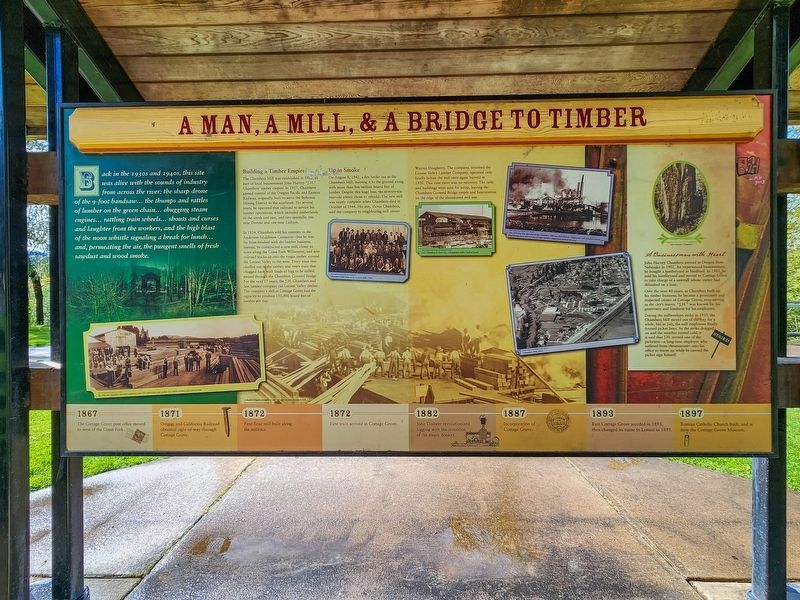
Back in the 1930s and 1940s, this site was alive with the sounds of industry from across the river: the sharp drone of the 9-foot bandsaw... the thumps and rattles of lumber on the green chain... chugging steam engines... rattling train wheels... shouts and curses and laughter from the workers, and the high blast of the noon whistle signaling a break for lunch... and, permeating the air, the pungent smells of fresh sawdust and wood smoke.
Building a Timber Empire
The Chambers Mill was established in 1925, as part of local businessman John Harvey “J.H.” Chambers’ timber empire. In 1917, Chambers gained control of the Oregon Pacific and Eastern Railway, originally built to serve the Bohemia Mining District to the southeast. For several years, he operated that railroad to service his lumber operations, which included timberlands to the south and east, and two sawmills: one near Dorena and one near Latham.
In 1924, Chambers sold his interests to the Anderson-Middleton Company—but he was far from finished with the lumber business. Instead, he constructed a new mill, closer to town along the Coast Fork Willamette, and
this page online
Up in Smoke
On August 8, 1942, a fire broke out at the Chambers Mill, burning it to the ground along with more than five million board feet of lumber. Despite this huge loss, the seventy-six-year-old owner chose to rebuild. The new mill was nearly complete when Chambers died in October of 1944. His son, Victor Chambers, sold the company to neighboring mill owner Warren Daugherty. The company, renamed the Lorane Valley Lumber Company, operated only briefly before the mill once again burned in 1950. This time there was no recovery. The rails and buildings were sold for scrap, leaving the Chambers Covered Bridge empty and functionless on the edge of the abandoned mill site.
A Businessman with Heart
John
Photographed by Douglass Halvorsen, April 11, 2026
2. A Man, a Mill, & a Bridge to Timber Marker
Over the next 40 years, as Chambers built up his timber business, he became a prominent and respected citizen of Cottage Grove, even serving as the city’s mayor. “J.H.” was known for his generosity and fondness for his employees.
During the millworkers strike in 1935, the Chambers Mill stayed out of the fray for a while, but in July, the mill employees finally formed picket lines. As the strike dragged on and the weather turned cold, it is said that J.H. invited one of the picketers—a long-time employee who suffered from rheumatism—into his office to warm up while he carried the picket sign himself.
1867 - The Cottage Grove post office moved to west of the Coast Fork.
1871 - Oregon and California Railroad obtained right-of-way through Cottage Grove.
1872 - First flour mill built along the millrace.
1872 - First train arrived in Cottage Grove.
1882 - John Dolbeer revolutionalized
Photographed by Douglass Halvorsen, April 11, 2026
3. A Man, a Mill, & a Bridge to Timber Marker
1887 - Incorporation of Cottage Grove.
1893 - East Cottage Grove seceded in 1893, then changed its name to Lemati in 1895.
1897 - Roman Catholic Church built, and is now the Cottage Grove Museum.
[Photo captions]
In 1942, the Chambers operation employed some 125 millworkers and another 125 timber workers and railroad men.
A bucker brigade atempts to put out a fire at the Chambers Mill.
Chambers Mill Crew at the Lorane Mill, 1949.
J.H. Chambers & Son’s No. 2 locomotive with a load of wood.
The 1942 fire that demolished the Chambers Mill was described as “suspicious”—it followed several threatening notes and a series of other lumber-related fires around the area.
Chambers Mill, 1942.
Erected by City of Cottage Grove.
Topics. This historical marker is listed in these topic lists: Bridges & Viaducts • Disasters • Horticulture & Forestry • Railroads & Streetcars. A significant historical year for this entry is 1867.
Location. 43° 47.366′ N, 123° 4.166′ W. Marker is in Cottage Grove, Oregon, in Lane County. It can be reached from South River Road south of W Harrison Ave. Touch for map. Marker is at or near this postal address: 1231 S River Rd, Cottage Grove OR 97424, United States of America. Touch for directions.

Regionally, this marker is in Oregon’s Willamette Valley. It is also on the American Pacific Coast, in the Pacific Northwest, and in the Lewis & Clark Corridor. Globally, it is in North America, in the Cascade Range, on the Ring of Fire, in the Pacific Rim, in the Western Hemisphere, in the Western World, and in the Anglosphere.
Other nearby markers. At least 8 other markers are within walking distance of this marker: Last Covered Railroad Bridge in Oregon (here, next to this marker); Cottage Grove—Getting Established (here, next to this marker); Timber Town (here, next to this marker); Millwork Memories (here, next to this marker); Chambers Covered Railroad Bridge (within shouting distance of this marker); Welcome to Slabtown (approx. 0.3 miles away); Cottage Grove Veterans Memorial (approx. 0.6 miles away); The Centennial Bridge (approx. 0.6 miles away). Touch for a list and map of all markers in Cottage Grove.
Credits. This page was last revised on April 24, 2026. It was originally submitted on April 23, 2026, by Douglass Halvorsen of Klamath Falls, Oregon. This page has been viewed 36 times since then. Photos: 1, 2, 3. submitted on April 23, 2026, by Douglass Halvorsen of Klamath Falls, Oregon. • James Hulse was the editor who published this page.
