History in Place
| — | General Daniel “Chappie” James Museum of Pensacola | — |

This neighborhood retains many of its original buildings. The property that is now the main area of the museum was the original James family home. Chappie grew up here, though most of his siblings had moved out by the time he was born.
As Lillie gained more students, she outgrew the space. Her husband Daniel built her a red wooden schoolhouse behind their home but it soon became too small as well. She eventually purchased the home next door, converting it into a school for older children. All that remains of the second building are the concrete steps near the sidewalk.
In 2000, the property was listed on the National Register of Historic Places. By 2018, city-funded improvements allowed the space to open as a dedicated museum honoring James and his family. This included a 1,500 square foot building that serves as the classroom for the Gen. Daniel "Chappie" James Flight Academy (est. 1996) which provides free aviation camps for children. The newest updates include an expansion, updated computers, a new flight simulator, and outdoor signage.
Erected 2024 by Chappie James Museum of Pensacola.
Topics and series.
this page online
Location. 30° 25.81′ N, 87° 12.807′ W. Marker is in Pensacola, Florida, in Escambia County. It is in Southeast Pensacola. It is on Doctor Martin Luther King Junior Drive (Florida Route 291) just north of East Moreno Street, on the left when traveling south. The marker is in General Daniel “Chappie” James, Jr. Memorial Park. Touch for map. Marker is at or near this postal address: 1606 Doctor M.L.K Jr Drive, Pensacola FL 32503, United States of America. Touch for directions.

Regionally, this marker is on the Florida Panhandle. It is also in the American South, specifically in the Deep South, and on the Gulf Coast. Globally, it is in the North Atlantic Region, North America, a Gulf of Mexico state, the Western Hemisphere, the Western World, and the Anglosphere. Historically, it finds itself in what was once New Spain, the territory of the Mississippian

Other nearby markers. At least 8 other markers are within walking distance of this marker: Living in Eastside (here, next to this marker); General Daniel "Chappie" James, Jr. Memorial Park (here, next to this marker); Early Military Career (a few steps from this marker); “Thou Shalt Not Quit” (a few steps from this marker); Reach for the Stars (a few steps from this marker); Growing Up (a few steps from this marker); General Daniel James, Jr. (within shouting distance of this marker); E.S. Cobb Center (about 700 feet away, measured in a direct line). Touch for a list and map of all markers in Pensacola.
Regarding History in Place. The James House is listed in the National Register of Historic Places — № 00001501.
From the National Register Nomination prepared by Robert O. Jones, 11/2000:
The one-story house fronts onto Alcaniz Street (recently renamed Martin Luther King Jr. Drive). A porch spans the narrow (20 foot) elevation. The porch roof is supported by square, wooden columns. Wooden railings and square balusters line the porch. A single maindoor is in the north half of the west wall, and a pair of tall windows is in the south half of the wall. The house is divided into five rooms. Within the front door and composing the north half of the building, is the large living room where Mrs. James taught students.UWF Historic Trust Collection3. Marker detail: Plaque ceremony dedicating the gym at Scott Air Force Base in James’s honor, 1979The James House is significant in the areas of Ethnic Heritage: Black and Education, and for its association with Lillie A. James. James was an outstanding local teacher of Black children, who used her home and adjacent buildings as a community school. She emphasized education as a means of personal and social advancement, and members of her family and former students became prominent public leaders. Mrs. James taught from 1901 until her death in 1957.
Educational opportunities for Blacks in Pensacola at the turn of the twentieth-century were not encouraging. Most public schools were rented single rooms or one-room buildings, with one teacher. Since public education was supported by local taxes, poor Black neighborhoods that paid few taxes had poor schools. Most Blacks performed jobs that required little formal training, and administrators considered educational opportunities
a low priority. Few Black teachers had a high school education, and few planned or prepared lessons. One good opportunity for Black education did exist in Pensacola for those that could afford it. The private Catholic St. Joseph's School was the largest of the seven Catholic schools for "Negros" in the state. The school had four teachers.Photographed by Cosmos Mariner, June 19, 20254. History in Place MarkerLooking north through General Daniel “Chappie” James, Jr. Memorial Park. The General Daniel "Chappie" James Museum (original James family home) is in the background.Lillie Ann James grew up in Pensacola with parents well situated within the Black community. Her father was a mail carrier, a rare position of public trust, and her mother was a domestic helper to an established white family. She received the equivalency of a high school education from St. Joseph's Catholic School. Lillie James felt that with a good education, Blacks who wished to succeed could obtain what they needed in society. She was nurturing, often sitting up with a sick child, listening to problems, and being patient with simple mistakes.
Mrs. James was critical of the typical public education available to Black children, for she thought low expectations and lax discipline would not produce excellent results. By the turn of the century, it became known within her community that she was tutoring
her children at home. Neighbors asked her to tutor their children, which she agreed to do. At one time she had seventy students in her school. As a need for space grew, Mr. James built a wooden building behind their home and painted it red. The enrollment continued to grow, so the James's bought a house next door, and removed its interior walls to create an assembly space. Younger children studied in the red school building, and the older children were taught in the converted house.Photographed by Cosmos Mariner, June 19, 20255. General Daniel “Chappie” James, Jr. Memorial ParkLooking east through the memorial park on the south side of the Chappie James Museum of Pensacola. This marker is the first of three interpretive panels on the left/north side of the park, seen here in the left foreground.Mrs. James' instruction prepared her students well to attend Washington High, the public high school for Blacks, which was active by 1920. All of the James' children went to college, and one daughter Frances, upon graduation from Florida A & M, assisted her mother in the instruction of pupils. The most prominent of her students though, was her son Daniel, Jr., who became the first Black to become a four-star general in the United States military, and Air Force commander of a base. General James said “there are a lot of walking monuments to my mother's love, faith and skill. I would not try to count the number who found a sense of purpose and direction and
set of values that sustain them to this day.” General James' achievements were based on the foundational training and education he obtained from his mother at home and at the school she established in the James House.Photographed by Cosmos Mariner, June 19, 20256. “Chappie’s First Steps – 1920”All that remains of Lillie James’ schoolhouse are these concrete steps near the sidewalk.



Related markers. Click here for a list of markers that are related to this marker. General Daniel “Chappie” James, Jr. Memorial Park
Also see . . .
1. General Daniel “Chappie” James Museum of Pensacola.
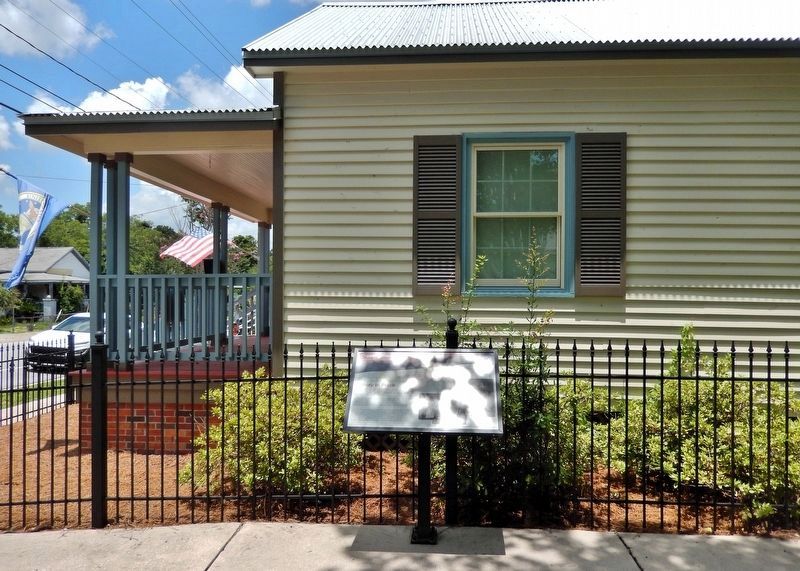
Excerpt: This historical museum showcases the life of General Daniel “Chappie” James, Jr., highlighting his life and accomplishments. The keys to his success are intended for young students and visitors alike. Born and raised in Pensacola, Florida, educated at his mother’s school, he graduated from Booker T. Washington High School and attended Tuskegee Institute where he became one of the first Tuskegee Airmen and later became the first African American four-star general of the United States Armed Forces. General James’ life is a role model for students as they study science, technology, engineering and mathematics. The museum interactive center focuses on discipline, teamwork, self-esteem and confidence,(Submitted on April 26, 2026, by Cosmos Mariner of Cape Canaveral, Florida.)all essential to good leadership.Photographed by Cosmos Mariner, June 19, 20257. General Daniel “Chappie” James, Jr. Historic HomesiteToday it houses the General Daniel "Chappie" James Museum of Pensacola. This historical marker is beside the fence in the right background.

2. “Chappie” James, Jr. Historic Homesite (Wikipedia).
Excerpt: The James House was the boyhood home of General Daniel “Chappie” James, Jr. On December 13, 2000, it was added to the U.S. National Register of Historic Places.(Submitted on April 26, 2026, by Cosmos Mariner of Cape Canaveral, Florida.)
Credits. This page was last revised on April 26, 2026. It was originally submitted on April 24, 2026, by Cosmos Mariner of Cape Canaveral, Florida. This page has been viewed 14 times since then. Photos: 1, 2, 3, 4, 5, 6, 7. submitted on April 26, 2026, by Cosmos Mariner of Cape Canaveral, Florida.
