Berliner Innenstadt in Mitte, Germany — Northeast German Plain (The European Plain)
Berlins Weg durch die Geschichte
⎯⎯⎯
Berlin’s Path Through History
Photographed by James Hulse, March 7, 2026
1. Berlins Weg durch die Geschichte / Berlin’s Path Through History Marker

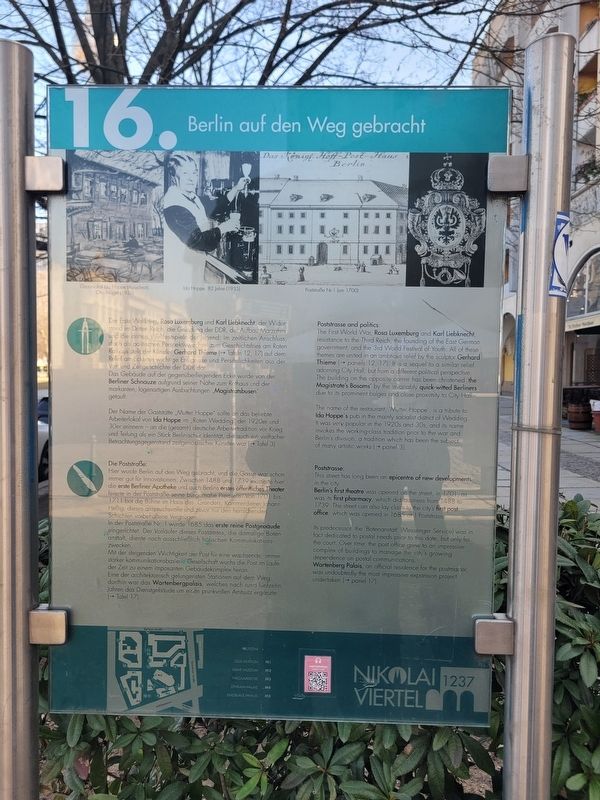
Der Erste Weltkrieg, Rosa Luxemburg und Karl Liebknecht, der Widerstand im Dritten Reich, die Gründung der DDR, der Aufbau Marzahns und die Dritten Weltfestspiele der Jugend: Im zeitlichen Anschluss, doch als politischer Perspektivwechsel zum Geschichtsfries am Roten Rathaus, stellt der Künstler Gerhard Thieme (→ Tafeln 12, 17) auf dem Relief am Eckhaus wichtige Ereignisse und Persönlichkeiten aus der Vor- und Zeitgeschichte der DDR dar.
Das Gebäude auf der gegenüberliegenden Ecke wurde von der Berliner Schnauze aufgrund seiner Nähe zum Rathaus und der markanten, logenartigen Ausbuchtungen „Magistratsbusen“ getauft.
Der Name der Gaststätte „Mutter Hoppe“ sollte an das beliebte Arbeiterlokal von Ida Hoppe im „Roten Wedding“ der 1920er und 30er erinnern – an die (gesamt)deutsche Arbeitertradition vor Krieg und Teilung als ein Stück Berliner Identität, die auch ein vielfacher Betrachtungsgegenstand zeitgenössischer Künstler war (→ Tafel 3).
Die Poststraße:
Hier wurde Berlin auf den Weg gebracht, und die Gasse war schon immer gut für Innovationen. Zwischen 1488 und 1739 existierte hier
this page online
In der Poststraße Nr. 1 wurde 1685 das erste reine Postgebäude eingerichtet. Der Vorläufer dieses Postamtes, die damalige Botenanstalt, diente noch ausschließlich höfischen Kommunikationszwecken.
Mit der steigenden Wichtigkeit der Post für eine wachsende, immer stärker kommunikationsbasierte Gesellschaft wuchs sie im Laufe der Zeit zu einem imposanten Gebäudekomplex heran.
Eine der architektonisch gelungensten Stationen auf dem Weg dorthin war das Wartenbergpalais, welches nach rund fünfzehn Jahren das Dienstgebäude um einen prunkvollen Amtssitz ergänzte (→ Tafel 17).
Gartenlokal Ida Hoppe (Ausschnitt), Otto Nagel (1936)
Ida Hoppe, 82 Jahre (1935)
Poststraße Nr. 1 (um 1700)
Poststrasse and politics:
The First World War, Rosa Luxemburg and Karl Liebknecht, resistance to the Third Reich, the founding
Photographed by James Hulse, March 7, 2026
2. Berlins Weg durch die Geschichte / Berlin’s Path Through History Marker
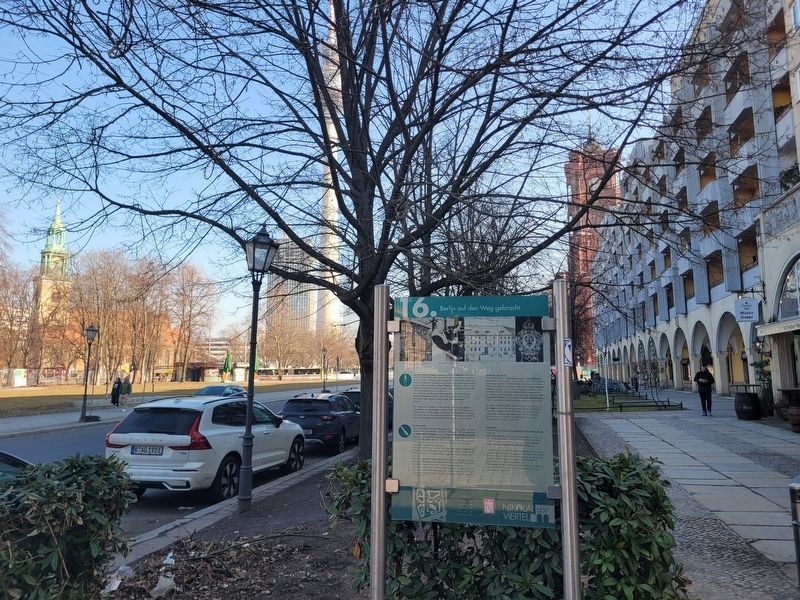
The view of the marker along the street with the Berlin TV Tower in the background.
The name of the restaurant, 'Mutter Hoppe', is a tribute to Ida Hoppe's pub in the mainly socialist district of Wedding. It was very popular in the 1920s and 30s, and its name invokes the working-class tradition prior to the war and Berlin's division, a tradition which has been the subject of many artistic works (→ panel 3).
Poststrasse:
This street has long been an epicentre of new developments in the city. Berlin's first theatre was opened on the street, in 1701, as was its first pharmacy, which did business from 1488 to 1739. The street can also lay claim to the city's first post office, which was opened in 1685 at 1 Poststrasse.
Its predecessor, the 'Botenanstalt'
Photographed by James Hulse, March 7, 2026
3. Berlins Weg durch die Geschichte / Berlin’s Path Through History Marker
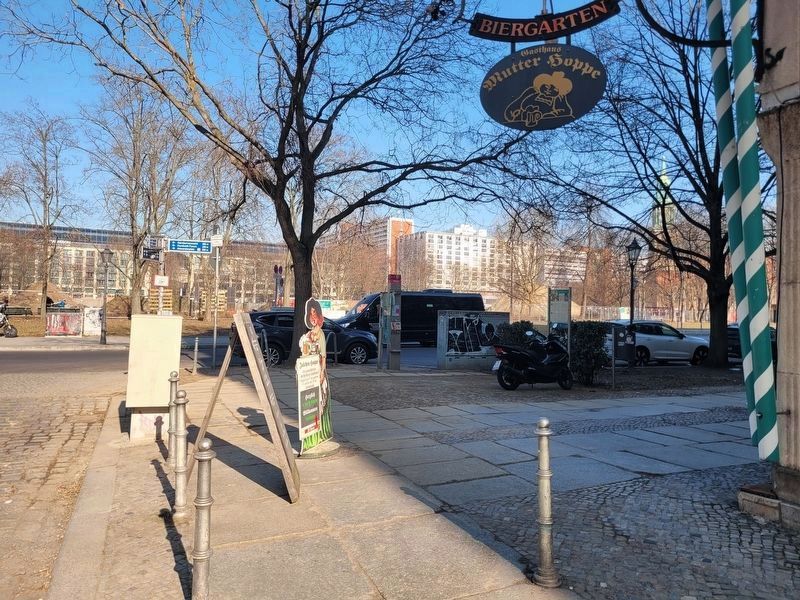
The view of the marker looking north along Poststraße. The marker is located behind the motorbike.
Garden restaurant Ida Hoppe (detail), Otto Nagel (1936)
Ida Hoppe, 82 years old (1935)
Poststraße No. 1 (around 1700)
Erected by Nikolai Viertel 1237. (Marker Number 16.)
Topics. This historical marker is listed in these topic lists: Entertainment • Industry & Commerce. A significant historical year for this entry is 1488.
Location. 52° 31.056′ N, 13° 24.337′ E. Marker is in Berlin, in Mitte. It is in Berliner Innenstadt. It is at the intersection of Poststraße and Rathausstraße, on the right when traveling north on Poststraße. Touch for map. Marker is at or near this postal address: Poststraße 30, Berlin 10178, Germany. Touch for directions.

Regionally, it is in Europe, the European Union, Atlantic Europe, Central Europe, the Schengen Area, Western Europe, and the Western World. Historically, it finds itself in what was once the Holy Roman Empire, the former East Germany, and at the Berlin Wall.
Other nearby markers. At least 8 other markers are within walking distance of this marker: Carl Gause & Geisterglaube / Carl Gause & Belief in Ghosts (within shouting distance of this marker); Zeittafel der Berliner Geschichte / Timeline of Berlin History (within shouting distance of this marker); Poststraße & Persönlichkeiten / Post Street & Personalities (within shouting distance of this marker); Hunger vs. Angst (within shouting distance of this marker); Märzrevolution / March Revolution (within shouting distance of this marker); Post, Palais, Paloma / Post, Palace, Paloma (about 90 meters away, measured in a direct line); Zille, Heinrich (about 90 meters away); Carl Hildebrand von Canstein (about 120 meters away). Touch for a list and map of all markers in Berlin.
Credits. This page was last revised on April 28, 2026. It was originally submitted on April 25, 2026, by James Hulse of Medina, Texas. This page has been viewed 20 times since then. Photos: 1, 2, 3. submitted on April 25, 2026, by James Hulse of Medina, Texas.
