Berliner Innenstadt in Mitte, Germany — Northeast German Plain (The European Plain)
Das Kaufhaus Israel, ein Opfer der Nazis
⎯⎯⎯
The Israel Department Store, a Victim of the Nazis
Photographed by James Hulse, March 7, 2026
1. Das Kaufhaus Israel, ein Opfer der Nazis / The Israel Department Store, a Victim of the Nazis Marker

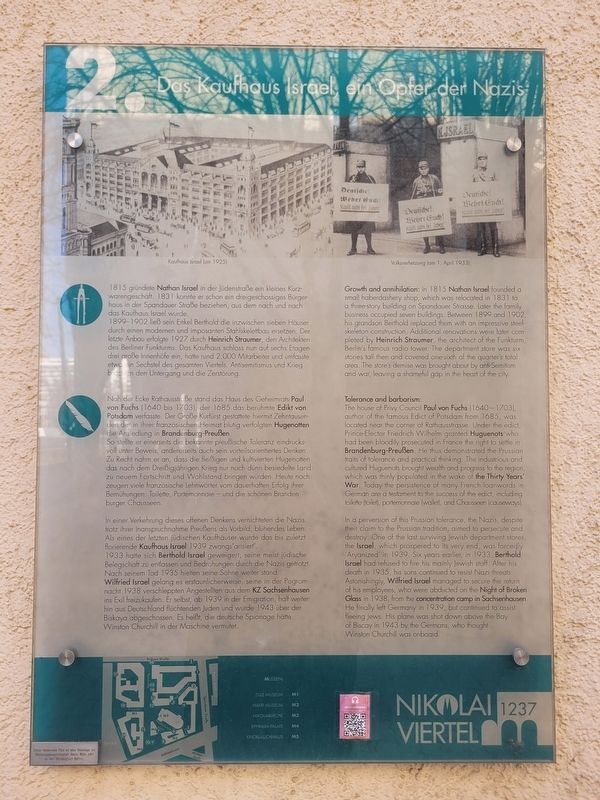
1815 gründete Nathan Israel in der Jüdenstraße ein kleines Kurzwarengeschäft. 1831 konnte er schon ein dreigeschossiges Bürgerhaus in der Spandauer Straße beziehen, aus dem nach und nach das Kaufhaus Israel wurde. 1899–1902 ließ sein Enkel Berthold die inzwischen sieben Häuser durch einen modernen und imposanten Stahlskelettbau ersetzen. Der letzte Anbau erfolgte 1927 durch Heinrich Straumer, den Architekten des Berliner Funkturms. Das Kaufhaus schloss nun auf sechs Etagen drei große Innenhöfe ein, hatte rund 2.000 Mitarbeiter und umfasste etwa ein Sechstel des gesamten Viertels. Antisemitismus und Krieg bedeuteten Untergang und Zerstörung.
Nahe der Ecke Rathausstraße stand das Haus des Geheimrats Paul von Fuchs (1640–1703), der 1685 das berühmte Edikt von Potsdam verfasste. Der Große Kurfürst gestattete hiermit Zehntausenden der in ihrer französischen Heimat verfolgten Hugenotten die Ansiedlung in Brandenburg-Preußen. So stellte er einerseits die bekannte preußische Toleranz eindrucksvoll unter Beweis, andererseits auch sein vorteilsorientiertes Denken. Zu Recht nahm er an, dass die fleißigen und
this page online
In einer Verkehrung dieses offenen Denkens vernichteten die Nazis, trotz ihrer Inanspruchnahme Preußens als Vorbild, blühendes Leben: Als eines der letzten jüdischen Kaufhäuser wurde das bis zuletzt florierende Kaufhaus Israel 1939 zwangsarisiert. 1933 hatte sich Berthold Israel geweigert, seine meist jüdische Belegschaft zu entlassen, und den Bedrohungen durch die Nazis getrotzt. Nach seinem Tod 1935 hielten seine Söhne weiter stand. Wilfried Israel gelang es, seine in der Pogromnacht 1938 verschleppten Angestellten aus dem KZ Sachsenhausen freizukaufen. Er selbst, ab 1939 in der Emigration, half weiterhin aus Deutschland flüchtenden Juden und wurde 1943 über der Biskaya abgeschossen. Es heißt, die deutsche Spionage habe Winston Churchill in der Maschine vermutet.
Kaufhaus Israel (um 1925)
Volksverhetzung (am 1. April 1933)
Photographed by James Hulse, March 7, 2026
2. Das Kaufhaus Israel, ein Opfer der Nazis / The Israel Department Store, a Victim of the Nazis Marker
Tolerance and barbarism:
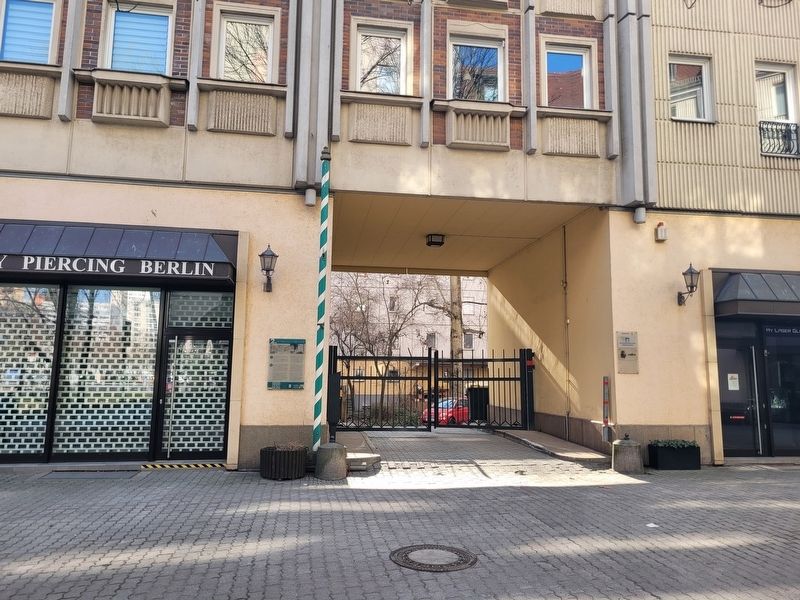
The house of Privy Council Paul von Fuchs (1640-1703), author of the famous Edict of Potsdam from 1685, was located near the corner of Rathausstrasse. Under the edict, Prince-Elector Friedrich Wilhelm granted Huguenots who had been bloodily prosecuted in France the right to settle in Brandenburg-Preußen. He thus demonstrated the Prussian traits of tolerance and practical thinking: The industrious and cultured Huguenots brought wealth and progress to the region, which
Photographed by James Hulse, March 7, 2026
3. Das Kaufhaus Israel, ein Opfer der Nazis / The Israel Department Store, a Victim of the Nazis Marker
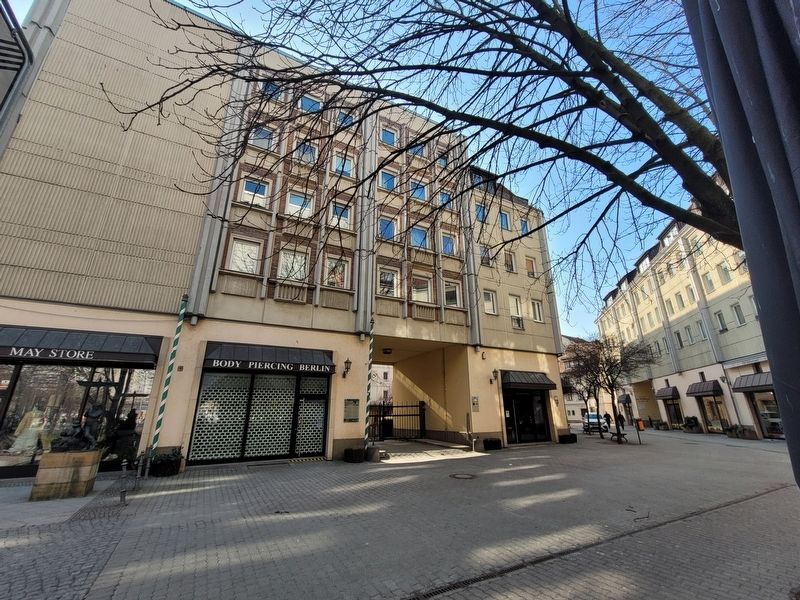
The view of the markers along along from across the street.
In a perversion of this Prussian tolerance, the Nazis, despite their claim to the Prussian tradition, aimed to persecute and destroy: One of the last surviving Jewish department stores, the Israel, which prospered to its very end, was forcedly 'Aryanized’ in 1939. Six years earlier, in 1933, Berthold Israel had refused to fire his mainly Jewish staff. After his death in 1935, his sons continued to resist Nazi threats. Astonishingly, Wilfried Israel managed to secure the return of his employees, who were abducted on the Night of Broken Glass in 1938, from the concentration camp in Sachsenhausen. He finally left Germany in 1939, but continued to assist fleeing Jews. His plane was shot down above the Bay of Biscay in 1943 by the Germans, who thought Winston Churchill was onboard.
Israel Department Store (around 1925)
Incitement of the people (on April 1, 1933)
Erected by Nikolai Viertel 1237. (Marker Number 2.)
Topics. This historical marker is listed in this topic list: War, World II. A significant historical year for this entry is 1815.
Location. 52° 31.064′ N, 13° 24.451′ E. Marker is in Berlin, in Mitte. It is in Berliner Innenstadt. It is at the intersection of Am Nußbaum and Spandauer Str., on the left when traveling west on Am Nußbaum. Touch for map. Marker is at or near this postal address: Am Nußbaum 1, Berlin 10178, Germany. Touch for directions.

Regionally, it is in Europe, the European Union, Atlantic Europe, Central Europe, the Schengen Area, Western Europe, and the Western World. Historically, it finds itself in what was once the Holy Roman Empire, the former East Germany, and at the Berlin Wall.
Other nearby markers. At least 8 other markers are within walking distance of this marker: Elementweise / Prefabricated Construction (within shouting distance of this marker); Martin Heinrich Klaproth (within shouting distance of this marker); Gewiss und ungerecht / Certain and Unjust (within shouting distance of this marker); Zum Nußbaum (within shouting distance of this marker); Berliner Originale / Berlin Originals (within shouting distance of this marker); Zeittafel der Berliner Geschichte / Timeline of Berlin History (about 90 meters away, measured in a direct line); Nikolaikirche / St. Nicholas Church (about 120 meters away); Rotes Rathaus / Red Town Hall (about 120 meters away). Touch for a list and map of all markers in Berlin.
Credits. This page was last revised on April 27, 2026. It was originally submitted on April 26, 2026, by James Hulse of Medina, Texas. This page has been viewed 13 times since then. Photos: 1, 2, 3. submitted on April 27, 2026, by James Hulse of Medina, Texas.
