Adams in Seattle in King County, Washington — The American West (Northwest)
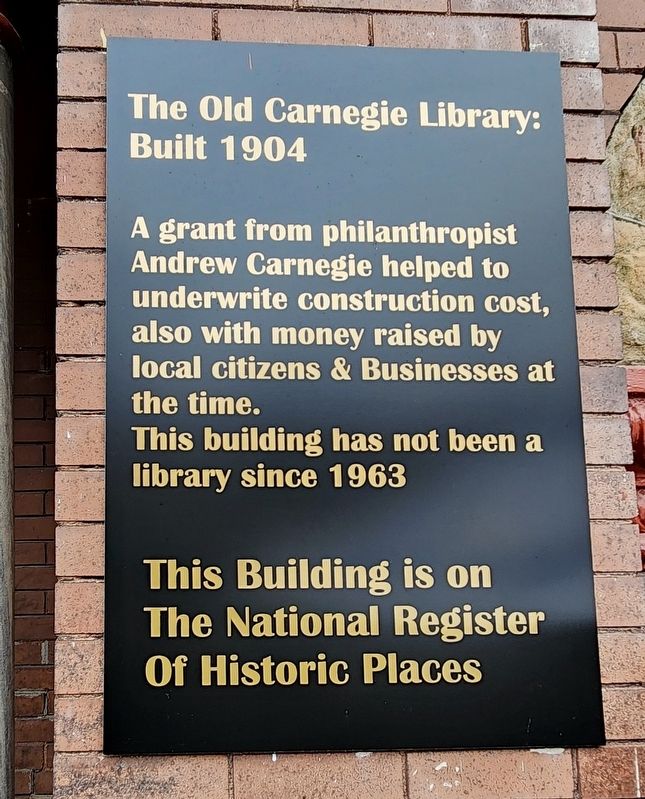
The Old Carnegie Library
Built 1904
Photographed by Douglass Halvorsen, February 21, 2026
1. The Old Carnegie Library Marker
A grant from philanthropist Andrew Carnegie helped to underwrite construction cost, also with money raised by local citizens & businesses at the time. This building has not been a library since 1963
This building is on The National Register of Historic Places
Topics and series. This historical marker is listed in these topic lists: Charity & Public Work • Education. In addition, it is included in the Carnegie Libraries, and the National Register of Historic Places (NRHP) series lists. A significant historical year for this entry is 1904.
Location. 47° 40.132′ N, 122° 23.003′ W. Marker is in Seattle, Washington, in King County. It is in Adams. It is on Northwest Market Street west of 20th Ave NW, on the left when traveling east. Touch for map. Marker is at or near this postal address: 2026 NW Market St, Seattle WA 98107, United States of America. Touch for directions.

Regionally, this marker is in the Puget Sound Region. It is also on the American Pacific Coast, in the Pacific Northwest, and in the Lewis & Clark Corridor. Globally, it is in North America, in the Cascade Range, in the Inside Passage, on the Ring of Fire, on the Pacific Rim, in the Western Hemisphere, in the Western World, and in the Anglosphere.
Other nearby markers. At least 8 other markers are within walking distance of this marker: America's Oldest Continually Operating Movie Theatre (within shouting distance of this marker); a different marker also named The Mural at Bergen Place (about 300 feet away); Ballard Centennial Tree (about 500 feet away); The Ballard Avenue Landmark District Historic Marker Project (about 500
this page online
Another marker is no longer nearby. Mural at Bergen Place (was about 300 feet away, measured in a direct line but has been replaced with another marker now near it).
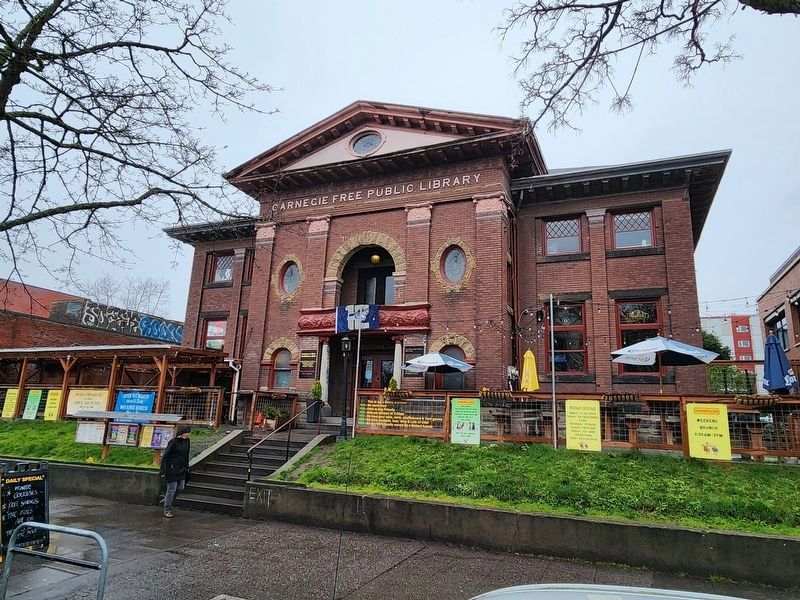
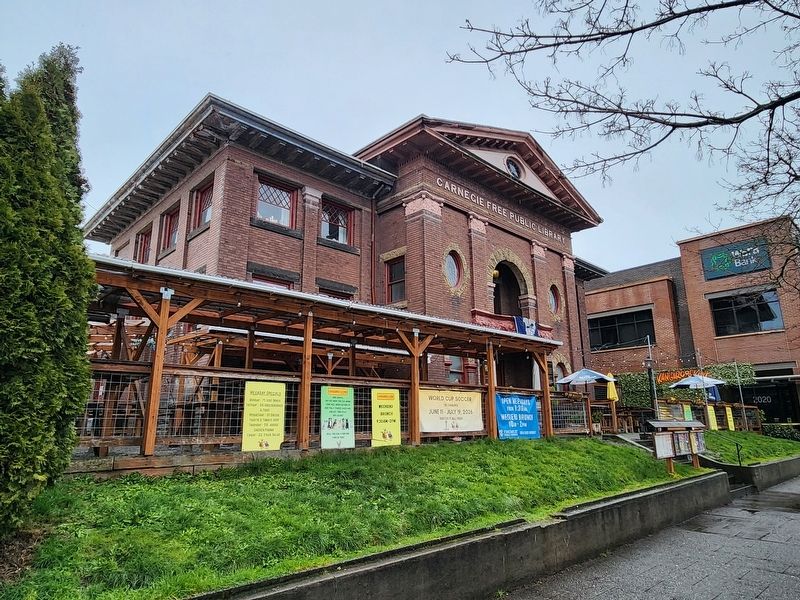
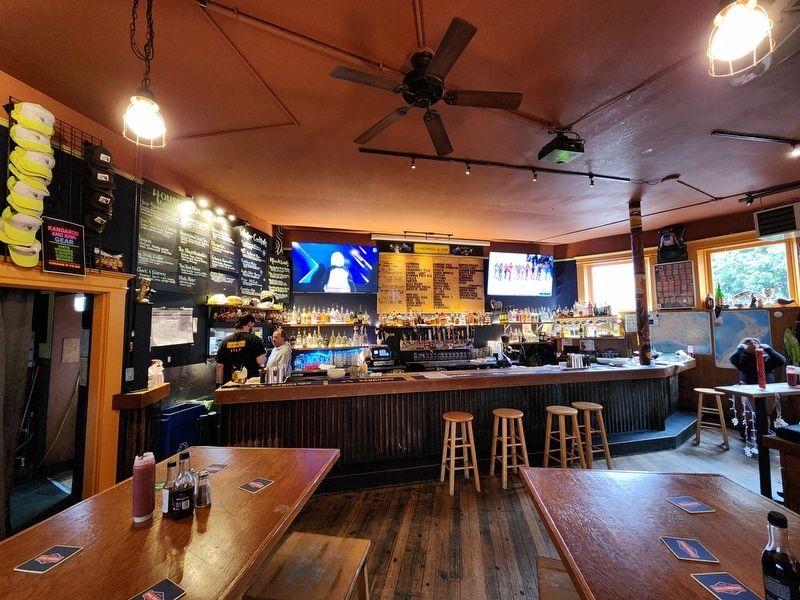
Regarding The Old Carnegie Library. The former library is currently home to Kangaro & Kiwi, an Australian-themed tavern and eatery.
Also see . . . National Register of Historic Places Inventory - Registration Form (1979). Statement of Significance:
The Ballard Carnegie Library is significant historically as a community cultural and education center for the Scandinavian immigrants who settled in the area. Architecturally the building exhibits an eclectic charm through its assemblage of roughly Italian classical details. The library also has the distinction of being Seattle's oldest library building, having narrowly escaped the wrecking ball at least twice.(Submitted on April 28, 2026, by Douglass Halvorsen of Klamath Falls, Oregon.)
Although not originating the free public library system in this country, Andrew Carnegie stimulated its development. There was a desperate need for library buildings in the United States during the late nineteenth century with many libraries housed in back rooms of stores and barber shops and the like. In the latter years of his life, Andrew Carnegie donated more than $40,000,000 for the erection of 1,679 public libraries in 1,412 communities of the United States. The only stipulation in the grant was that the community applyingmust supply the site and authorize an annual maintenance of ten percent of the total amount contributed by Andrew Carnegie.Photographed by Douglass Halvorsen, February 21, 20262. The Old Carnegie Library MarkerThe marker is located on the right entrance to the building, as seen in the photo (partially covered by an umbrella).
The independent city of Ballard privately raised $2,500 for the purchase of a suitable site and recieved a grant of $15,000 on March 27, 1903 for the erection of the library.
The Ballard Free Public Library served the community as a library from June 24, 1904 to its replacement by a new facility on June 7, 1963. Since Ballard's early population was predominately immigrant Scandinavians the library became a focus for attaining the communicative tools and cultural background necessary for the immigrant's successful adjustment to his new country. The library over the years was used for such ancillary functions as a classroom for English, naturalization and first aid classes. Since 1903 the building has become an accepted visual feature in the community. With the old Fire Station 18 across Market Street, a Seattle Landmark and National Register property, the old library represents an important sense of District continuity to Ballard residents.
The Architect, Henderson Ryan, came to Seattle around the turn of the century, beginning a prolific career in the area. He was born in Alabama and educated at the University of Kentucky. He designed or supervised construction on many early Seattle apartment buildings and residences. The Ballard Carnegie Library, the Waldorf Apartments on Pike Street and the Swedish Baptist Church (now the Baptist Tabernacle) also on Pike Street are among his buildings which are still in existence. He also designed the Liberty Theater (1914) on First Avenue, the Raleigh Hotel,the Moore Building, the Broadway Building, the Antonia Apartments, the Taylor Apartments and the Keen Apartments, all in Seattle; and the Telegraph Office in Nome, Alaska, which became a model for other offices across that Territory.Photographed by Douglass Halvorsen, February 21, 20263. The Old Carnegie Library
Photographed by Douglass Halvorsen, February 21, 2026
4. The Old Carnegie Library interior
The interior of the former library, looking at the tavern counter.
Credits. This page was last revised on April 29, 2026. It was originally submitted on April 28, 2026, by Douglass Halvorsen of Klamath Falls, Oregon. This page has been viewed 22 times since then. Photos: 1, 2, 3, 4. submitted on April 28, 2026, by Douglass Halvorsen of Klamath Falls, Oregon. • James Hulse was the editor who published this page.
