Melbourne, Victoria, Australia — Oceania
Melbourne Olympic Swimming Pool

Photographed by Dean Barton-Ancliffe, April 14, 2026
1. Melbourne Olympic Swimming Pool Marker
The Melbourne Olympic Games
1956
The XVIth Olympiad of the Modern Era
The weight of the diamond shaped roof is borne by angled, articulated steel girders and trusses and stabilised by external vertical steel rods.
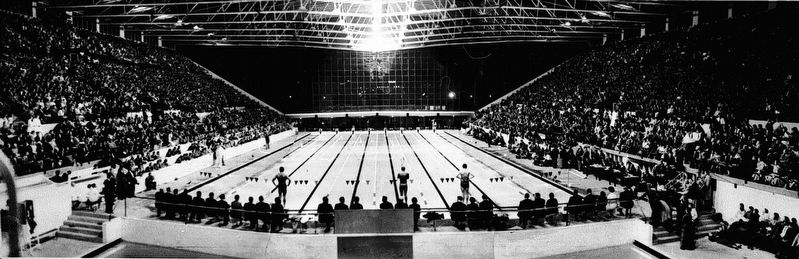
This building was purpose built for the 1956 Melbourne Olympic Games as its aquatic centre for all the swimming, diving and water polo events.
Melbourne architects, Borland, Mcintyre & Murphy won an international design competition for the building with their unique design and construction methods. The Olympic Swimming Pool became the showpiece of the Olympic Games facilities and its individuality of style was acknowledged by placement on the Victorian Heritage Register in 2002.
The stadium had a capacity of 5500 spectators and enclosed two pools, an eight lane 50 x 20 metre swimming pool and a separate 20 x 15 metre Diving Pool at the Southern end, the first time a diving pool had been enclosed for the Olympic Games.
It was converted to the Melbourne Sports and Entertainment Centre in 1981/82 and redeveloped again in 2003/04 as a Sporting Centre of Excellence.
Australian
this page online
1956 Organising Committee
Olympic Park Committee of Management
Design Ross J. Bastiaan 2006
To celebrate the 50th anniversary of the Melbourne Olympic Games, Melbourne & Olympic Park Trust 2006
Erected 2006.
Topics. This historical marker is listed in these topic lists: Architecture • Sports. A significant historical year for this entry is 1956.
Location. 37° 49.42′ S, 144° 58.805′ E. Marker is in Melbourne, Victoria. It is on Olympic Boulevard (Route 20) 0.1 kilometers east of Batman Avenue, on the left when traveling west. Touch for map. Marker is at or near this postal address: Olympic Boulevard, Melbourne VIC 3004, Australia. Touch for directions.

Regionally, it is in Oceania, Australasia, the Pacific Ocean, South Pacific, the Pacific Rim, the Western World, and the Anglosphere. Historically, it finds itself in what was once a British colony.
Other nearby markers. At least 8 other markers are within walking distance of this marker: Bob Rose (within shouting distance of this marker); Lou Richards (within shouting distance of this marker); Sharelle McMahon (about 90 meters away, measured

Photographed by Dean Barton-Ancliffe, April 14, 2026
2. Melbourne Olympic Swimming Pool Marker
at the front of the stadium
Also see . . . Melbourne 1956: The Swimming Stadium. Official Olympic Website
The venue for the swimming, diving and water polo competitions at the Olympic Games and home to the first enclosed diving pool in Olympic history, the centre is now used as a training and administrative base by the Victorian Institute of Sport (VIS) and by Collingwood Football Club’s Australian rules and netball teams. Its facilities include a world-class gymnasium, a 25m lap pool, an exhibition space, corporate event and function rooms, and a hydrotherapy spa. The centre’s community and training facilities are also open to recreational athletes and host grass-roots leisure and sports initiatives.(Submitted on April 28, 2026, by Dean Barton-Ancliffe of Rowville, Victoria.)
An enduring landmark of the 1956 Olympic Games, the Holden Centre is a significant building in architectural, historicaland symbolic terms, and is listed in the Victorian Heritage Register. An early example of a pre-tensioned steel-framed construction, it won many awards when it opened.Photographed by Museums Victoria3. Melbourne Olympic Swimming PoolDuring Olympic Events in 1956
Credits. This page was last revised on April 29, 2026. It was originally submitted on April 28, 2026, by Dean Barton-Ancliffe of Rowville, Victoria. This page has been viewed 17 times since then. Photos: 1, 2, 3. submitted on April 28, 2026, by Dean Barton-Ancliffe of Rowville, Victoria. • Andrew Ruppenstein was the editor who published this page.
