Melbourne, Victoria, Australia — Oceania
The Army and Olympic Park
Photographed by Dean Barton-Ancliffe, April 14, 2026
1. The Army and Olympic Park Marker
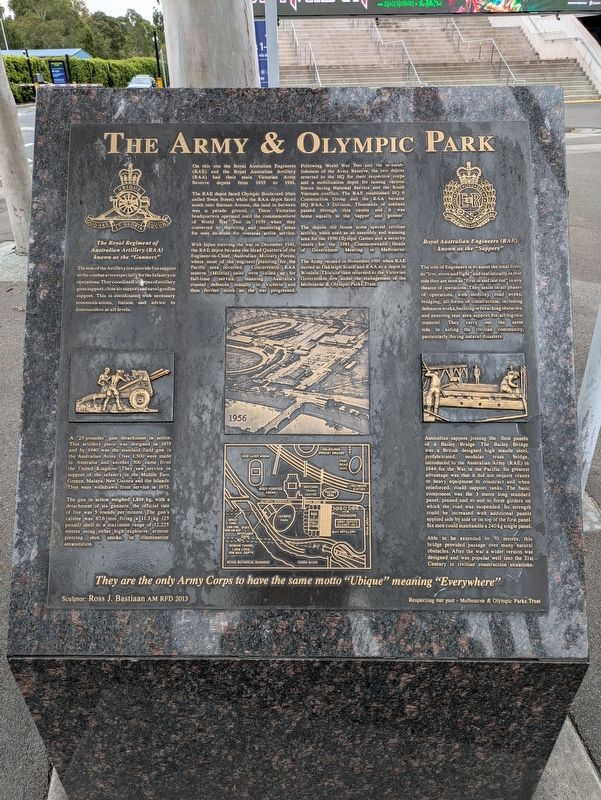
On this site the Royal Australia Engineers (RAE) and the Royal Australian Artillery (RAA) had their main Victorian Army Reserve depots from 1931 to 1991.
The RAE depot faced Olympic Boulevard (then called Swan Street) while the RAA depot faced south onto Batman Avenue, the land in between was a parade ground. These Victorian headquarters operated until the commencement of World War Two in 1939 when they converted to reporting and mustering areas for men en-route for overseas active service.
With Japan entering the war in December 1941, the RAE depot became the Head Quarters of the Engineer-in-Chief, Australian Military Forces, where most of the engineer planning for the Pacific area occurred. Concurrently, RAA Reserve (Militia) units were called up for full-time service, manning Australia's coastal defences initially in Victoria and then further north as the war progressed.
Following World War Two and the re-establishment of the Army Reserve, the two depots reverted to the HQ for their respective corps and a mobilization depot for raising various forces during National Service and the
this page online
The depots did house some special civilian activity when used as an assembly and training area for the 1956 Olympic Games and a security centre for the 1984 Commonwealth Heads of Government Meeting in Melbourne.
The Army vacated in November 1991 when RAE moved to Oakleigh South and RAA to a depot in Windsor. This site then returned to the Victorian Government now under the management of the Melbourne & Olympic Parks Trust.
The Royal Regiment of the Australian Artillery (RAA) known as the "Gunners"
The role of the Artillery is to provide fire support to the combat arms especially the infantry on operations. They coordinate all types of artillery guns support, close air support and naval gunfire support. This is coordinated with necessary communications, liaison and advice to commanders at all levels.
Royal Australian Engineers (RAE) known as the "Sappers"
The role of the engineers is to assist the total

Photographed by Dean Barton-Ancliffe, April 14, 2026
2. The Marker in front of AAMI Park
They are the only Army Corps to have the same motto "Ubique" meaning "Everywhere"
Sculptor: Ross J. Bastiaan AM RFD 2013
Respecting our past - Melbourne & Olympic Parks Trust
Erected 2013 by Melbourne & Olympic Parks Trust.
Topics. This historical marker is listed in these topic lists: Military • War, World II. A significant historical year for this entry is 1935.
Location. 37° 49.457′ S, 144° 59.091′ E. Marker is in Melbourne, Victoria. It is on Olympic Boulevard (Victoria Route 20) 0.2 kilometers west of Punt Road ( Route 29). Touch for map. Marker is at or near this postal address: 60 Olympic Boulevard, Melbourne VIC 3004, Australia. Touch for directions.

Regionally, it is in Oceania, Australasia, the Pacific Ocean, South Pacific, the Pacific Rim, the Western World, and the Anglosphere. Historically, it finds itself in what was once a British colony.
Other nearby markers. At least 8 other markers are within walking distance of this marker: Ferenc Puskás (about 210 meters away, measured in a direct line); Sportsmanship (about 210 meters away); Sharelle McMahon (approx. 0.3 kilometers away); Lou Richards (approx. 0.4 kilometers away); Morell (Anderson Street) Monier Arch Bridge (approx. 0.4 kilometers away); Melbourne Olympic Swimming Pool (approx. 0.4 kilometers away); Carlo Catani (approx. 0.4 kilometers away); Bob Rose (approx. half a kilometer away). Touch for a list and map of all markers in Melbourne.
Also see . . . The Victorian Corps of Engineers History.
The origins of the Royal Australian Engineers date back to 15 November 1860, when the Corps of Engineers was founded in the colony of Victoria by MAJ GEN Sir Peter Scratchley. By 1876, five of the six colonies—New South Wales, Victoria, Queensland, Tasmania and Western Australia—had raised their own engineer units. These were amalgamated on 1 July 1902 as the Corps of Engineers. At this time, the corps consisted of field, fortress, telegraph, electric and submarine mining companies. On 19th March 1907 the small regular engineer component was granted the prefix “Royal” however, the militia remained the “Australian Engineers” until 31st January 1936.(Submitted on April 30, 2026, by Dean Barton-Ancliffe of Rowville, Victoria.)
Credits. This page was last revised on May 2, 2026. It was originally submitted on April 30, 2026, by Dean Barton-Ancliffe of Rowville, Victoria. This page has been viewed 29 times since then. Photos: 1, 2. submitted on April 30, 2026, by Dean Barton-Ancliffe of Rowville, Victoria. • Andrew Ruppenstein was the editor who published this page.
