Marylebone in City of Westminster in Greater London, England, United Kingdom — Northwestern Europe (the British Isles)
Frederick Roberts, 1st Earl Roberts
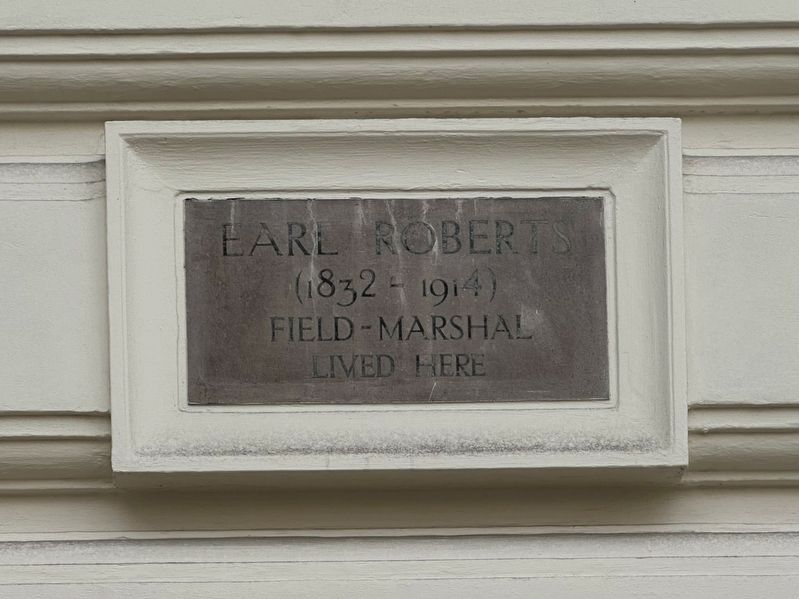
Photographed by Andrew Ruppenstein, April 26, 2026
1. Earl Roberts Marker
Earl Roberts
(1832-1914)
Field-Marshal
lived here
Erected 1922 by London County Council.
Topics and series. This historical marker is listed in this topic list: Military. In addition, it is included in the Victoria Cross and George Cross Recipients series list.
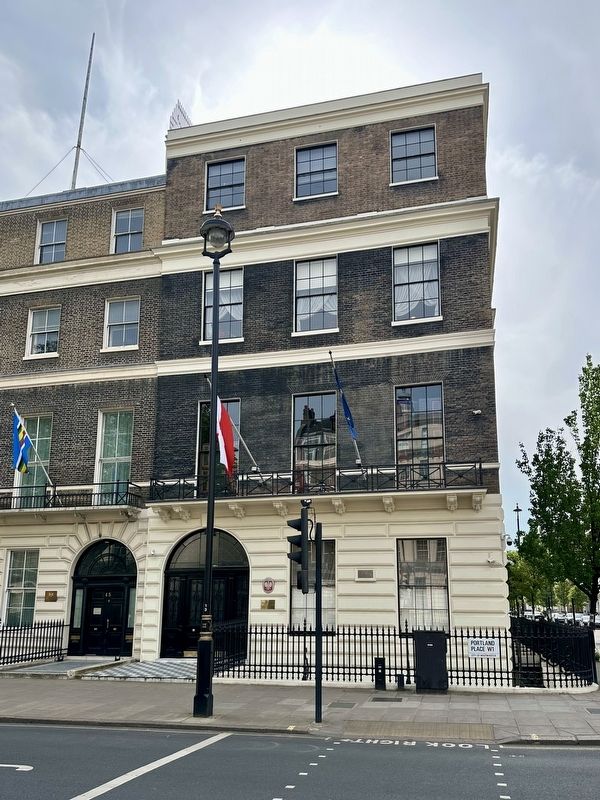
Location. 51° 31.25′ N, 0° 8.732′ W. Marker is in City of Westminster, England, in Greater London. It is in Marylebone. It is at the intersection of Portland Place and Weymouth Street, on the left when traveling north on Portland Place. Touch for map. Marker is at or near this postal address: 47 Portland Place, City of Westminster, England W1B, United Kingdom. Touch for directions.

Regionally, this marker is in London and in the Greater South East. Globally, it is on the Atlantic Ocean, in the North Atlantic Region, in Europe, in Atlantic Europe, on one of the British Isles, in the Western World, and in the Anglosphere. Historically, it finds itself in what was once the Roman Empire.
Other nearby markers. At least 8 other markers are within walking distance of this marker: General Władisław Sikorski
this page online
Also see . . . Frederick Roberts, 1st Earl Roberts (Wikipedia). Overview:
Field Marshal Frederick Sleigh Roberts, 1st Earl Roberts (30 September 1832 – 14 November 1914), was a British Victorian era general who became one of the most successful British military commanders of his time. Born in India to an Anglo-Irish family, Roberts joined the East India Company Army and served as a young officer in the Indian Rebellion during which he was awarded the Victoria Cross for gallantry. He was then transferred to the British Army and fought in the Expedition to Abyssinia and the Second Anglo-Afghan War, in which his exploits earned him widespread(Submitted on May 2, 2026.)fame. Roberts would go on to serve as the Commander-in-Chief, India, before leading British forces for a year during the Second Boer War. He also became the last Commander-in-Chief of the Forces before the post was abolished in 1904.Photographed by Andrew Ruppenstein, April 26, 20262. Earl Roberts Marker - wide biew
A man of small stature, Roberts was affectionately known to his troops and the wider British public as "Bobs" and revered as one of Britain's leading military figures at a time when the British Empire reached the height of its power. He became a symbol for the British Army and in later life became an influential proponent of stronger defence in response to the increasing threat that the German Empire posed to Britain in the lead-up to the First World War.
Additional keywords. plaque
Credits. This page was last revised on May 2, 2026. It was originally submitted on May 2, 2026, by Andrew Ruppenstein of Lamorinda, California. This page has been viewed 11 times since then. Photos: 1, 2. submitted on May 2, 2026, by Andrew Ruppenstein of Lamorinda, California.
