Landergin-Harrington House
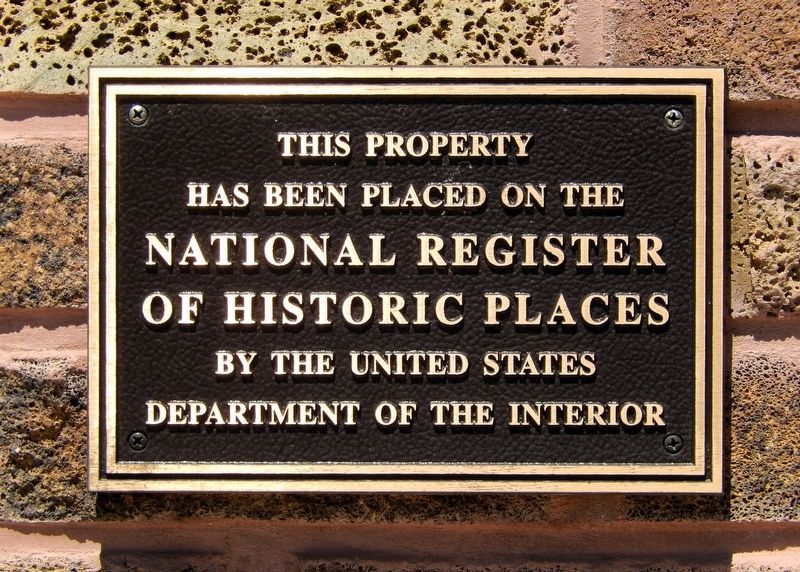
This property has been placed on the
National Register of Historic Places
by the United States Department of the Interior
Topics and series. This historical marker is listed in these topic lists: Architecture • Notable Buildings. In addition, it is included in the National Register of Historic Places (NRHP) series list. A significant historical year for this entry is 1914.
Location. 35° 11.826′ N, 101° 50.365′ W. Marker is in Amarillo, Texas, in Potter County. It is at the intersection of South Polk Street and Southwest 16th Avenue, on the left when traveling north on South Polk Street. The marker is mounted directly on the subject house, on the right side of the front terrace. Touch for map. Marker is at or near this postal address: 1600 South Polk Street, Amarillo TX 79102, United States of America. Touch for directions.

Regionally, this marker is on the Texas Panhandle. It is also on the American Great Plains, specifically on the Southern Plains, and specifically on the High Plains. Globally, it is in North America, a Gulf of Mexico state, the Western Hemisphere, the Western World, and the Anglosphere. Historically,
this page online
Other nearby markers. At least 8 other markers are within walking distance of this marker: Shuford-Killough House (within shouting distance of this marker); Houghton House (about 700 feet away, measured in a direct line); Avery and Mary Turner House (about 700 feet away); Polk Street United Methodist Church (about 800 feet away); H. W. and Katie Galbraith House (approx. 0.2 miles away); Herring-Crudgington House (approx. 0.2 miles away); Polk Street Schools (approx. ¼ mile away); Jons-Danner-Gilvin House (approx. 0.3 miles away). Touch for a list and map of all markers in Amarillo.
Regarding Landergin-Harrington House. National Register of Historic Places № 77001466. Also a contributing property in Plemons/Mrs. M.D. Oliver-Eakle Historic District, NRHP № 92000370.
From the National Register Nomination prepared by Joe Williams, Marie Landon and Michael Guarino, 5/10/1977:
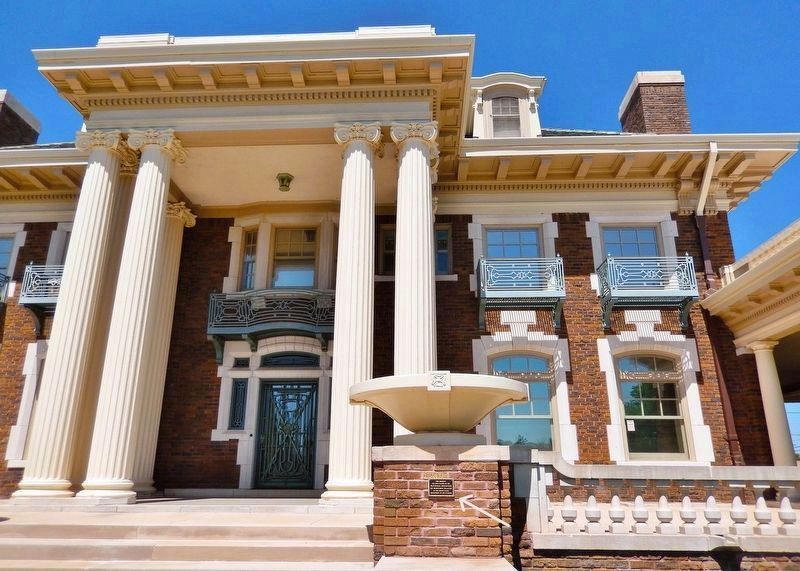
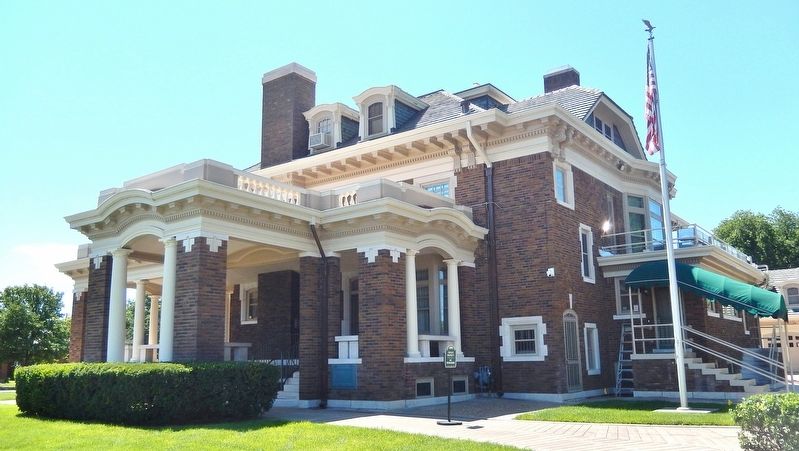
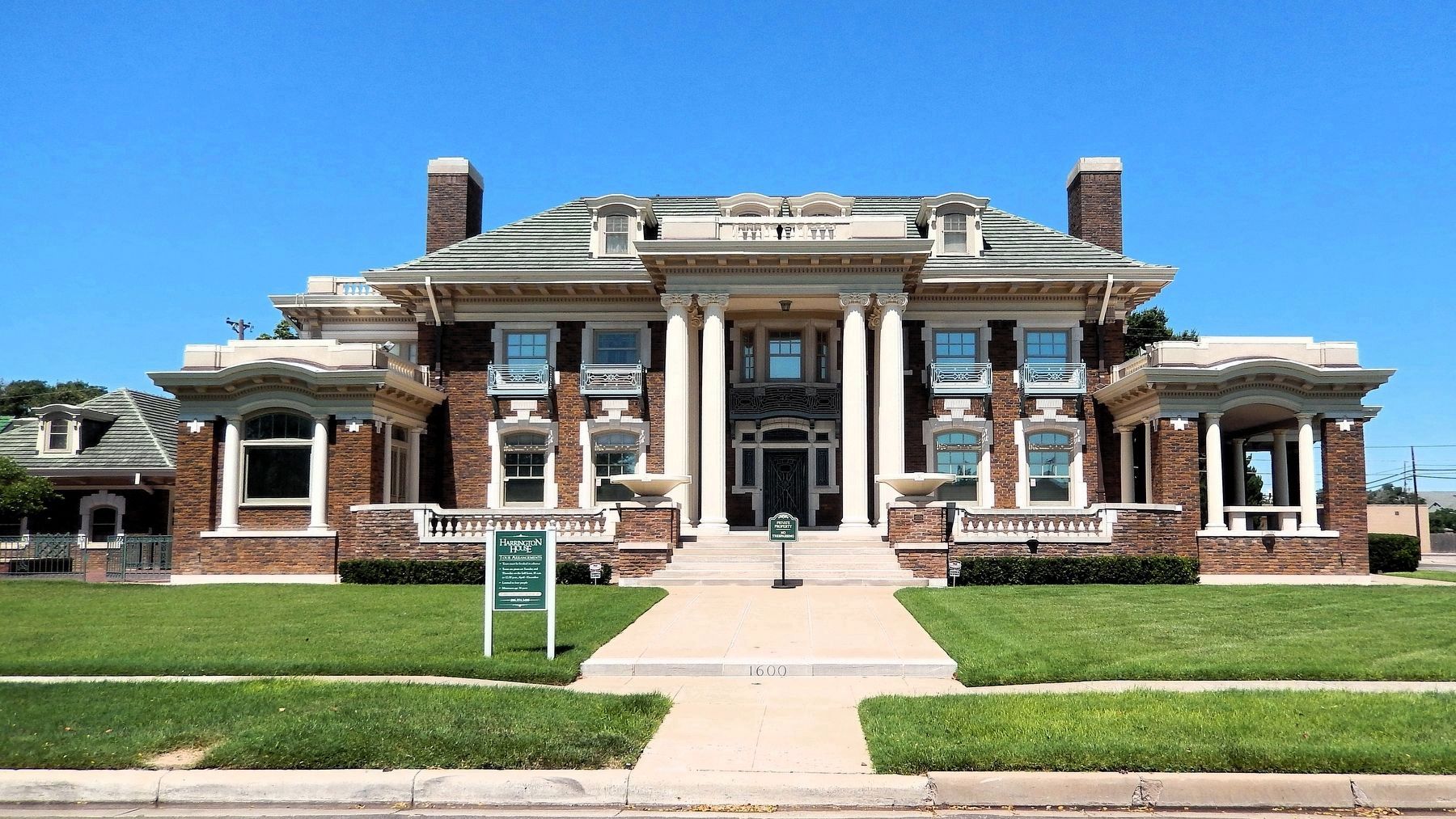
The Landergin-Harrington House is a brick Classical Revival structure which was constructed in 1914.Located on a block with several houses of the same period, the opulent Landergin House is a focal point of the area. The two-and-a-half-story structure, with basement service rooms, was built as a town house for John and Pat Landergin. The Shepard, Frarrar and Wiser architectural firm from Kansas City, Kansas designed the house.Photographed by Cosmos Mariner, July 7, 20252. Landergin-Harrington House MarkerThe marker mounted on the brick pier on the right side of the front terrace stairs.The dark, brown, brick structure consists of a rectangular main block with flanking one-story wings and a porte cochere. Sheltering the central bay of the main block's five-bay scheme is a two-story portico crowned by a modillioned and dentiled cornice and a balustraded deck. Each corner of the portico is supported by three fluted cast iron columns, while fluted pilasters further demarcate the central bay.
The main entrance consists of a leaded glass door, flanking sidelights and a tripartite transom. At the second level of this entrance bay is a tripartite window. On the first floor the window size is increased by a three-light segmental arched transom. These windows are further highlighted by light stone framing, voussoirs, and keystone. The second-floor windows are also framed by the stone and are further
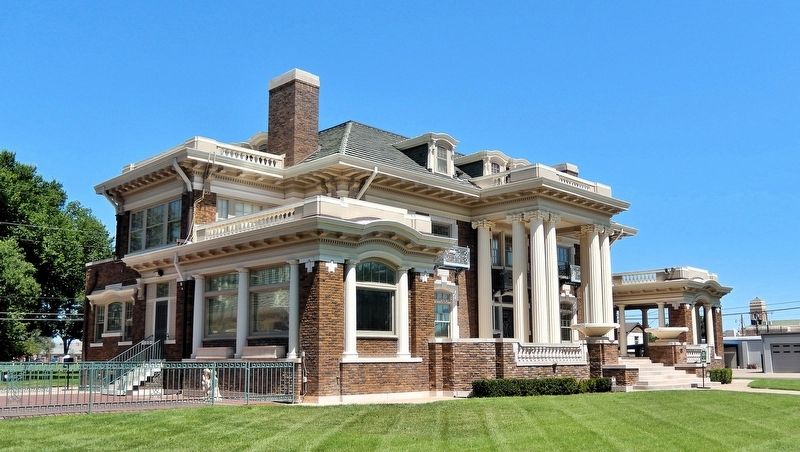
embellished by the projecting iron balconies.Photographed by Cosmos Mariner, July 7, 20253. Landergin-Harrington House (southeast elevation)A full entablature with modillioned and dentilled cornice and paired brackets at each corner, surround the main block of the house. A hipped roof crowns the building — each side contains segmental arched dormers with brackets and molded cornices.
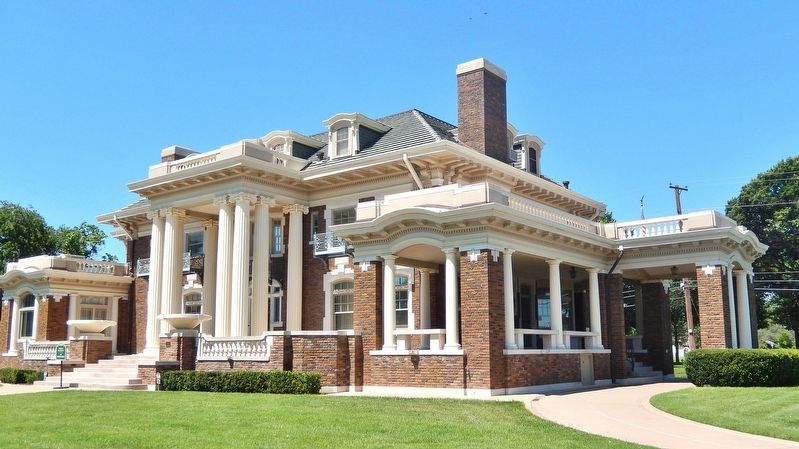
The flanking one-story wings to the north and south sides are supported by corner brick piers and one-story cast iron columns. Displaying a similar entablature to that of the two-story portico, the extensions have a unique arched or bowed cornice. The south portion is enclosed while the north end forms a gallery with a balustraded deck. A porte cochere extends from the center of the north gallery, also displaying the bowed arch. These extensions project beyond the main east facade, forming a terminus at each corner of the broad concrete terrace. The terrace has a cast concrete balustrade on either side of the wide centrally placed steps. The steps are framed by brick podiums surmounted by matching concrete urns.
The interior plan is based on a wide central hallway flanked on either side by symmetrical rooms. This plan is repeated on all four levels.
The ground floor and second floor have a staircase handsomely crafted of mahogany, as are the dentilled cornices, wainscoting and door frames of the hallways. The staircase has slim machine turned balusters and tapering octagonal newel posts with brass urn finials.Photographed by Cosmos Mariner, July 7, 20254. Landergin-Harrington House (northeast elevation)The other rooms of the house are equally elaborate and have many unusual features. The “Palm Room” located in the glass enclosed wing has an interior fountain with a marble basin and marble lions head waterspout. There is a shallow vaulted ceiling and an elaborately patterned terrazzo floor. The first floor also contains an oak paneled dining room, with an oak beamed ceiling, serviced by a butler’s pantry which still contains its original wood framed ice boxes with heavy nickel-plated hardware. The library with mahogany paneling and leaded glass bookcases, has an intricate bargework ceiling and its original brass chandelier. The second and third levels contain bedrooms, while the basement contains the service facilities including a boiler room, laundry and storerooms. Also housed in the basement is the brick-veneered billiard room, which has a plaster frieze depicting various
activities on the Landergin ranches.Photographed by Cosmos Mariner, July 7, 20255. Landergin-Harrington House (northwest elevation)An important architectural landmark for Amarillo, the opulent Landergin-Harrington House reflects a financial success of the area's cattle industry and Amarillo's importance as the center of the ranching activity in the Texas Panhandle. The Landergin-Harrington House was the home of two of the Panhandle's most influential ranchers, financiers, and pioneer oilmen, Pat and John Landergin.
Pat Landergin (1854-1929) and John Landergin (1856-1923) were the sons of Irish immigrant farmers in Oxford, New York. As teenagers the Landergins came to Kansas and worked as trail drivers on several cattle drives throughout the southwest, finally settling in Eureka, Kansas, in 1875. They purchased three ranches totaling 2,600 acres and during the late 19th century became prominent ranchers in the area. Pat served as a member of the Kansas legislature, a trustee of two Kansas colleges, a bank director in Eureka and director of the Kansas Livestock Association.
As the result of a drought and depressed cattle market in 1905, the Landergin brothers sought additional pastureland in Texas. That year the brothers leased
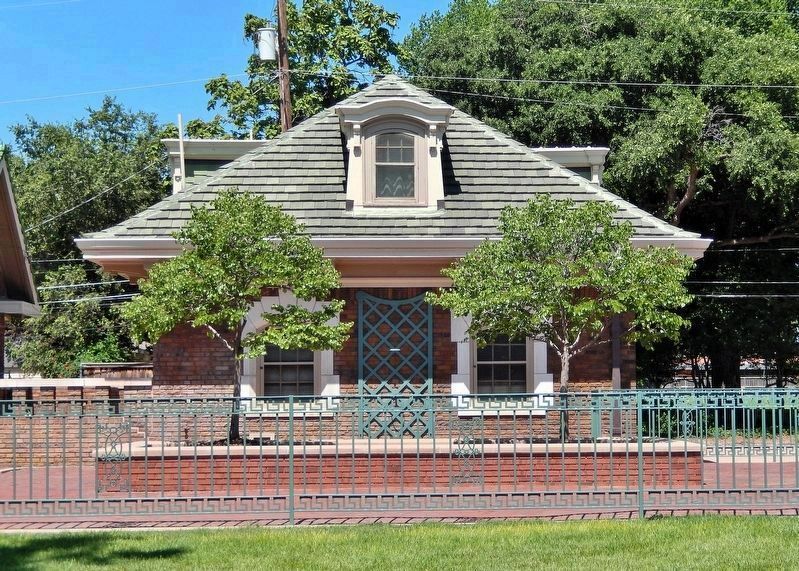
92,000 acres of the L.S. Ranch near Amarillo, Texas, and in 1907 they completed the purchase of the land. They later extended their holdings to 100,000 acres of the XIT Ranch in Oldham and Deaf Smith counties, as well as land in New Mexico and Arizona. Pat Landergin was elected President and later director of the Panhandle Cattlemen's Association, while John became first Vice-President of the Southwestern Cattle Raiser's Association. By 1916 the Landergin brothers owned a total of 1½ million acres in three states.Photographed by Cosmos Mariner, July 7, 20256. Landergin-Harrington House (garage/servant quarters)From the National Register Nomination: Standing to the west (rear) of the house is a one-and-a-half story garage with a steeply pitched, hipped roof. Segmental arched dormer windows, with molding identical to the dormers on the main house, project from the roof. A door and window on the ground floor are embellished with stone framing, echoing the window embellishments of the main house. This building contains parking spaces for three automobiles, a horse stall and servants’ quarters.After their move to Texas in 1907, the Landergins first lived at the old L.S. Ranch headquarters in Oldham County. In 1911 the Landergins decided to move into Amarillo. In 1912 they bought four lots at the western extent of Polk Street, the principal commercial and residential street in Amarillo, and began making plans to build a house. The Landergins hired the architectural firm of Shepard, Frarrar and Wiser from Kansas City, and engaged the Robert Keith Furniture and Carpet Company, also of Kansas City, for interior design. Begun in 1913, the large Classical Revival house was completed in mid-1914.
Founding directors of
the Amarillo Oil Co. in 1917, the Landergins enjoyed continued financial success until the collapse of cattle prices during the Depression brought about dissolution of their empire. The house was sold at auction to Don and Sybil Harrington in 1940 for a fraction of its construction cost. An independent oil operator and businessman, Harrington and his wife Sybil were active civic leaders in the arts communities of Amarillo and New York City. The Harringtons retained many of the original furnishings and made only minor alterations.Photographed by Cosmos Mariner, July 7, 20257. Landergin-Harrington House (east/front elevation)
Also see . . . Harrington House.
(features interior photos and more historical details) Excerpt: The turn of the century saw rapid development in the Texas Panhandle, ranging from the growth of the cattle industry to the discovery of oil and gas. Harrington House represents both eras. Built in 1914 by cattlemen John and Pat Landergin, the House was acquired in 1940 and preserved by Don and Sybil Harrington, leaders in the oil and gas industry and generous contributors to numerous philanthropic causes. Harrington House is a fine example of the Neoclassical style, with exquisite materials and workmanship prevalent throughout the home.(Submitted on May 6, 2026, by Cosmos Mariner of Cape Canaveral, Florida.)
Credits. This page was last revised on May 6, 2026. It was originally submitted on May 2, 2026, by Cosmos Mariner of Cape Canaveral, Florida. This page has been viewed 42 times since then. Photos: 1, 2, 3, 4, 5, 6, 7. submitted on May 6, 2026, by Cosmos Mariner of Cape Canaveral, Florida.
