Arkansas City in Desha County, Arkansas — The American South (West South Central)
Desha County
County Seat
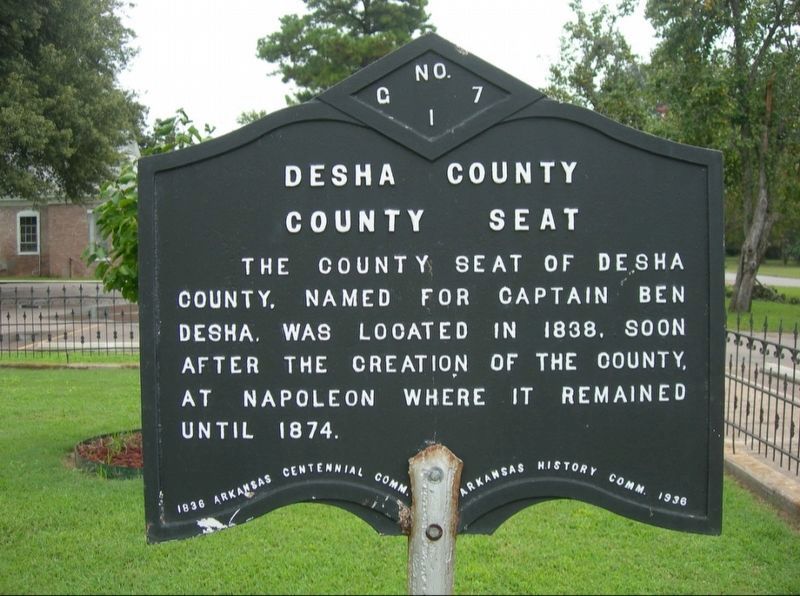
Photographed by Jimmy Emerson, Aug 2020
1. Desha County Marker
Erected 1936 by Arkansas Centennial Commission and Arkansas History Commission. (Marker Number G 17.)
Topics and series. This historical marker is listed in this topic list: Political Subdivisions. In addition, it is included in the Arkansas Centennial Commission series list. A significant historical year for this entry is 1838.
Location. 33° 36.548′ N, 91° 12.141′ W. Marker is in Arkansas City, Arkansas, in Desha County. It is at the intersection of Robert S Moore Avenue and Natchez Street, on the left when traveling east on Robert S Moore Avenue. Touch for map. Marker is at or near this postal address: 608 Robert S Moore Avenue, Arkansas City AR 71630, United States of America. Touch for directions.

Regionally, this marker is in the Arkansas Delta, in the Mississippi Alluvial Plain, and in the Quapaw Homeland. It is also in the American South, specifically in the Deep South, in the Upper South, in the Mississippi Delta, in the Piney Woods, and
this page online
Other nearby markers. At least 8 other markers are within 9 miles of this marker, measured as the crow flies: John H. Johnson Cultural & Educational Museum (about 500 feet away, measured in a direct line); Flood of 1927 (approx. 0.2 miles away); a different marker also named Desha County (approx. 0.2 miles away); The X. O. Pindall Law Office (approx. 0.2 miles away); Arkansas City Commercial Historic District (approx. ¼ mile away); Arkansas City River Port (approx. 0.3 miles away); Mississippi River Blues: The 1927 Flood (approx. 7.3 miles away in Mississippi); William Fisher Johnson (approx. 8.3 miles away in Mississippi). Touch for a list and map of all markers in Arkansas City.
Another marker is no longer nearby. The Great Flood of 1927 (was approx. 7.6 miles away in Mississippi
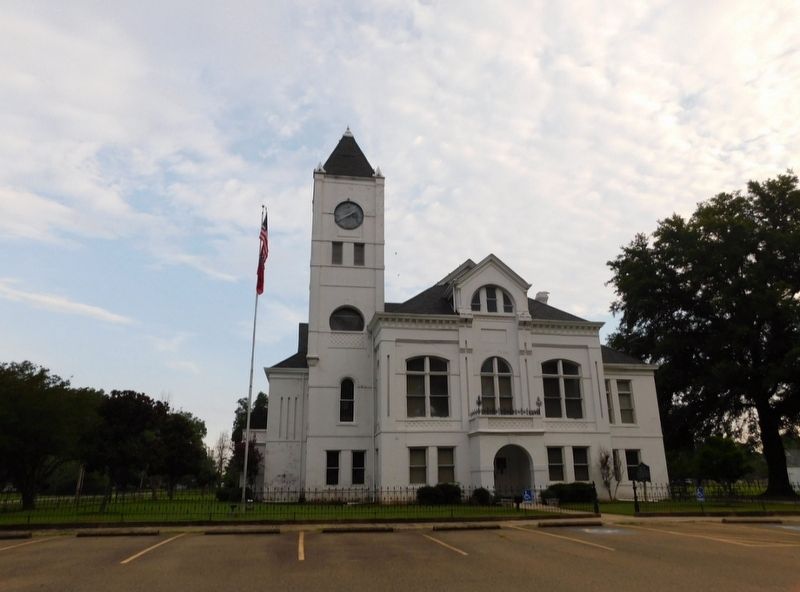
Photographed by Jimmy Emerson, Aug 2020
2. Desha County Marker
Desha County courthouse and marker to the right of the entrance
More about this marker. Located in front of courthouse
Also see . . . Napoleon (Desha County) (Encyclopedia of Arkansas). Excerpt:
The town Napoleon of Desha County was located at the confluence of the Mississippi River and the Arkansas River. Although its founders had hoped that its location would make it a major city comparable to St. Louis, Missouri, or New Orleans, Louisiana, the town was badly damaged during the Civil War and then totally destroyed within ten years of the war by the flooding of the rivers.(Submitted on May 3, 2026.)
… Although Selfridge was only seeking a shortcut around the guerrilla ambush, he succeeded in rerouting the Mississippi River, ultimately turning Beulah Bend into an oxbow lake. His work also spelled the end of the town of Napoleon, for the new channel of the river happened to be aimed directly at the town. High water in 1868 caused the marine hospital to crumble into the river. Another flood in 1874 completely submerged what was left of Napoleon. By October of that year, the county government was moved to Watson. The iron church bell once used in Napoleon is now in the Catholic church in McGehee (Desha County). At times when the level of the Mississippi is unusually low—as it was in the summer of 1954—the remains of the town can still be detected in the sandbars of the river.
Credits. This page was last revised on May 3, 2026. It was originally submitted on May 2, 2026, by Jimmy Emerson of Dalton, Georgia. This page has been viewed 26 times since then. Photos: 1, 2. submitted on May 2, 2026, by Jimmy Emerson of Dalton, Georgia. • Andrew Ruppenstein was the editor who published this page.
